Where Did the Diesel Go? Remote Fuel Tank Level Monitoring Has the Answer


Key Takeaways
Correct for diesel, not water: a pressure-based level sensor reads the weight of the fuel above it, so the tank's setup on the Platform must reflect the fuel's lower density before any depth or volume figure can be trusted.
Seat the sensor clear of the water layer: condensation and sludge settle on the tank floor, and a sensor sitting in them reports more fuel than the tank holds.
Treat a sudden drop as a question, not a verdict: the same falling curve can mean a scheduled draw, a siphon or an open drain valve, and the time of day usually tells you which.
Check every delivery against the curve: the step up in level after a refill shows how much fuel actually arrived, which is the simplest reconciliation most fuel managers never do.
Choose the network by tank spread: a private LoRaWAN gateway suits a cluster of tanks on one depot or mine site, while cellular NB-IoT/LTE-M fits tanks spread over a wide area.
Three Records, Three Different Fuel Numbers
Ask a site manager how much diesel is in the bulk tank and the answer depends on which record they reach for. The supplier's delivery docket gives one figure, last week's dip reading gives another, and the generator or plant hours suggest a third. Remote fuel tank level monitoring replaces those competing guesses with a single continuous record of what the tank actually holds, hour by hour, without anyone climbing onto it.
That record matters most where tanks sit far from the people who pay for them: generator day tanks at telecom sites, mine depots, farm fuel stations and hospital emergency power. Each is a store of cash that is easy to drain and hard to count.
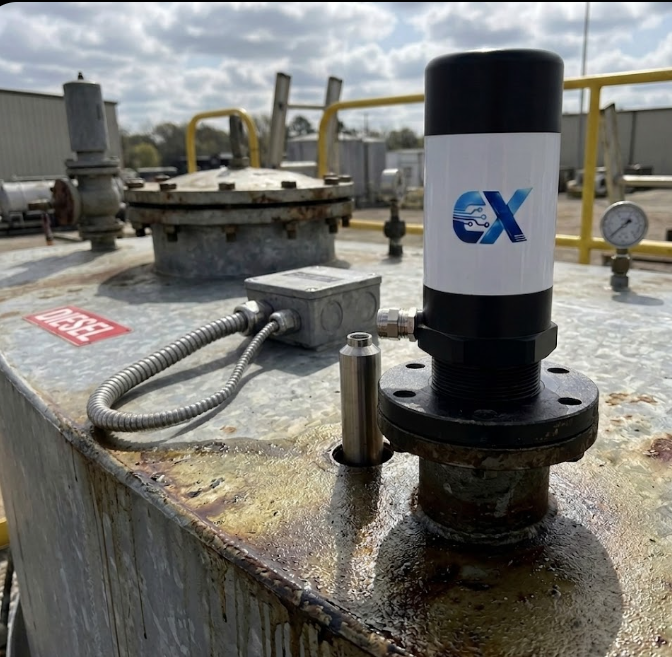
Ellenex addresses this with its Remote Diesel Tank Level Monitoring solution, which pairs a submersible hydrostatic level transmitter with private LoRaWAN or cellular connectivity and the Ellenex Platform. This article follows the fuel from tank floor to stock report and explains what is different for diesel.
Unexplained Losses, Dry Generators and Rushed Deliveries
Shrinkage nobody can explain: without a continuous record, a missing share of fuel can be blamed on theft, a leak, poor dips or inaccurate dockets, and the argument usually ends without an answer.
Standby power that fails when called: a generator day tank that ran low unnoticed turns a grid outage into a site outage, and the first sign is often the alarm from the equipment the generator was meant to protect.
Emergency deliveries at premium cost: when a tank is found nearly empty, the refill is booked in a hurry, often outside the supplier's normal route, and paid for accordingly.
Slow leaks that become environmental incidents: a weeping fitting loses fuel a little at a time, and by the time the stain shows, the cleanup costs far more than the lost diesel.
Inventory in the wrong place: without live stock levels, some tanks are topped up too early while others run close to empty.
Diesel Tanks Guard Their Secrets Well
Dipsticks depend on the person holding them: reading a wetted rod in poor light, after a delivery has stirred the surface, gives a figure that varies between visits.
The fuel is not water: diesel is lighter than water, so a device or formula set up for water will understate every reading unless it is corrected for the fuel.
Water and sludge collect underneath: condensation and sediment gather on the floor of most diesel tanks, quietly changing what a bottom-mounted sensor sees.
Tank shapes rarely make the arithmetic easy: horizontal cylinders, skid tanks and irregular bunded tanks all hold different volumes for the same change in depth, so depth alone does not tell you how many liters remain.
Sites are remote and unpowered: many fuel stores sit at the edge of a property or beside a communications tower, with no mains supply or wired network.
Losses happen when nobody is looking: siphoning, unauthorized filling and leaks often occur overnight or across a weekend, which is exactly when manual checks do not.
Remote Fuel Tank Level Monitoring, Worked Through for Diesel
The sensing principle behind a submersible level sensor is the same in any liquid, and the remote water tank level monitoring article covers it for water storage. In short, the sensor measures the pressure created by the liquid above it and turns that into depth. The steps below concentrate on what changes when the liquid is diesel and the goal is stock control rather than supply.
The Fuel Column Presses on a Stainless Diaphragm
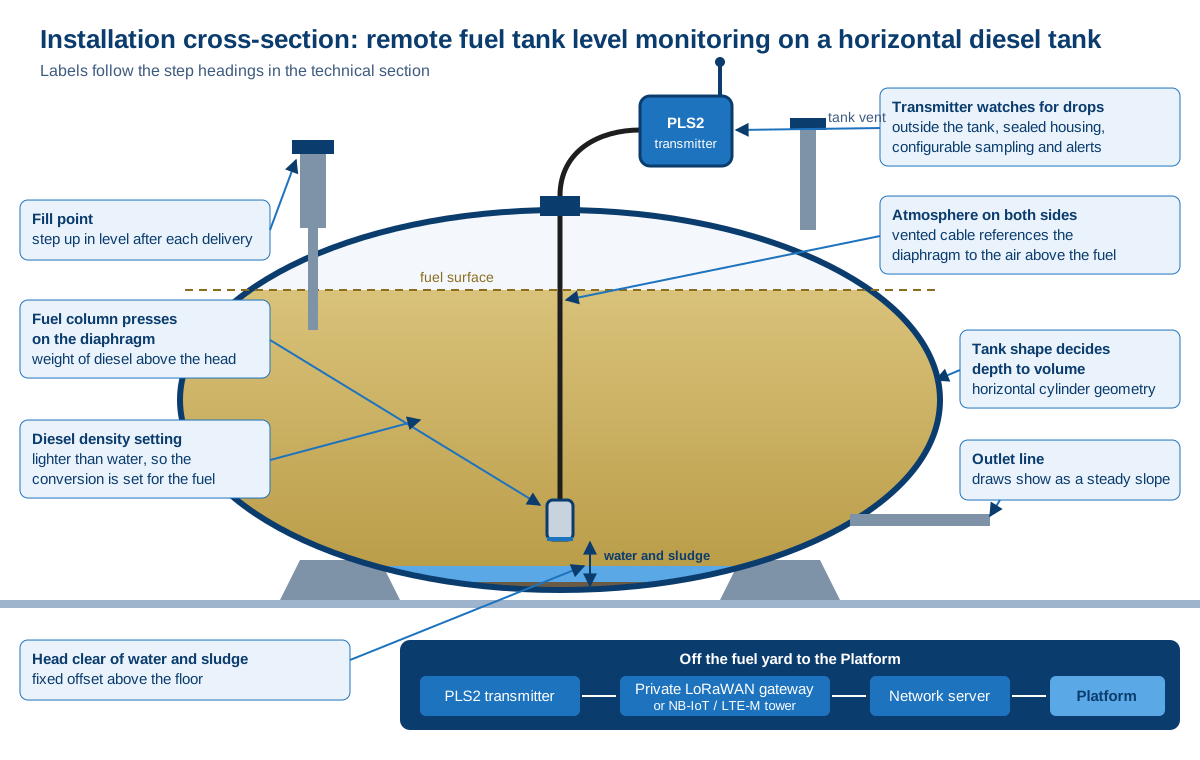
The sensing head is lowered through a top opening until it rests near the floor of the tank. The weight of the fuel above it pushes on a stainless steel diaphragm, and a piezoresistive element behind the diaphragm turns that push into an electrical signal. The PLS2-L and PLS2-N share this stainless steel sensing head.
Lighter Than Water: Why Diesel Needs Its Own Density Setting
A pressure sensor knows how heavy the column above it is, not how tall. Because diesel weighs less than the same volume of water, a given depth of fuel produces less pressure than that depth of water would. Convert it using water's density and the tank always looks lower than it is. The Ellenex Platform includes a sensor calibration and formula configuration interface, which is where the conversion from reading to depth and volume is set up for each tank, and for a fuel tank that setup has to reflect the fuel being stored.
Atmosphere on Both Sides of the Diaphragm
Both transmitters use a vented gauge reference. A small tube inside the cable lets the back of the diaphragm see the same air pressure as the fuel surface, so changes in barometric pressure cancel out instead of appearing as fuel coming and going.
Seating the Sensor Clear of Water and Sludge
Water is heavier than diesel and settles to the lowest point of the tank, along with sediment. A sensor resting in that layer counts the water above its diaphragm as if it were fuel, and can foul over time. Common practice is to hang the head a short, fixed distance above the floor, away from the fill pipe and suction line, and to record that offset so it can be included when the tank is set up on the Platform.
Tank Shape Decides How Depth Turns Into Volume
Depth is only half the answer; stock is counted in liters or gallons. The solution converts depth into volume using the tank's geometry, including horizontal cylinders and irregular shapes. Every volume, consumption and delivery figure depends on entering the tank dimensions correctly. The Effortless Efficiency diesel level sensor article covers odd tank shapes further.
The Transmitter Watches for Sudden Drops
The transmitter digitizes each reading, applies its factory calibration and encrypts the payload before it leaves the tank. Sampling and transmission intervals are configurable, as are the conditions that trigger a transmission, so a tank can stay quiet while the level behaves and report promptly when it does not. The PLS2-L datasheet also lists event-triggered sampling alongside its periodic schedule.
Off the Fuel Yard: Private Gateway or Cellular Tower
The PLS2-L sends over LoRaWAN to an outdoor industrial gateway that Ellenex pre-commissions to bind to its network server on power-up. The PLS2-N sends over NB-IoT or LTE-M directly to a mobile tower, and the solution ships it with a pre-configured nano-SIM. Either way the Ellenex network server authenticates, decrypts and removes duplicate messages before the data reaches the Platform. Ellenex's primers on LoRaWAN and NB-IoT/LTE-M give the background on each route.
Reconciling Deliveries and Draws on the Platform
On the Ellenex Software Platform, each tank shows liquid depth, derived volume, historical trends and device health. High and low thresholds raise alerts, and the solution also warns on sudden drops and anomalous activity, sending notifications through several channels. Because the history is continuous, a refill appears as a clear step up and normal use as a steady slope, so deliveries can be checked against dockets and consumption against plant hours. Demand forecasting then shows when each tank will need fuel.
Fuel Management Without the Morning Dip Run
Stock is known before the day starts: the fuel controller opens one view of every tank instead of waiting for drivers or site staff to phone in dip readings.
Overnight losses surface by breakfast: a drop outside working hours raises an alert with a time stamp, so the conversation starts with evidence rather than suspicion.
Deliveries are checked as they land: the size of each step on the curve can be compared with the docket while the delivery is still fresh.
Refills follow burn rate, not habit: tanks that use fuel slowly are left alone, and tanks that are drawing faster than expected are moved up the delivery list.
Leaks show their signature: a slow, steady decline at hours when nothing should be drawing points to a fitting or tank problem worth inspecting.
Several teams share one source: role-based access lets operations, finance and the fuel supplier each see their own tanks.
Fuel Visibility on the Balance Sheet
The return comes from many small savings rather than one large one. Ellenex sets out the general approach to costing an IoT rollout in its financial case for IoT implementation.
Dip Runs Replaced by a Glance at the Dashboard
Every manual reading of a remote tank costs a vehicle trip and a person's time. Once tanks report on their own, visits are kept for maintenance rather than counting.
Diesel Kept in the Tank, Not in a Stranger's Jerry Can
When every drop outside normal operating hours is recorded and alerted, opportunistic siphoning becomes harder to hide, and the fuel that would have walked away stays where it was paid for.
Standby Engines That Never Start on an Empty Day Tank
A generator that runs out of fuel during an outage fails at the worst possible moment. Low-level alerts on its tank give time to refill before the next call on standby power. Ellenex covers the generator itself in its remote diesel generator monitoring solution.
Fewer Hands on Ladders, Hatches and Fuel Vapor
Each dip means climbing a tank, opening a hatch and standing over fuel vapor. Fewer dips mean less exposure to falls and spills.
Deliveries Booked on Burn Rate
Knowing how fast each tank is being drawn down lets fuel orders be grouped by route and timed for when tanks genuinely need them, which avoids both premium emergency runs and half-empty delivery trips.
A Short Install on Tanks Already in Service
The solution is pre-configured at the factory and needs no power tools, software drivers or developer setup on site. Tanks do not have to be emptied, and no trenching or mains power is needed at the tank.
Consumption Records That Settle Budget Arguments
A continuous history of every tank shows where fuel actually goes, by site and by period. That evidence supports budgets, supplier negotiations and equipment decisions.
Fuel Tank Problems and the PLS2 Features That Solve Them
Diesel, Seals and Cable: Checking Compatibility First
Each transmitter pairs a stainless steel diaphragm and body with a Viton O-ring and a polyurethane cable, and both datasheets list diesel tanks among their applications. The PLS2-N datasheet notes that its polyurethane cable suits oil and diesel. Neither product datasheet lists a hazardous-area rating, so for petrol, solvents or any fuel stored in a classified zone, confirm suitability with Ellenex before ordering.
One Range for a Shallow Day Tank, Another for Bulk Storage
The PLS2-L and PLS2-N are both offered in a choice of measuring ranges, with the cable supplied to match the range by default and other lengths available on request. A shallow day tank and a tall bulk tank each get a sensor sized to the depth it will see.
Enclosures That Live Outside the Tank
The transmitter mounts outside the tank in a weather-sealed, UV-stabilized enclosure, while the sensing head is fully submersible. Each model comes in a cylindrical or rectangular enclosure, with internal or external antenna options, which helps where a steel tank shell or bund wall sits between the transmitter and the network.
Battery Life Set by Your Reporting Schedule
Power comes from a replaceable lithium battery inside each transmitter. Its capacity is stated as a count of readings and transmissions, not as a calendar period, so the schedule you choose is what spends it: a tank reporting a few times a day lasts far longer between battery changes than one set to report every few minutes. On the rectangular enclosure, an external power option and a high-capacity battery are available for tanks that need frequent reporting.
Drop Alerts That Reach Someone Who Can Act
Thresholds are set and changed on the Platform, not at the tank. Low-level and sudden-drop alerts can go to the fuel controller, the site supervisor and, where it makes sense, the fuel supplier. The Ellenex mobile app keeps those alerts and tank levels in view away from a desk.
Fuel Yards in a Cluster or Tanks Spread Across a Region
Where several tanks sit within one depot, quarry or farm, the PLS2-L and a single private LoRaWAN gateway keep all of them on a network the site controls, with no per-device carrier subscription. Out of the box the PLS2-L talks to the Ellenex network server, and it can be set up for other major network servers if the site already runs one. Where tanks are scattered, such as generator day tanks at separate telecom or utility sites, the PLS2-N connects each one directly to the cellular network over NB-IoT or LTE-M, with GPRS fallback as an option and a nano-SIM from any provider. The broader trade-offs are covered in what LPWAN is.
Sensor, Network, Platform: Cause and Effect for Diesel Stock
A submersible hydrostatic head with a vented reference, sized to the tank depth.
Outcome: a continuous depth record that does not drift with the weather.
Calibration and formula settings on the Platform that reflect the stored fuel and the tank's geometry.
Outcome: volume figures in the units the fuel team already uses.
Configurable sampling, transmission conditions and drop alerts.
Outcome: quiet operation during normal use and prompt warnings when fuel leaves unexpectedly.
A private LoRaWAN gateway or direct NB-IoT/LTE-M connection, each carrying encrypted payloads.
Outcome: reliable reporting from depots and isolated sites alike.
Historical trends, demand forecasting, an open API and webhooks.
Outcome: deliveries planned from data and fuel records that flow into existing ERP or SCADA systems.
Installation Habits for Diesel Tanks (General Practice)
The points below reflect widely followed industry practice for submersible sensors in fuel storage. They are general guidance, not Ellenex procedures; always follow site rules for working on fuel tanks.
Use an existing top opening: a spare gauge port or a dedicated dip tube keeps the sensor away from the turbulence of the fill pipe and the suction of the outlet line.
Fix the hanging depth: clamp the cable at the entry point so the head stays at the same height above the floor, and record that height for the Platform setup.
Stay above the sump: keep the head out of the lowest point where water and sediment gather, and drain tank water on the schedule your site already follows.
Seal the cable entry: a gland or cap that grips the cable keeps rain and dust out of the tank without crushing the vent tube.
Protect the vent end: mount the enclosure where the cable's vent opening stays dry and cannot fill with water.
Take one manual reading at commissioning: a careful dip or sight-gauge reading when the sensor goes live gives a reference point for checking the setup.
Stock Counts You Can Defend at Month End
With every tank reporting continuously, fuel stops being a number someone estimates and becomes a record someone can audit. Deliveries are matched to dockets on the day they arrive, consumption is tied to the equipment and sites that used it, overnight losses are investigated while the evidence is fresh, and refills are planned around real burn rates instead of habit. The result is fewer surprises at standby generators, fewer emergency deliveries and a month-end stock figure that finance, operations and the fuel supplier can all accept. The same approach extends to other stored liquids, from remote water tanks to remote chemical tanks, all within Ellenex's wider infrastructure monitoring portfolio.
Frequently Asked Questions
Does a diesel tank need a different setup from a water tank on the same sensor?
The hardware can be the same, since both transmitters list diesel and water tanks among their applications. What changes is the conversion from reading to depth, which has to reflect the lighter fuel.
If the conversion is left set for water, every reading will show less fuel than the tank holds. A careful manual dip at commissioning confirms the setup.
What happens to the reading when water collects at the bottom of the tank?
If the water layer stays below the sensing head, it has no effect on the reading, because the sensor only responds to the liquid above it. If water rises above the head, the sensor counts that heavier water as fuel and reports a higher level than is really there.
That is why the head is normally hung a fixed distance above the floor and why regular water draining remains part of good fuel housekeeping.
Can the readings confirm how much fuel each delivery actually added?
Yes. A delivery shows on the trend as a clear step from the level before filling to the level after it settles. Converted to volume, that step is the amount the tank received.Comparing it with the supplier's docket for each delivery is the quickest way to spot short deliveries.
Why does the fuel level seem steadier on the sensor than on a warm-afternoon dip?
Diesel expands as it warms, so the surface rises on a hot afternoon and falls overnight even when no fuel moves. A dipstick sees that movement directly.A pressure sensor responds to the weight of the fuel above it, and warming does not change that weight, so its reading moves far less with temperature.
Is it safe to leave the sensor in place while the tank is being filled?
The sensor is designed to stay submerged permanently, so there is no need to remove it for a delivery. Readings taken while fuel is pouring in will be disturbed, so compare deliveries using a reading taken once the surface has settled rather than the peak recorded during filling.
Do biodiesel blends or other fuels need a compatibility check first?
Both datasheets describe the transmitters as suited to liquids compatible with stainless steel and list diesel tanks as an application. Blends and other fuels can treat seals and cable materials differently.For any fuel other than standard diesel, share the fuel type with Ellenex before ordering. The same applies to fuels stored in a hazardous-area zone, because the product datasheets do not list a hazardous-area rating.
What should be checked first when a tank shows a sudden overnight drop?
Start with the simple explanations: a generator test run, a scheduled transfer to another tank or an approved refueling. The Platform history shows the exact time the drop began, which can be matched against equipment logs and site access records. If none of those explain it, check drain valves and fittings for leaks, then look at site security.
Related Reading
The Impact of LoRaWAN Diesel Level Sensors on Industrial Farming: how diesel level sensors support large farming operations, including fuel security.
Igniting your Energy Efficiency in Agriculture: Ellenex Diesel Tank Monitoring Solutions: diesel tank monitoring for farm energy efficiency and sensor selection.
Diesel and Oil Tank Level Monitoring for Ports: inventory monitoring of diesel and oil tanks in a connected port.
Enhancing Tank Level Monitoring with Ellenex Submersible Level Sensor in Harsh Outdoor Applications: the submersible level sensor range in harsh outdoor tank applications.
Useful Links
Talk to Ellenex
Fuel that cannot be accounted for is usually a visibility gap long before it becomes a security problem. Tell Ellenex which tanks you run, how fuel reaches them and who signs off the stock count through the sales inquiry page. In reply, Ellenex will propose a sensor range, a network route and a first set of drop alerts for your remote diesel tank level monitoring rollout.