

Remote Water Tank Level Monitoring: End the Surprise of a Dry Tank

Key Takeaways
Measure from below the surface. A submersible sensor reads the pressure of the water above it, so the reading stays steady even when the surface is choppy, dusty, frothy or covered by a lid.
Size the sensor to the real tank. The cable length and measuring range should match the working depth of each individual tank, not a catalog average.
Treat reading frequency as a budget. Battery capacity is rated in readings and transmissions, so how often a sensor reads and reports decides how long it lasts in the field.
Choose the network route by geography. LoRaWAN with a private gateway suits tanks clustered on one site, while NB-IoT/LTE-M suits tanks scattered across a region.
Send warnings to people, not only to dashboards. Adjustable high and low thresholds with multi-channel alerts turn a level reading into an action someone actually takes.
A Tank Nobody Can See Into Is a Tank Nobody Can Trust
Most outdoor water tanks are still checked the old way: someone drives out, climbs the ladder, looks inside and drives home. Remote water tank level monitoring replaces that loop with a sensor that reports the level on its own, so a trip happens only when the data says it should. Ellenex builds this around a battery-powered submersible sensor, described on the Remote Water Tank Level Monitoring solution page.
The need is widest where tanks are far from the people who depend on them. Process water at a mine, fire-fighting reserves at a plant, storage at a council depot, stock water on a station: the tank is rarely beside the desk where the decisions are made. A level that was fine on the last visit tells you little about this afternoon.
What makes the problem worth solving properly is that tank levels move for reasons nobody sees. Pumps cycle, valves stick, inlets clog, and demand changes with the weather and the shift roster. A single reading taken in person is a snapshot, while a reading that arrives on a schedule is a trend you can act on.
This guide covers what goes wrong when tanks go unwatched, how the measurement works from the water to the alert, how to choose between the two Ellenex connectivity routes, and what to watch for during installation. It is part of Ellenex coverage of water infrastructure monitoring.
What an Unwatched Tank Quietly Costs You
A dry tank discovered too late. When the first sign of trouble is a pump running on nothing or a crew with no water, the cost is lost production and a scramble to refill, not just the missing water.
Overflow nobody notices. A stuck inlet valve can pour treated water onto the ground for hours. The loss is the water itself, the treatment behind it and sometimes the erosion or flooding that follows.
Wasted trips. Crews drive long distances to confirm that a tank is fine. Every uneventful visit is paid for in fuel, vehicle wear and working hours.
Hidden leaks and slow drift. A tank that drops a little faster than demand explains is a leak or an unmetered draw. Without a trend line, the pattern stays invisible for weeks.
Risk to the people doing the checking. Climbing tank ladders, opening hatches and working alone on remote sites carries real safety exposure that a sensor removes entirely.
Why Outdoor Tanks Resist Easy Measurement
Remote and off-grid locations. Many tanks have no mains power and no wired network, so any monitoring has to run on a battery and a wireless link.
Weather and sunlight. Electronics that sit outdoors face heat, cold, rain and relentless ultraviolet exposure, which punishes plastic enclosures that were not built for it.
Different tanks, different depths. A shallow header tank and a deep storage tank need different measuring ranges and cable lengths, and a one-size device leaves one of them poorly served.
A trade-off between detail and battery life. More frequent readings give a sharper picture but draw down the battery sooner, so someone has to decide what is enough.
Coverage that varies by site. A site with ten tanks in one yard has different network needs from ten tanks spread across a region, and cellular signal is not equal everywhere.
Alerts that reach nobody. A number on a screen is useless if the person who can act on it is not looking at that screen when the level crosses a limit.
From Water Pressure to Phone Alert: Inside Remote Water Tank Level Monitoring
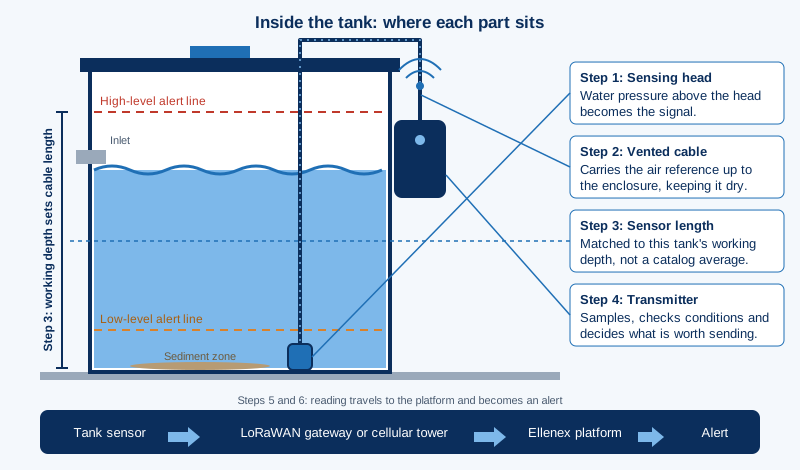
The sequence below follows one reading from the bottom of the tank to the person who needs to know. If you want the underlying principle in more depth, Ellenex has covered it in an earlier post on submersible tank level sensing. In short: the deeper the water above the sensor head, the more pressure it feels, and that pressure is converted into a level.
Step 1: The Weight of Water Becomes a Signal
A sensing element in the submersible head reacts to the pressure of the water column above it. The change in electrical output is tiny but repeatable, which is why this approach works in tanks where floats jam and non-contact methods struggle with condensation or foam. The solution datasheet describes a piezoresistive element at the end of a vented submersible cable.
Step 2: A Vented Cable Keeps the Reference Honest
Water pressure alone is not the level, because the air above the tank also pushes down. A vented cable carries a thin air path from the sensor head up to the electronics so that atmospheric pressure is cancelled out. That is what keeps a passing weather front from reading as a change in level, and it is why the vent end deserves some care at installation.
Step 3: Matching the Sensor Length to the Tank
The head sits near the bottom of the tank and the cable runs up to the enclosure, so the cable length and measuring range are chosen for each tank's working depth. By default the cable is supplied to suit the measuring length, and other lengths can be requested. Choosing a range matched to the tank, rather than a generous one, keeps the resolution useful across the part of the tank you actually care about.
Step 4: Deciding in the Transmitter What Is Worth Sending
The transmitter samples on a configurable schedule, or in response to events, and can send every reading, only event-driven readings or only those that meet set conditions. Sending less often saves battery, while sending on a condition makes sure a sudden change is not missed. The platform also tracks battery condition, so a fading battery shows up in the data before it becomes a site visit.
Step 5: Two Routes to the Platform
The LoRaWAN variant sends its message over a sub-GHz radio to an Ellenex outdoor gateway, which passes it to the Ellenex Network Server. The gateway connects back by Wi-Fi, Ethernet or cellular. The cellular variant uses NB-IoT or LTE-M and talks straight to the nearest tower, with no gateway to install. For a short recap of how the two compare, see Ellenex's technical comparison of NB-IoT and LoRaWAN.
Step 6: What the Platform Does With Each Reading
The Ellenex software platform receives the encrypted telemetry and turns depth into trend charts, volume and consumption views and threshold alarms. Teams can import and export data, assign access by role and connect through an API or into SCADA, so the tank level appears wherever operators already work.
How Daily Operations Shift Once the Tank Reports In
Visits become exceptions. Crews go out when a tank needs attention, not on a fixed loop, and they arrive knowing what they will find.
Refills are scheduled, not reactive. A falling trend tells the supply team a refill is coming, which makes tanker bookings and pump runs predictable.
Anomalies stand out. A tank that falls overnight when nothing should be drawing from it is flagged by the pattern, long before anyone would have noticed by eye.
Responsibility is clear. Alerts go to named people through the channels they actually use, so everyone knows who owns the response.
Arguments end. When a level reading and a timestamp exist, there is no debate about when a tank ran low or who last checked it.
The fleet is visible at a glance. Dozens of tanks across several sites sit on one screen, ranked by what needs attention first.
The Business Case, Told in Tank Terms
The financial arguments below are general in nature. For a structured way to weigh them against your own situation, Ellenex publishes a guide to the financial case for IoT implementation.
Fewer Trips Down Long Gravel Roads
Routine inspection drives are the most obvious saving. When the tank reports itself, the vehicle stays in the yard unless the data calls it out, and the hours go to work that needs a person.
Water That Stays in the Tank
Early overflow and leak signals mean less water, and less treated or pumped water, is lost. The sooner an abnormal pattern is seen, the smaller the loss.
Pumps That Never Run Dry
Pumps and valves that depend on tank level are protected when a low-level warning arrives in time. Avoiding a dry run protects equipment that costs far more than the sensor.
Safer Than Climbing a Tank Ladder
Every inspection avoided is a ladder not climbed and a hatch not opened, which reduces exposure to falls, confined access and lone working.
Refills Planned Instead of Rushed
Supply deliveries and pump schedules can be booked on a trend rather than an emergency, which tends to be calmer and cheaper than urgent response.
Low Cost to Put in Place
A battery-powered, wireless sensor avoids trenching, cabling and mains connections, which are typically the expensive part of wired telemetry. The hardware is designed for quick commissioning on an existing tank.
Evidence for the Next Capital Decision
Months of level history show how much storage a site truly uses and when. That evidence supports decisions about whether to expand a tank, add capacity or retire one.
Matching Each Tank Challenge to the Right Ellenex Tool
Sensor Length That Fits the Tank
Ellenex offers the same tank sensor in a LoRaWAN version, the PLS2-L, and a cellular version, the PLS2-N. Both are available with a measuring range and cable length matched to the tank, and custom lengths can be requested.
Hardware That Shrugs Off Sun and Weather
The submersible head is sealed against immersion, and the electronics sit in a weather-sealed, UV-protected enclosure that comes in cylindrical or rectangular styles. The sensor body and diaphragm are stainless steel, and the cable is polyurethane, so the sensor suits liquids that are compatible with those materials.
Reading Frequency Versus Battery Life
Both variants run on a replaceable lithium battery, and an external supply with battery backup or a higher-capacity battery can be fitted to the rectangular enclosure. Because capacity is rated in readings and transmissions, a site that reads often and reports every reading will drain the battery sooner than one that reads often but sends only on change. The PLS2-L can send on every sample, on an event or on a condition, and the PLS2-N is configured through the platform in the same way.
Warnings That Reach the Right Person
The Ellenex platform supports variable high and low thresholds, multi-channel alerting and dynamic alerting. A low-level warning can go to the pump operator, while a high-level warning goes to the person who can close the inlet.
Choosing LoRaWAN or Cellular for Your Site Layout
Where many tanks share a site, a private LoRaWAN network is often the better fit: one outdoor gateway can serve the whole yard, and the sensors need no SIM or carrier plan. Where tanks are scattered, the cellular PLS2-N talks directly to the tower with no gateway, though it needs a carrier data subscription and workable coverage. For background on each technology, see Ellenex's guides to LPWAN, LoRaWAN and NB-IoT and LTE-M.
The Ellenex Remote Tank Solution at a Glance
Mechanism: A battery-powered submersible sensor measures water pressure through a vented cable, converts it into depth, and reports it over LoRaWAN through an Ellenex gateway or over NB-IoT/LTE-M straight to the tower.
Mechanism: The Ellenex platform receives encrypted data, applies thresholds and presents depth, volume and consumption trends through dashboards, an API and SCADA integration.
Outcome: Fewer routine site visits, earlier warnings of low or overflowing tanks and a level history that supports planning.
Outcome: A single approach that works for a cluster of tanks on one site or for assets spread across a wide area, backed by the same platform that serves the rest of Ellenex infrastructure monitoring.
Further detail is on the Ellenex solution page for remote tank monitoring.
Installing a Tank Sensor: Field Habits That Pay Off
These points reflect widely accepted industry practice for submersible level sensors, not an Ellenex procedure, so always follow the instructions supplied with the product.
Keep the head clear of the inlet. Hanging the sensor away from the inlet stream and off the sediment layer reduces noise and fouling.
Protect the vent. Keep the vent end of the cable dry and away from condensation, since moisture in the reference path can distort readings.
Avoid sharp bends. Route the cable gently over the tank edge and secure it so wind or turbulence cannot saw it against a rough surface.
Mount the enclosure with a clear view. Keep the antenna away from large metal surfaces and place the enclosure where the radio signal can get out.
Verify on day one. Compare the first reading against a known manual measurement so that you trust the starting point.
Mistakes That Make a Good Sensor Look Bad
Ordering a range far larger than the tank. An oversized range spreads the useful part of the tank across a small slice of the measuring span.
Reading far too often. Aggressive sampling can empty a battery sooner than any trend needs.
Ignoring media compatibility. If the liquid in the tank is not compatible with stainless steel, the sensor is the wrong choice, and that should be settled before ordering.
Skipping the network check. A cellular sensor needs coverage at the tank, and a LoRaWAN site needs a gateway placed with a clear path to the sensors.
Alerting everyone about everything. When every threshold goes to every person, the important alert gets lost, so route warnings by role.
What a Well-Monitored Tank Estate Looks Like
A tank estate that is monitored properly stops being a collection of separate chores and becomes a single view. Operators see levels, trends and battery health on one screen, maintenance is planned from the data, and the people who respond to alerts know why they were called. The result is calmer operations, fewer surprises and a steady record of how water is used. The same approach extends across other water infrastructure monitoring assets, such as groundwater bores, dams and reservoirs and livestock troughs, all of which sit within the wider Ellenex infrastructure monitoring range.
Frequently Asked Questions
Can one sensor handle a tank whose level swings widely during the day?
Yes, provided the measuring range covers the full working depth of the tank. The sensor measures continuously across its range, so a tank that is nearly full in the morning and low by evening produces a clear daily pattern.
The sampling interval matters more than the swing. If levels change quickly, a shorter interval or an event-triggered reading ensures that the fast movements are captured rather than averaged away.
How do I know whether my tank liquid is compatible with the sensor?
The sensor body and diaphragm are stainless steel, and the cable is polyurethane, so the sensor suits liquids that are compatible with those materials. Clean water in storage tanks is the typical case.
If the tank holds anything unusual, such as treated water with aggressive additives or a chemical mix, check the compatibility before ordering. The Ellenex team can help you confirm it.
What if there is no cellular coverage or mains power at the tank?
Power is rarely the obstacle, because the sensors run on a replaceable lithium battery and need no mains connection. Coverage is the real question, and it decides the route.
Where cellular signal is weak, a private LoRaWAN network with an outdoor gateway placed at a good vantage point can reach tanks that a phone signal cannot. Where signal is good, the cellular variant avoids the gateway altogether.
Can alerts go to more than one person, and can thresholds change later?
Yes. The platform supports variable high and low thresholds and multi-channel alerting, so different people can receive different warnings by the channel they prefer.
Thresholds are not fixed at installation. Operators can adjust them as seasons, demand or operating rules change, without visiting the tank.
How do tank readings reach the systems my team already uses?
The platform exposes data through an API and supports integration with SCADA, as well as data import and export. That lets tank levels appear in existing dashboards and reports rather than in yet another standalone screen.
Access can also be organized by role, so an operations manager, a maintenance lead and an external contractor each see only what they need.
How do I change a sensor's settings after it has been installed?
Settings such as sampling and transmission behavior can be changed remotely through the platform using downlinks, so there is no need to return to a tank to adjust them. Local configuration over a wireless connection is also supported.
Firmware updates can be applied locally or over the air as well, which keeps a large estate of sensors consistent over time.
Can tanks on several sites be managed under one login?
Yes. The platform is multi-tenant and organizes access by role, so tanks from different sites can sit in one account while each person sees only the assets they are responsible for.
A device inventory keeps the estate organized as it grows, and data can be imported or exported when a report or another system needs it.
Related Reading
Enhancing Tank Level Monitoring with Ellenex Submersible Level Sensor in Harsh Outdoor Applications: a deeper look at the sensing principle and hardware family behind submersible tank monitoring.
Smart Water Management with Ellenex Wireless Tank Level Monitoring: how tank storage ties into energy use across water and wastewater operations.
Sensors Unleashed: A Guide to Choosing Ultrasonic, Radar or Submersible Tech: how the three main sensing approaches compare.
Monitoring Made Smarter: Harnessing IoT for Manhole and Wastewater Level Monitoring: level monitoring for the other end of the water cycle.
Useful Links
Talk to Ellenex
Bring the tank, the terrain and the name of whoever needs the warning, and the Ellenex team will help you map them to a sensor, a connectivity route and an alert plan. Start the conversation with Ellenex and tell us what your tanks are doing today.


