

Fish Kills Begin Before Dawn: River Dissolved Oxygen Monitoring Sees Them First


Key Takeaways
Schedule the reading for the river's worst hour. Oxygen in a slow, plant-rich reach usually bottoms out around dawn, which daytime samples miss.
Report saturation alongside concentration. Percent saturation shows whether plants and algae are pushing oxygen up or decay is pulling it down; concentration shows what fish actually have to breathe.
Watch the width of the daily swing. A day-night range that widens week after week is an early sign of enrichment and a coming bloom.
Set two alerts, not one. A low threshold protects fish tonight; a high threshold on afternoon supersaturation warns that a crash may follow after the bloom.
Choose the network by how stations are spread. A private LoRaWAN gateway suits clustered stations; NB-IoT or LTE-M suits scattered ones.
The Lowest Oxygen of the Day Arrives While Nobody Is Sampling
In most rivers that carry algae and rooted plants, the scarcest oxygen of the day is found in the hour before sunrise, long after field crews have gone home and long before they return. That timing is the reason river dissolved oxygen monitoring works best as a continuous record rather than a visit: the condition that harms fish tends to happen when no one is standing on the bank to see it.
The pattern follows the light: photosynthesis adds oxygen by day, while respiration keeps consuming it through the night. The factsheet on dissolved oxygen published by the US Environmental Protection Agency (EPA 841F21007B, July 2021) puts it plainly: levels in surface water are likely to be lowest early in the morning, and aquatic organisms are most vulnerable at that time. The same document notes that continuous sensors allow changes to be assessed throughout the day.
Ellenex supports this with its River and Waterway Dissolved Oxygen Monitoring solution: a battery-powered optical probe with a LoRaWAN or cellular transmitter, reporting to the Ellenex Platform. It sits within the wider family of Ellenex water infrastructure monitoring applications and the broader infrastructure monitoring portfolio.
Oxygen control inside treatment basins is a separate subject, covered in our article on dissolved oxygen control in aeration.
Fish Kills, Odors and Lost Permits When Oxygen Goes Unwatched
Low oxygen rarely announces itself. These are the failures catchment teams most often describe when a river runs without continuous oxygen data.
Fish kills discovered after the fact. Fish caught in a hypoxic reach overnight are found in the morning, with only a late sample to explain them.
Blooms that collapse without warning. A dense algal bloom can lift oxygen far above saturation in the afternoon, then drag it down sharply when the algae die and decay. Without a trend, the crash looks sudden.
Odors and complaints from stagnant water. An oxygen-starved pool can go septic, and anglers or neighbors usually notice the smell before any monitoring program does.
Disputed discharge responsibility. Without continuous data, it is hard to show when oxygen began to fall and which upstream input preceded it.
Restoration money spent on the wrong reach. Sparse daytime samples can rank the wrong stretches as the worst, sending habitat and nutrient programs elsewhere.
Why Oxygen Slips Past Routine River Surveys
Several features of rivers and of field programs make oxygen hard to capture properly.
The minimum falls outside working hours. The low point usually lands before dawn, so daytime programs structurally miss it.
Conditions change within hours. A still, warm afternoon or a storm flush moves oxygen faster than any sampling round can follow.
One spot does not represent a whole river. Pools, weir backwaters, riffles and the water just below an outfall can hold very different oxygen at the same moment.
Monitoring points are remote. Reaches worth watching often lie far from mains power or a data cable.
Probes live in a hostile place. Sediment, biofilm, debris and changing water levels all work against an instrument left in a river.
Temperature keeps shifting the target. Cooler water can hold more oxygen than warmer water, so the same concentration can mean a comfortable river in winter and a stressed one in late summer.
River Dissolved Oxygen Monitoring, Measured Through the Night
A useful oxygen record depends on a chain of steps, from the sensing layer in the water to the alert on a phone.
A Dye That Dims When Oxygen Is Near
The CDO2 probes use a luminescent optical method. A sensing layer is excited with light and glows in response; oxygen molecules in contact with that layer reduce the glow, and the solution datasheet describes the transmitter reading this effect through phase-shift detection. Both product datasheets state that the method is approved under the ASTM D888 standard for dissolved oxygen without the need for recalibration, and that the water does not have to move past the sensor for a valid reading.
That last point matters in a river, because still pools and weir backwaters are exactly where low oxygen is most likely and where flow-dependent probes struggle. Optical sensing is covered in more depth in our article on the dissolved oxygen sensor and its role in environmental monitoring.
Correcting for Water That Warms and Cools
The optical response changes with temperature, and so does the amount of oxygen water can hold. Both CDO2-L and CDO2-N datasheets list temperature compensation through a built-in thermistor, so each oxygen value is corrected for the water around the probe before it leaves the transmitter.
The solution datasheet also lists water temperature among the reported values, which helps explain why a reach that looked healthy in spring struggles in a heatwave.
Saturation and Concentration: Two Views of One Sample
The probes report dissolved oxygen as a concentration and as percent saturation. Concentration answers the biological question of how much oxygen fish and invertebrates can take up. Saturation answers the process question: whether the water holds more oxygen than it would at equilibrium with the air, which points to strong photosynthesis, or less, which points to consumption by decay and respiration.
Placing the Probe Where the River Actually Mixes
This step reflects general field practice, not an Ellenex procedure. Probes are usually placed in well-mixed water that stays submerged at low flow, clear of the bank and of any outfall plume, often inside a perforated guard fixed to a pier, bridge or stake.
Many programs pair an upstream reference station with a second station in the reach most likely to go low, such as a slow pool above a weir.
Choosing a Cadence That Catches the Dawn Low
Sampling and transmission are separate settings. According to its datasheet, the CDO2-L can sample periodically or when triggered by an event, accepts a new sampling interval by downlink, and can transmit each sample or hold back until set conditions apply. The CDO2-N datasheet places its sampling interval, transmission interval and transmission conditions under Ellenex Platform configuration.
Each CDO2 battery is specified by how many readings it can take and how many messages it can send, so the reporting rhythm chosen for a station, rather than the calendar, decides when a replacement visit falls due. A practical approach is to sample often enough to capture the overnight decline and send every sample only in the warm months.
Across the Catchment by Private Gateway or Public Tower
With LoRaWAN, each CDO2-L passes encrypted packets to an industrial outdoor gateway, and the Ellenex network server checks, decrypts and de-duplicates them before they reach the platform. One gateway on a high point can serve several stations along a reach, and the solution datasheet notes zero SIM fees on private network deployments. Background: what LoRaWAN is.
With cellular, each CDO2-N reaches a public mobile tower on its own, and the solution datasheet notes a pre-configured SIM with an active carrier subscription. Background: NB-IoT and LTE-M explained. Our earlier network comparison for industrial sites weighs the two routes.
From Packet to Pre-Dawn Alert on the Ellenex Platform
The Ellenex Software Platform decodes each message and charts oxygen, saturation and temperature over time. Every station gets separate high and low limits, and breaches go out through several notification channels, so the person responsible for a reach hears about a falling minimum before the morning run. History, export, API access and role-based permissions are available on the web at ellenex.net and in the Ellenex mobile app.
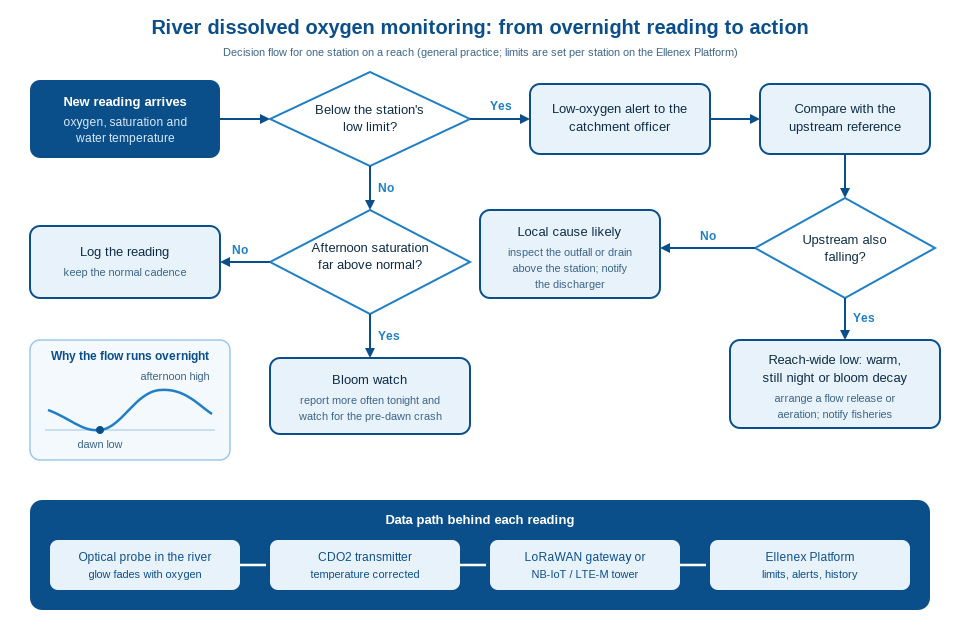
Field Teams Working From an Overnight Oxygen Record
When every station reports through the night, the work of a catchment team changes in practical ways.
The morning starts with last night's minimum. Staff see how low each reach went before dawn instead of guessing from an afternoon spot check.
Blooms are visible while they build. A widening gap between afternoon highs and pre-dawn lows shows enrichment before a crash.
Response is targeted. Crews visit the reach that crossed its threshold, not a fixed route.
Upstream causes become traceable. Comparing a reference station with a downstream station shows whether a drop began locally or arrived with the flow.
Evidence accumulates automatically. A continuous record supports talks with regulators, dischargers and funding bodies.
What Steadier Oxygen Data Saves a Catchment Program
These benefits are described in general terms, because their size depends on the river and the program. Ellenex's IoT implementation cost guide helps put figures to a specific site.
Fewer Pre-Dawn Field Runs
Capturing the overnight minimum by hand means sending someone out in the dark. Continuous stations remove most of those runs.
Fish Stocks and Fisheries Kept Intact
Early warning gives managers time to ask a discharger to hold back, arrange an environmental flow release or aerate a critical pool before fish are lost.
Downstream Intakes Warned Before Poor Water Arrives
An oxygen crash and the decay that follows can affect water drawn for treatment, irrigation or stock. An upstream alert gives intake operators time to adjust.
Less Night Work on Slippery Banks
Every reading a station collects is one less trip along a wet bank in poor light.
Restoration Spending Aimed at the Worst Reaches
A season of continuous data ranks reaches by how often and how deeply they go hypoxic, directing habitat works, shading and riparian fencing where they matter most.
Stations Without Trenches, Poles or Power
Pre-configured, battery-powered probes avoid the cabling and power supplies a wired station needs, so a monitoring point can be added without a construction project.
Records That Hold Up in Permit and Policy Debates
Long-term oxygen history backs permit discussions and funding applications with evidence.
Matching CDO2-L and CDO2-N to Life in Open Water
Each challenge described earlier has a matching feature in the river package.
Catching the Minimum That Falls Outside Working Hours
The overnight decline is recorded on a schedule set from the platform, whether or not anyone is on site. On the CDO2-L LoRaWAN optical dissolved oxygen sensor, sampling can also be event-triggered and transmission can be conditional, so a station can report often when oxygen is falling and more sparingly when it is stable.
Following Conditions That Change Within Hours
Upper and lower alarm limits set per station turn each probe into an early warning point: a low alert protects fish overnight, and a high alert on afternoon supersaturation flags a bloom that may be heading for a crash.
Covering More Than One Spot on a Reach
Because each station is self-contained, a reference point upstream and a watch point below an outfall can be added at modest cost. Where several stations share a reach, the LoRaWAN variant reporting through one private gateway keeps network costs low; where they are spread across a catchment, the CDO2-N cellular optical dissolved oxygen sensor connects each one to the nearest tower.
Working Far From Power and Cable
Each CDO2 carries its own replaceable lithium cell, and for the rectangular enclosure the datasheets also offer external supply or a larger battery. Units arrive pre-configured, so commissioning at the riverbank is short.
Surviving Months in Moving, Muddy Water
The stainless steel sensor head is fully submersible, with titanium offered on request. Electronics are housed in a weather-sealed, UV-protected cylindrical or rectangular enclosure, and a standard cable is supplied, with longer lengths available to reach from a bridge or pier to the water.
Reading Oxygen Correctly as the Seasons Turn
Built-in temperature compensation, with water temperature reported alongside oxygen, lets a summer decline be read in context. Full details are on the river dissolved oxygen solution page.
What the River Oxygen Package Does, and What Follows
A submersible optical probe measures oxygen without needing flow past the sensor, compensates for temperature and reports concentration and saturation. Outcome: readings remain valid in still pools and backwaters, where low oxygen is most likely.
A configurable sampling schedule runs day and night, with conditional transmission on the LoRaWAN variant. Outcome: the pre-dawn minimum is recorded on every night it occurs, not only on sampling days.
High and low thresholds with multi-channel alerting run on the Ellenex Platform. Outcome: the person responsible for a reach hears about a falling minimum or a bloom while there is still time to act.
Battery power, pre-configuration and a choice of private LoRaWAN or public cellular connectivity. Outcome: stations are added without trenching or mains power.
History, export, API access and role-based permissions on one platform. Outcome: one dataset serves crews, managers and regulators.
Supersaturated Afternoons and Other Readings That Mislead
River oxygen data has a few well-known traps. These points describe general practice, not Ellenex procedures.
A High Afternoon Reading Treated as Good News
Values well above saturation on a sunny afternoon often mean dense algae or weed growth, and the same biomass consumes oxygen overnight.
A Flat Line That Looks Like Stability
A trace that loses its day-night rhythm may mean a probe buried by sediment, wrapped in debris or left dry as levels dropped.
A Slow Drift Mistaken for a Trend
Biofilm can slow a sensing surface over time, so many programs log occasional side-by-side checks against a trusted handheld meter.
A Single Station Blamed for a Whole River
One probe describes the water around it, so compare it with an upstream reference before declaring a whole reach hypoxic.
Pairing Oxygen With pH, Turbidity and Salinity on the Same Reach
Oxygen rarely changes alone, and several Ellenex river solutions share the same platform and network choices.
pH: photosynthesis and respiration move pH through the same daily cycle, so River and Waterway pH Monitoring adds a second view of that activity (see our river pH monitoring article).
Turbidity: sediment-laden runoff often carries organic matter too, so River and Waterway Turbidity Monitoring helps link oxygen drops to storms (see our river turbidity monitoring article).
Salinity and conductivity: saline water holds less oxygen, and conductivity shifts can reveal discharges or tidal intrusion, making River and Waterway Salinity and Conductivity Monitoring a natural companion in lowland rivers.
All of them can sit within one water infrastructure monitoring estate on a single dashboard.
A Reach That Reports Its Own Hardest Hours
With continuous oxygen data, a river stops being judged by the hours when people happen to visit it. The pre-dawn minimum, the widening daily swing and the afternoon peaks that precede a crash appear on one chart, with alerts reaching the right people in time to protect fish and downstream users, and the record becomes evidence for permits, restoration and catchment planning.
Frequently Asked Questions
Why is dissolved oxygen used as a measure of river health?
Dissolved oxygen is the oxygen gas held in water, as distinct from the oxygen bound into the water molecule itself. Fish, insects, crustaceans and the microbes that break down organic matter all depend on it, and it is among the indicators most relied on to judge river health. Oxygen enters a river from the atmosphere at the surface, especially where water is turbulent, and from photosynthesis by plants and algae. It is removed by respiration and by the decay of organic material. When consumption outpaces supply, oxygen falls into a stressful range, and the EPA factsheet on dissolved oxygen notes that hypoxic or anoxic conditions do not support fish or macroinvertebrate populations. Because it responds to so many pressures, oxygen is often the first measurement to show that a river is under strain.
Ellenex measures this indicator with the CDO2 optical probes in the River and Waterway Dissolved Oxygen Monitoring solution, reporting oxygen as both concentration and percent saturation together with water temperature. The CDO2-L reports over LoRaWAN through a private gateway, while the CDO2-N links straight to the mobile network using NB-IoT or LTE-M. Both feed the Ellenex Platform, where each station's history shows how its oxygen behaves through the day, across the seasons and in response to events upstream, giving catchment teams a continuous view of the indicator rather than isolated readings taken on visit days. That history also makes it easier to compare reaches and to show partners how a river responds to restoration work.
Why does a river's oxygen level rise and fall over a day?
The daily cycle, often called a diel cycle, is driven by light. During daylight, aquatic plants and algae photosynthesize and release oxygen into the water, so oxygen climbs through the afternoon and can exceed saturation in sunny, enriched reaches. After dark, photosynthesis stops, but respiration by plants, algae, animals and microbes continues, so oxygen falls steadily through the night. The lowest values usually occur around dawn, which is when fish are most at risk. The size of this daily swing depends on how much plant and algal growth the river supports, so a wider swing generally points to more nutrients and a greater chance of a dangerous overnight low. Temperature adds to the pattern, since warmer water holds less oxygen to begin with.
Capturing this cycle is the core purpose of the Ellenex river solution. Sampling schedules are set from the Ellenex Platform, so a station can record oxygen through the night without anyone on site, and the CDO2-L can also use event-triggered sampling and conditional transmission to report more often when oxygen is changing quickly. Built-in temperature compensation keeps the readings comparable as the water warms and cools, and plotting concentration and saturation together on the Ellenex Software Platform makes the daily swing, and any widening of it over weeks, easy to see at a glance. Alerts on the overnight low then turn that pattern into a prompt for action rather than a finding in a later report.
What causes fish kills from low oxygen in rivers?
Most oxygen-related fish kills in rivers result from a combination of factors rather than a single cause. Warm weather reduces how much oxygen water can hold and increases how fast organisms consume it. Low or stagnant flow cuts the mixing that would otherwise replenish oxygen from the air. Excess nutrients from fertilizer runoff, wastewater and animal waste fuel dense growth of algae and weeds, which then consume large amounts of oxygen overnight and when they die and decay. Organic discharges, storm runoff carrying leaf litter and debris, and the first flush of a storm after a long dry spell can add a sudden oxygen demand. When several of these line up on a warm, still night, oxygen in a pool or backwater can fall below what fish can tolerate before morning.
The Ellenex solution addresses the timing problem behind many fish kills by watching oxygen continuously and alerting on it. Upper and lower alarm limits on the Ellenex Platform can warn both of afternoon supersaturation, a sign of a bloom that may crash, and of a falling overnight minimum, with alerts sent through several channels. Stations placed upstream and downstream of a suspected input, using the CDO2-L on a private LoRaWAN network or the CDO2-N on cellular, help show whether a decline began locally or arrived with the flow, which supports a faster and better-targeted response. The logged record also documents the event for any follow-up with dischargers, regulators or fisheries groups.
How is dissolved oxygen in rivers usually measured?
Traditionally, river oxygen has been measured with grab samples analyzed by chemical titration, or with handheld meters during field visits. These methods are accurate when done carefully but describe only the moment and the spot where the sample was taken, usually during daytime working hours. For continuous records, agencies and researchers deploy submerged probes that log or transmit readings at set intervals. Two sensing principles dominate: electrochemical probes, which consume a small amount of oxygen and need water moving across a membrane, and optical luminescent probes, which measure the effect of oxygen on a glowing sensing layer and do not consume oxygen. General practice is to place a probe in well-mixed water at a depth that stays submerged, protect it from debris and check it against a reference reading from time to time.
The Ellenex river package uses the optical approach. Both CDO2 variants use a luminescent optical sensing element that the datasheets describe as approved under the ASTM D888 standard without need for recalibration, with temperature compensation built in and no need for water movement across the sensor. The stainless steel sensor head is fully submersible, and the transmitter applies factory calibration and sends encrypted readings to the Ellenex Platform. Because readings arrive continuously, an occasional side-by-side check with a handheld meter is enough to confirm the record stays trustworthy. Details of both variants are on the river dissolved oxygen solution page.
Is it practical to monitor river oxygen remotely and continuously?
For many organizations, continuous remote monitoring has become the practical way to understand river oxygen, because the daily minimum falls outside working hours and conditions can change within a few hours. The EPA factsheet on dissolved oxygen describes continuous sensors as a cost-effective way to assess changes through the day. The main practical considerations are power, communications, physical protection of the probe and a plan for periodic checks. Battery-powered stations with low-power wireless networks remove the need for mains power and data cables, which were historically the largest costs of a permanent river station. The remaining work is choosing representative sites and keeping probes clean and secure through floods and low flows.
The Ellenex solution was built for this situation. Both CDO2 variants are battery-powered, with a replaceable lithium cell, and arrive pre-configured. The CDO2-L suits several stations along one reach reporting through a single private LoRaWAN gateway, while the CDO2-N suits scattered stations that each reach a tower through NB-IoT or LTE-M. Because each battery's rating counts readings and messages, the schedule chosen on the Ellenex Platform sets the interval between battery visits. Readings, alerts and history are then available on the web at ellenex.net and in the Ellenex mobile app, so field staff, managers and partner agencies can each see the stations relevant to them.
Related Reading
Dissolved Oxygen Sensor: IoT's Role in Environmental Monitoring: optical versus electrochemical sensing in depth.
Does Your River pH Monitoring Catch What Happens Between Samples?: how continuous pH data reveals river chemistry that grab samples miss.
River Turbidity Monitoring That Follows a Sediment Plume Downstream: tracking runoff and sediment events along a river.
A River Flood Monitoring System Should Warn on Rate of Rise, Not Just Height: how river level stations deliver early flood warnings.
Useful Links
Talk to Ellenex
A single summer of overnight readings from one troubled reach is often enough to show whether a river needs closer attention. To set one up, share the reach you have in mind, the nearest point of access and whether mobile coverage or a high point for a gateway is available through the Ellenex sales inquiry page, and an engineer will propose a probe variant, a network route and a starting alert band.


