Does Your River pH Monitoring Catch What Happens Between Samples?


Key Takeaways
Continuous beats occasional. A probe that reports on a schedule and on events records the excursions that a weekly bottle sample steps right over.
Acidity is only half the story. Temperature is measured alongside pH, and redox sensing can be added as a second signal, so a change can be judged in context.
Mount for the water, not for convenience. A spot with real flow, a protective shield and easy access matters more than any setting in the dashboard.
Probe care is part of the design. Cleaning and calibration routines decide whether a reading can still be trusted months after installation.
Pick the route by geography. LoRaWAN with a private gateway suits clustered stations; NB-IoT/LTE-M suits stations scattered across a wide catchment.
A River's Chemistry Can Swing Between Two Grab Samples
The pH scale is logarithmic, so a river that looks only slightly different on a meter can be chemically far from where it stood a day earlier. That is the central problem river pH monitoring has to solve: acidity and alkalinity drift in the background, and the biggest moves tend to happen when nobody is standing on the bank. Ellenex River and Waterway pH Monitoring puts a battery-powered probe in the water so those moves are recorded as they happen instead of being guessed at afterward.
Most agencies and operators still depend on scheduled sampling. A technician drives out, fills a bottle or lowers a handheld meter, and records one value for one moment. The method is valid, and it remains the reference for laboratory work, but it is a snapshot. Rain on a disturbed catchment, a leaking industrial line or a dosing mistake upstream can begin and end between two visits.
A fixed probe turns that snapshot into a timeline. It samples on a schedule you set, can send readings when conditions change, and forwards everything to the Ellenex Software Platform, where trends and alerts live. If you want the wider picture of how this fits a river catchment strategy, the water infrastructure monitoring overview shows the other measurements that often sit beside pH.
This article stays on the environmental side of the problem: natural rivers, streams, runoff channels and urban waterways. Chemical dosing and process control inside treatment units is a different job, and it is covered by the pH monitoring solution for remote industrial water treatment units.
Silent Excursions: What Unwatched Water Chemistry Costs
When pH is only checked now and then, the consequences tend to arrive as complaints rather than alarms. These are the general patterns that operators and agencies describe.
Spills that nobody can date. Without a continuous record, an acidic or alkaline pulse can only be reconstructed from downstream damage, which makes it hard to say when it began or where it came from.
Stress on aquatic life. Fish and invertebrates tolerate only a limited chemical window, and a short excursion can do harm that a later, normal sample never reveals.
Disputes without evidence. Discharge permit disagreements are difficult to settle when the only data is a handful of spot values taken on convenient days.
Downstream users caught unprepared. Intakes, irrigation takeoffs and treatment works learn about a change only after it has reached them, with no time to adjust.
Sampling effort in the wrong place. Routine rounds keep visiting the same sites while the real source of a problem sits on an unvisited reach.
Why Rivers Resist Routine Chemistry Checks
Rivers are among the least cooperative places to measure anything. The same properties that make them valuable make them awkward for instruments.
Moving water changes constantly. Flow, rainfall and season alter the chemistry of the same spot from hour to hour, so one value rarely represents the reach.
Biofilm and algae coat the sensing surface. A glass membrane that is fouled responds slowly and drifts, which quietly erodes trust in the data.
Floods bring debris and sediment. A probe on a bank or bridge needs protection from impact, abrasion and burial.
Sites are remote and rarely have mains power. Many useful stations are far from buildings, so the device must run on its own battery for long periods.
Access can be unsafe. Steep banks, fast water and cold conditions turn a simple sampling trip into a risk assessment.
Coverage is uneven. Cellular signal and radio line of sight vary along a valley, which affects which network route is realistic.
River pH Monitoring Step by Step: From Glass Membrane to Dashboard
A river probe looks simple from the outside, but several distinct things happen between the water and the screen. Understanding them makes it easier to judge where a deployment can go wrong.
Glass, Reference and a Voltage That Tracks Acidity
The sensing element is a combination probe. A thin pH-sensitive glass membrane and a reference junction sit in the same body, and the voltage between them shifts with the acidity of the water. The sensor head is built from corrosion-resistant materials and is fully submersible, so it can stay in the stream rather than being lifted out for each reading. No formulas are needed to use it: the transmitter converts that voltage into a pH value using its stored calibration.
Temperature Changes the Answer, So Temperature Is Measured Too
The electrical response of a pH probe depends on water temperature, which can move noticeably between night and afternoon in a shallow stream. A built-in temperature sensor lets the transmitter compensate for that effect, and the temperature itself is reported as a useful signal. A reading that shifts with the daily temperature cycle looks very different from one that jumps while temperature stays flat.
Redox as a Second Opinion
Oxidation-reduction potential, or redox, can be added as an optional measurement on the same combined probe. It does not replace pH. It adds context: when pH and redox both move together, the water has changed in a more meaningful way than a small pH wobble alone would suggest. Treat it as an extra clue for the person reading the trend.
Choosing a Mounting Spot That Samples the Real Flow
General field practice is to mount the probe where water is moving and mixed, away from stagnant eddies and the dead zones behind obstacles. A bridge abutment or a sturdy post on the bank, with the sensor head inside a slotted protective shield, keeps it in the current while protecting it from drifting debris. Choose a spot where a technician can reach it safely, because a probe nobody can service will not stay accurate.
Processing and Sending Only What Matters
Inside the transmitter, the signal is digitized, the stored calibration is applied and the reading is encrypted. The sampling interval is configurable, and the datasheets describe periodic, event-triggered and conditional transmission, so a station can report routinely and also speak up when something changes. Sending only when it is useful is one of the biggest factors in how long a battery lasts.
Two Network Routes to the Platform
The route depends on the version. The LoRaWAN probe, CPH2-L, sends short radio messages to an Ellenex outdoor gateway, which passes them through a network server to the platform. The cellular probe, CPH2-N, connects over NB-IoT or LTE Cat-M1 directly to the tower, with no gateway to install. To compare the technologies in depth, see what LoRaWAN is and what NB-IoT and LTE-M are.
What the Platform Does With Each Reading
Readings arrive on dashboards with history, device inventory and health information. Thresholds trigger alerts to the people you choose, and the data can be passed on through an open API and exports to other systems. You can open it in a browser at ellenex.net or through the Ellenex mobile app.
Daily Work on a Catchment That Reports Itself
Once probes are reporting, the rhythm of a monitoring team changes. The question shifts from "when do we go and look" to "what did the record show overnight".
Trends replace single values. Teams read the shape of a day or a storm event rather than a lone number.
Alerts direct attention. A threshold alert sends staff to the right reach first instead of following a fixed route.
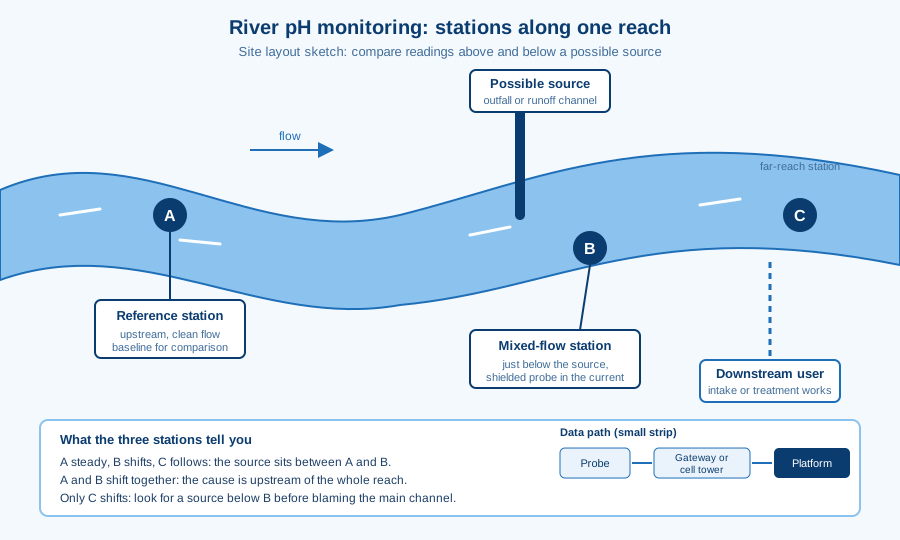
Upstream and downstream compare easily. With stations on both sides of a suspected source, a difference between them becomes visible quickly.
Field visits become purposeful. Technicians go out to clean, verify and collect laboratory samples when the data says it matters.
Gaps are noticed. Device health information shows a silent station before it silently stops recording.
Reports assemble themselves. Logged data supports routine summaries without hand-typing sample sheets.
What Continuous Chemistry Data Is Worth to a Catchment Team
The financial argument for continuous readings is easiest to make in plain operational terms. For a structured way to build the case in your organization, the Ellenex guide to the financial case for IoT implementation is a good starting point.
Fewer Sample Runs to Remote Banks
Routine collection trips are a steady cost in time and vehicle use. A probe that reports on its own lets teams focus visits on maintenance and confirmation sampling.
Pollution Caught Before It Travels Downstream
An early alert shortens the time between an excursion and a response. Finding a problem while it is still local is usually easier to contain than tracing it after it has spread through a longer reach.
Intakes and Treatment Works Warned Early
Operators downstream can prepare when they are told a chemical change is approaching, whether that means adjusting a process or temporarily pausing an intake.
Staff Kept Away From Fast, Cold Water
Every trip avoided is one fewer person at a slippery bank or a flooded access track. Safety benefits are quiet but real.
Sampling Rounds Planned Around Real Events
Instead of sampling on a fixed calendar, teams can collect laboratory samples during the events the probe flags, which makes the confirmed data more useful.
A Light Footprint on the Riverbank
The probes ship pre-configured and need no programming or special tools, which keeps the cost and disruption of adding a station modest.
A Record That Supports Permits and Budgets
A timestamped history gives environmental teams something concrete to bring to compliance discussions and capital planning, instead of anecdote.
Where Ellenex Probes Meet River Conditions
Every river deployment has its own awkward corners. These are the challenges that come up most often and how the CPH2 pair addresses them.
Fouling and Drift: Built for Long Deployments
The sensing assembly uses special pH glass and a gelled reference, and the sensor head is made from corrosion-resistant materials intended for continuous immersion. Fouling can never be eliminated in a river, so the design assumes periodic cleaning and calibration, covered later in this article. Both variants, CPH2-L and CPH2-N, share the same measurement approach.
Flood Pulses and Debris: Hardware for Moving Water
The sensor head is fully submersible and connects through an armored cable to a weather-sealed, UV-protected enclosure. Enclosure versions differ in how the antenna and switch are arranged, so the right choice depends on the mounting position and whether the transmitter can sit above the flood line.
Remote Banks Without Mains Power: Battery Capacity Explained
The probe runs from a replaceable lithium battery, and some enclosure versions accept optional external power. Battery capacity is rated in a number of readings and transmissions rather than in calendar time, so how long a station lasts is largely set by how often it reads and reports. A quiet reach can sample sparingly, while a sensitive reach near an outfall may justify faster sampling and a shorter replacement cycle.
Alerts That Reach the Right Desk
Configurable thresholds on the Ellenex Platform trigger alerts through the channels you pick. The same readings are available to field staff on the mobile app, so the person at the riverbank sees what the office sees.
LoRaWAN Gateway or Cellular: Picking the Route for Your Catchment
Where several stations sit within radio reach of each other, the LoRaWAN probe with a private gateway keeps data on a network you control. Where stations are scattered over a wide area with good cellular coverage, the NB-IoT/LTE-M probe connects straight to the tower. The NB-IoT units ship with a pre-configured SIM and active carrier subscription, and the cellular probe supports common protocols such as MQTT. Both versions work with the platform, and the LPWAN overview explains why low-power networks suit this job.
Ellenex River pH Solution: Mechanism and Outcome
Mechanism: a submersible combination probe measures pH, with optional redox and temperature compensation, and a transmitter encrypts and sends the reading by LoRaWAN or cellular.
Outcome: a continuous, timestamped record of river chemistry on dashboards and mobile, with alerts when thresholds are crossed.
Mechanism: configurable sampling and conditional transmission balance battery capacity against how closely you want to watch.
Outcome: fewer routine trips, quicker response to excursions and data that backs up compliance reporting.
Mechanism: the River and Waterway pH Monitoring solution is delivered pre-configured, with a standard platform license included.
Outcome: a station that can be deployed with modest effort and extended later to the neighboring measurements of turbidity, dissolved oxygen and salinity and conductivity.
Keeping the Glass Honest: Cleaning and Calibration Routines
This section describes widely accepted field practice, not an Ellenex procedure. Follow the instructions supplied with your specific probe and your organization's quality procedures.
A pH probe in a river is a consumable measuring surface. Biofilm, algae and fine sediment coat the glass and the reference junction over time, and the response becomes slow or biased. A gentle cleaning with a soft cloth or brush and clean water, done on a schedule that matches how quickly the site fouls, removes most of it.
Calibration checks the probe against reference solutions of known pH, usually buffers chosen to bracket the range you expect, and adjusts the probe's offset and slope. Many teams check after cleaning, before critical sampling periods and whenever a trend looks suspicious. Record the date, the buffers used and the before-and-after readings every time. Those records are what let you say later that a particular stretch of data was trustworthy.
Between visits, the data itself is a diagnostic. A reading that creeps in one direction with no matching temperature or event often points to fouling rather than chemistry, and a flat line may signal a problem with the probe or power. Pair field checks with laboratory samples on an agreed schedule, so the continuous record stays anchored to a trusted reference.
Turning Logged Readings Into Evidence Regulators Can Follow
Environmental data only counts if it can be defended. Requirements for surface water monitoring, discharge permits and reporting differ by country and by agency, so confirm with your regulator what they accept for continuous probe data before relying on it for compliance.
In general, regulators and auditors look for several things: a known location, accurate timestamps, a documented calibration history, a record of maintenance and a clear chain from raw reading to the figure in a report. A continuous platform record can supply the first two and part of the last. The calibration and maintenance logs have to come from your own field routine.
Treat the probe as an early-warning layer and a trend source, and keep confirmed laboratory sampling for the points where a formal decision depends on the number. That division of labor also keeps sampling budgets sensible: the probe tells you when to look, and the laboratory confirms what you found.
A Catchment That Warns You Before the Complaint Call
Taken together, continuous probes change river pH monitoring from an occasional audit into an ongoing conversation with the water, and they slot naturally into a wider water infrastructure monitoring program. Teams gain earlier warnings, a defensible record, fewer trips to unsafe banks and a clearer view of which reaches deserve attention. The ground work still matters, from mounting position to cleaning discipline, but with those in place the data repays the effort by showing what routine sampling could only suggest.
Frequently Asked Questions
How often should a river probe report if conditions are usually stable?
Start with a modest routine interval and let event-triggered or conditional transmission handle the surprises. A stable reach does not need constant reporting, and a lighter schedule preserves battery capacity.
Review the first few weeks of data before tightening anything. If the trend is flat and alerts are quiet, keep the schedule. If daily swings are interesting, reduce the interval only for the sites where it adds value.
Can one probe tell me what caused a pH excursion?
No. A probe tells you that and when the chemistry changed, plus the temperature at the time, and redox if that option is fitted. It does not identify the substance behind the change.
Use the timestamp to focus your response. Compare upstream and downstream stations, check rainfall and discharge records for that window and collect laboratory samples to confirm the cause.
Where on the bank or bridge should the probe sit to represent the river?
Aim for moving, well-mixed water away from eddies, slack pools and the outlet of a single small inflow. Mounting inside a protective shield on a bridge abutment or sturdy post is common practice.
Keep the sensor head below the lowest expected water level and the transmitter above the highest. Also confirm that the position can be reached safely in normal conditions, since a probe that is hard to reach tends to be neglected.
Will algae and sediment ruin readings between maintenance visits?
They will degrade readings if left alone, which is why cleaning is part of the plan rather than an afterthought. How fast it happens depends on light, nutrients, temperature and sediment load at the site.
Set the first cleaning interval conservatively, then lengthen it if the data stays clean. A slow, one-directional drift with no corresponding event is a classic sign that it is time to clean.
Why does the probe also report temperature, and when is redox worth adding?
Temperature is needed so the transmitter can compensate the pH reading, and it is also useful in its own right for judging whether a change is natural or unusual.
Redox is worth considering where oxidizing or reducing pollutants are a concern, such as certain industrial or mining influences. It is an optional second signal on the same probe, not a replacement for pH.
What happens during floods or when the probe is briefly out of water?
A fully submersible sensor head tolerates immersion, but a probe that dries out for long periods in a drought can drift or become fouled. Floods bring debris, so a protective shield and robust mounting matter.
After an extreme event, check the probe physically and compare it against a reference before trusting the data. Mark the affected period in your records so later readers know to treat it with care.
What should I record about each installation so readings can be audited later?
Record the exact location, mounting details, installation date, probe and transmitter identifiers, and the connectivity route in use. Keep a log of every cleaning and calibration.
Photographs of the mounting position are valuable. Store them with the logs so a new team member can understand the history of each station without relying on memory.
Related Reading
The Unsung Heroes of Water Quality Monitoring: pH Sensors: an earlier introduction to why pH deserves a place in water quality programs.
Ellenex pH Sensors: Precision Water Quality in the Water Infrastructure Monitoring: how the same probe family supports aquaculture and energy-conscious water management.
What are the best IoT sensors for monitoring water quality?: a wider guide to the measurements that complement pH.
Safeguarding Communities by River Flood Monitoring Integration to Road Alarming System: how river level data is put to work alongside chemistry.
Useful Links
Talk to Ellenex
Which stretch of water keeps you awake at night? Name it, tell us who should get the first call when its chemistry shifts, and the team will help you match a probe, a network route and an alert plan to that reach. Open the conversation on the Ellenex sales inquiry page, and part of your infrastructure monitoring plan will already be on paper.