Blocked or Overloaded? Underground Stormwater Level Monitoring Tells You Which


Key Takeaways
Watch the pits that flood first. Start stormwater drain level monitoring at the sags, culvert inlets and junction pits where water historically backs up, then extend outward once the pattern is clear.
Treat a slow rise in dry weather as a blockage clue. Water that lingers in a pit with no rain on the radar usually points to silt, debris or a collapsed section downstream, not to an undersized pipe.
Size the range for surcharge, not for normal flow. A probe that maxes out at pipe-full level goes silent exactly when the drain starts to overload and readings matter most.
Pick the network route by geography. Use LoRaWAN with a private gateway where many pits sit within one precinct, and NB-IoT/LTE-M where drains are scattered across a wide council area.
Send alerts to the crew that can act. Route rate-of-rise and surcharge warnings to the people who dispatch vacuum trucks and traffic control, not only to a planning inbox.
Most Drains Flood Because They Are Blocked, Not Because They Are Small
A common assumption after a street floods is that the drain was too small for the storm. Very often the pipe was fine; it was half full of silt, leaves or a lodged shopping cart before the first drop fell. Underground Stormwater level monitoring tests that assumption with evidence, by recording how deep the water stands inside pits, culverts and conduits between storms as well as during them.
Underground drainage is designed to sit empty most of the time and carry large volumes for short periods. That makes its condition unusually hard to judge. A blocked culvert and a healthy one look identical from the sidewalk on a dry day, and the difference only shows when a storm cell arrives and water has nowhere to go. Continuous level data changes the question from "did it flood?" to "what was the water doing in the hours before it flooded?" A pit that drains slowly after light rain, or holds water for days, is announcing a problem well ahead of the next major event.
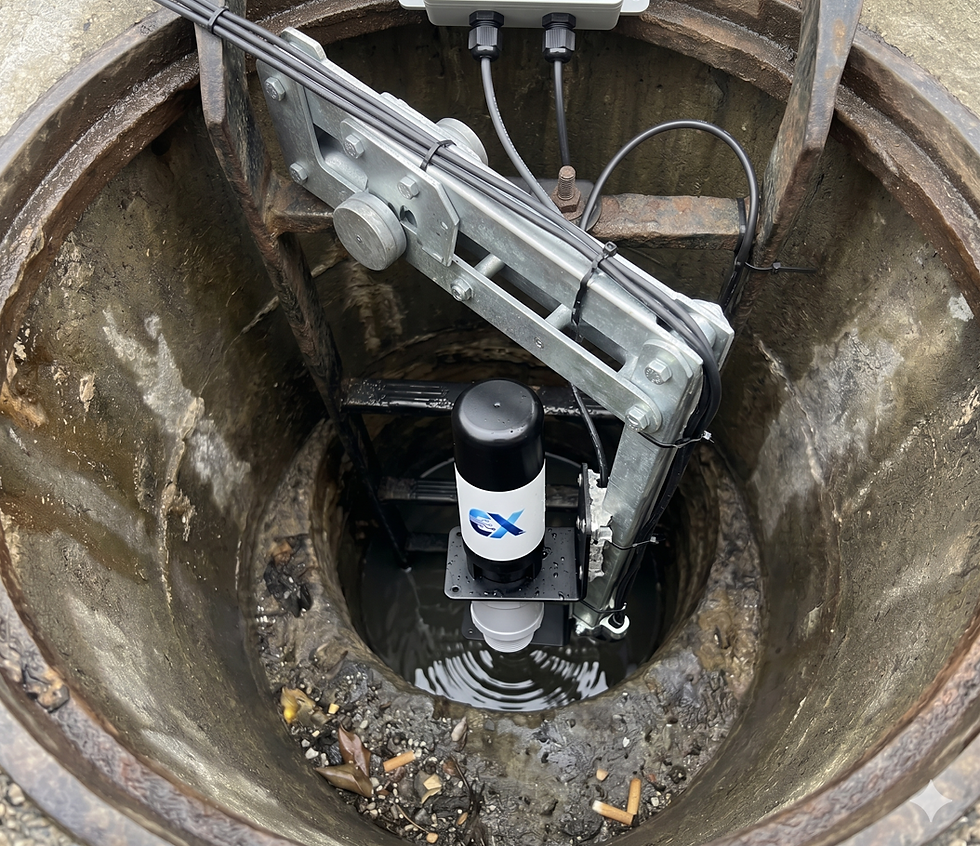
Ellenex addresses this with a battery-powered submersible level transmitter that hangs inside the pit and reports over LPWAN. The Ellenex underground stormwater level monitoring solution pairs that probe with a network route and the Ellenex Platform, so drainage teams can see depth, rise rate and surcharge across the network without lifting a lid. It sits within the wider Ellenex water infrastructure monitoring portfolio.
Silt, Debris and Surcharge: The Bill for Drains Nobody Watches
Property and road flooding: When a culvert inlet chokes, water ponds on the road, enters basements and shops, and closes lanes. The cost lands on residents, insurers and the asset owner's reputation at the same time.
Hidden structural damage: Water that surcharges repeatedly can pressurize joints, wash fines out of the surrounding soil and leave voids under the pavement that appear later as sinkholes or failed road surfaces.
Reactive, after-hours call-outs: Without data, crews learn about a blockage from a complaint, usually at night and mid-storm, when clearing it is slowest, most expensive and least safe.
Wasted cleaning effort: Fixed-cycle cleaning sends vacuum trucks to pits that were already clear while the pits that silt up quickly are left until the next scheduled round.
Pollution carried downstream: Blocked or overloaded drains can push litter, sediment and contaminants into receiving creeks and rivers in a single flush, creating environmental and regulatory exposure.
Below the Road, Out of Signal and Off Limits to Casual Checks
Confined-space rules: Entering a stormwater pit or culvert is typically treated as confined-space work, which means permits, gas testing, standby personnel and traffic control for every inspection.
Long dry spells, short violent peaks: Drains sit idle for weeks, then go from empty to surcharged in minutes. Periodic visits almost always land in the quiet periods and miss the events that matter.
Radio-hostile locations: Concrete walls, steel or cast-iron lids and the surrounding soil weaken radio signals, so a device that works on a bench can struggle once it is below grade.
No power at the pit: Most drainage structures have no mains supply nearby, and trenching cable to hundreds of pits is rarely justified for a monitoring project.
Debris and silt at the measurement point: Sticks, plastic and sediment move through the drain with every storm, so anything placed in the flow has to tolerate being bumped, buried and submerged.
Thousands of assets, few staff: A single council can own a very large number of pits and culverts, far more than any team can visit regularly, so prioritizing where to look is part of the challenge.
Underground Stormwater Level Monitoring From Probe to Phone
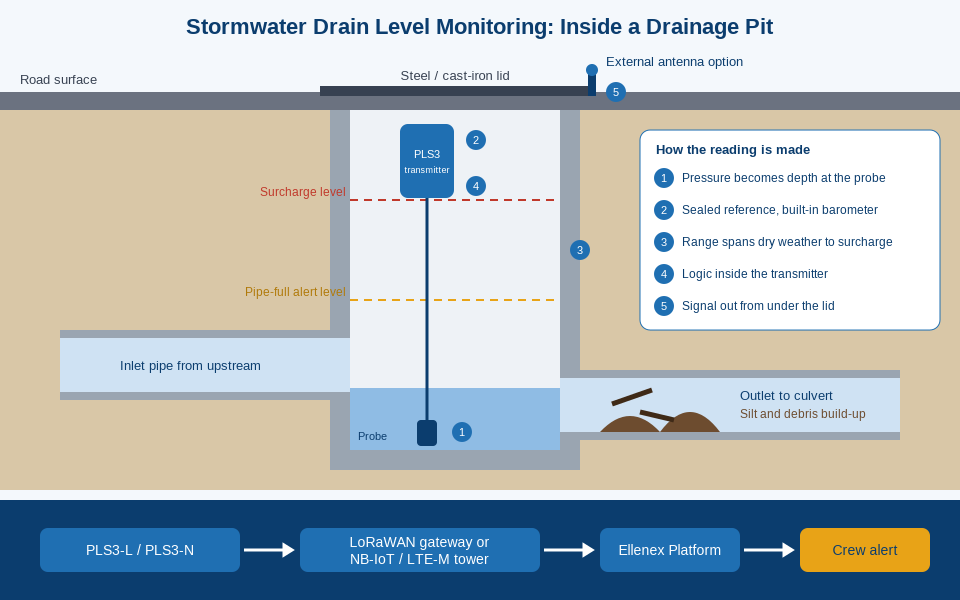
The steps below follow a single reading from the bottom of a pit to an alert on a supervisor's phone. Each step lines up with a label on the diagram that follows.
A Pressure Reading Becomes a Water Depth
The probe sits near the floor of the pit or culvert, below the lowest water level worth recording. Water above it presses on a stainless steel diaphragm, and that hydrostatic pressure rises in direct step with depth. Because the measurement depends on pressure rather than on a reflected beam, foam, floating litter and a dark, wet chamber do not interfere with the reading. If the hydrostatic principle is new to you, the earlier Ellenex post on submersible tank level sensing covers it in more detail.
Sealed Reference, Built-In Barometer
Air pressure above the water changes with the weather, and a storm front can shift it noticeably. The PLS3 datasheets describe a sealed gauge reference combined with a built-in atmospheric pressure sensor, so the transmitter can separate changes in water depth from changes in the weather. For a drainage pit that may fill to the lid, a design that does not depend on an open breathing path to the surface is a practical advantage.
A Range That Covers Dry Weather and Full Surcharge
The measurement range is chosen to suit the structure. For stormwater, the useful span runs from the dry-weather invert level all the way up to the top of the pit, so the probe keeps reporting once the pipe is full and water is rising toward the road. Ranges and cable lengths are selected per structure to match its depth, and non-standard options can be requested.
Logic Inside the Transmitter
The transmitter wakes on a configurable sampling interval, takes a reading and decides what to send. The LoRaWAN version, PLS3-L, supports periodic or event-triggered sampling and can transmit every sample, on an event or only when a condition is met, which keeps routine dry-weather traffic low while still reporting quickly when water starts to climb. Both versions accept sampling-period changes over the air by downlink, so the interval can be shortened before a forecast storm without anyone visiting the pit.
Getting a Signal Out From Under a Lid
On the LoRaWAN route, the PLS3-L transmitter sends its reading to a gateway, which forwards it to a network server and on to the Platform. A pre-configured gateway is included in the LoRaWAN package, and the transmitter can also be pointed at other network servers. On the cellular route, the PLS3-N transmitter talks straight to the nearest mobile tower using NB-IoT or LTE-M (Cat-M1) and a nano-SIM from a network provider, with optional GPRS fallback. Both variants can be ordered with the antenna inside the enclosure or mounted externally, which matters when the enclosure sits under a heavy lid.
Dashboards, Thresholds and Alerts on the Platform
The Ellenex Platform converts each message into depth, plots it against time and compares it with thresholds set for that pit. Alerts for high level, surcharge and rapid rise reach staff by SMS, email or through the Ellenex mobile app, while every past reading remains available for later analysis or export through the API.
Drainage Crews Who Clear Pits Before the Forecast Arrives
Cleaning ranked by need: Pits that hold water after light rain move to the top of the cleaning list, while pits that drain quickly can safely wait for the next scheduled round.
Storm-day situational awareness: Supervisors watch depth climb across the network on one screen and send crews and traffic control to the structures that are actually filling.
Fewer confined-space entries: Routine "is it blocked?" checks are answered from the office, so pit entries are reserved for real maintenance work.
Evidence after an event: Every flood complaint can be checked against the depth record for the nearest pits, showing whether a blockage, a capacity limit or an external source was responsible.
Faster confirmation after clearing: Once a crew removes a blockage, the next storm's readings confirm whether the pit now drains as expected.
Shared visibility: Asset, operations and emergency management teams look at the same data instead of relying on phone calls during an event.
Counting the Savings Hidden in a Dry Pit
Remote level data rarely pays for itself through a single line item. The return builds up across operations, risk and planning, and the Ellenex knowledge center article on IoT implementation costs and returns is a useful companion when putting a business case together.
Inspection Trips That No Longer Happen Blind
Crews stop driving to pits just to lift a lid and look. Visits happen when the data says something has changed, which frees time for the work that actually reduces flood risk.
Flooding Damage That Never Reaches a Property
Catching a blockage between storms means it can be cleared before water reaches houses, shops or roads. Avoided damage claims and avoided disruption are often the largest benefit, even though they are the hardest to see.
Pumps, Pipes and Road Surfaces Spared
Fewer surcharge events mean less pressure on joints, less soil washed into pipes and fewer voids forming under the road. Where stormwater feeds pump stations, steadier inflows also reduce strain on that equipment.
Less Time Spent Below Ground
Each inspection that is replaced by a reading is one less permit, one less gas test and one less person below ground. That is a direct safety gain as well as a cost saving.
Cleaning Programs Ranked by Evidence
A depth history shows which pits silt up fastest and which stay clear. Cleaning budgets can then follow the network's real behavior rather than a fixed calendar.
A Deployment Without Trenches or Mains Power
Battery operation and LPWAN connectivity remove the need for cabling, cabinets and power supplies at each structure, so a pilot can start with a handful of pits and grow from there.
A Drainage Record for Capital Planning
Months of depth data reveal which catchments run close to capacity even when they are clean. That evidence supports upgrade decisions, grant applications and conversations with developers about new connections.
Solving Each Drainage Obstacle With PLS3-L or PLS3-N
Confined Spaces and Manual Checks
Once installed, both the PLS3-L and PLS3-N report depth on a schedule, and their sampling interval and other parameters can be changed over the air. Routine condition checks move from the pit to the screen, and the transmitter's firmware can also be updated remotely.
Short, Violent Storm Peaks
The PLS3-L can switch to event-triggered sampling and conditional transmission, so it stays quiet in dry weather and reports promptly when a threshold condition is met. With either variant, the sampling period can be shortened by downlink ahead of a forecast storm, and the Platform flags a rapid rise as well as a high level.
Below-Grade Radio Conditions
Connectivity is chosen per site. Where many pits sit within one precinct or along one corridor, LoRaWAN with a private gateway gives a single network that the asset owner controls, with no SIM for each device. Where drains are spread across suburbs or rural roads, the PLS3-N connects to an existing NB-IoT or LTE-M network instead. An external antenna option on both variants helps when the enclosure sits beneath a steel or cast-iron lid. The trade-offs between the two technologies are covered in the Ellenex post comparing LoRaWAN and NB-IoT for industrial monitoring.
No Power at the Pit
Each transmitter carries a replaceable lithium battery inside, and an external power option exists for sites that have a supply. For the PLS3, the datasheet states battery capacity as a tally of readings plus uplinks rather than a duration, so how long it lasts in service follows the sampling and reporting schedule chosen for each pit. A pit that reports sparingly in dry months and more often during storms draws on that budget at its own pace.
Debris, Silt and Submersion
The sensor head has a stainless steel body and diaphragm and is fully submersible, and it reports through an enclosure built to resist weather and sunlight. The polyurethane cable suits water service, and pressure sensing means the reading is not confused by litter floating on the surface.
Scale Across a Whole Network
Every transmitter reports into the same Platform, where dashboards, threshold alerts and API access work the same way whether there are five pits or five hundred. That shared view supports the broader infrastructure monitoring programs many councils and utilities already run.
What the Stormwater Package Does and What It Delivers
Sensing: A fully submersible stainless steel probe measures hydrostatic pressure near the pit floor, with a sealed reference and built-in atmospheric pressure sensor separating water depth from weather changes.
Connectivity: PLS3-L reports over LoRaWAN through a pre-configured gateway; PLS3-N reaches the Platform through public cellular coverage, so no gateway has to be installed.
Processing: Configurable sampling, over-the-air settings and, on PLS3-L, event-triggered and conditional transmission keep data flowing when it is needed.
Platform: The Ellenex Platform turns readings into depth trends, rise-rate and surcharge alerts, and exportable records.
Earlier intervention: Blockages show up as slow drainage between storms, so they can be cleared before the next event.
Safer operations: Fewer confined-space entries and better-targeted crew deployment during storms.
Better planning: A long-term record of how each catchment behaves supports cleaning schedules and capital works decisions.
Hanging a Probe in a Stormwater Pit: General Practice
The points below reflect widely used industry practice for submersible level sensors in drainage structures. They are general guidance, not Ellenex-specific procedures, and site safety rules always take priority.
Install from the surface where possible. Many probes can be lowered into position from above with the pit isolated and traffic controlled, which avoids a confined-space entry for the installation itself.
Keep the probe out of the main flow path. Positioning the probe against a wall or in a corner, away from the incoming jet of water, reduces the chance of debris snagging or striking it.
Set the probe just below the lowest level of interest. Placing it slightly above the very bottom of the sump keeps it clear of settled silt while still reading low water levels.
Secure the cable along its full length. Fixing the cable to the pit wall stops it whipping in fast flows and keeps it out of reach of debris carried through the pit.
Mount the enclosure high and check the signal before closing up. The transmitter should sit as high in the pit as practical, and a test transmission before the lid goes back confirms the radio path.
Record the reference levels. Noting the invert, outlet pipe soffit and lid levels at installation lets the Platform's thresholds be set in terms crews understand.
Beyond the Pit: Rivers, Manholes and Rain Gauges
Stormwater pits are one link in a longer chain. Rainfall drives the inflow, sewer and drainage manholes share the same underground corridors, and the water eventually reaches creeks and rivers.
Rain level monitoring: Pairing pit depth with local rainfall from the Ellenex remote rain level monitoring solution makes it easier to tell a blockage from a storm that simply exceeded design capacity.
Manhole level monitoring: The Ellenex manhole water and wastewater level solution extends visibility into sewer and combined networks where overflow risk is similar.
River flood monitoring: Where drains discharge to a river, the Ellenex flood monitoring on rivers solution shows whether high receiving-water levels are backing up the outfall.
Storm Season, Managed From Readings Rather Than Reports
With stormwater drain level monitoring in place, drainage teams stop learning about blockages from flooded streets and start seeing them as slow drainage curves on a screen days earlier. Cleaning crews go where silt is actually building, storm-day dispatch follows live depth across the network, fewer people enter confined spaces, and each event leaves behind a record that strengthens the next maintenance plan and the next capital works bid. The result is a drainage network that is run on measured behavior, supported by the same water infrastructure monitoring tools used across other Ellenex deployments.
Frequently Asked Questions
What is stormwater drain level monitoring and who uses it?
Stormwater drain level monitoring is the continuous measurement of water depth inside the pits, culverts, conduits and junction chambers that carry runoff away from roads and urban areas. It is used mainly by local councils, road authorities, drainage utilities and owners of large sites such as airports, ports and industrial estates. The data serves two purposes: operational awareness during storms, when teams need to know where water is rising fastest, and condition assessment between storms, when slow drainage or standing water reveals blockages and capacity problems. In general practice, monitoring starts at known trouble spots and is extended across a catchment as the value becomes clear.
The Ellenex underground stormwater level monitoring solution is built for these users. A submersible PLS3 transmitter hangs inside each structure and reports depth over LoRaWAN or a cellular LPWAN link into the Ellenex Platform. Drainage teams see every monitored pit on one dashboard, receive high-level and rapid-rise alerts on their phones, and keep a history they can review after each storm or export to other asset management systems.
What causes stormwater drains and culverts to block?
Most blockages come from material carried in by runoff. Leaves, grass clippings and sediment wash off roads and gardens with every rain, and in some areas litter, construction debris and larger objects follow. Sediment settles where flow slows down, such as in sumps, at bends and at changes in pipe size, gradually reducing capacity. Tree roots can enter through joints, and older pipes may crack or partially collapse. Culvert inlets are especially vulnerable because debris tends to lodge against them during high flows. Industry practice generally treats blockage as a progressive process, which is why inspection and cleaning frequency matter as much as original pipe size.
Ellenex monitoring makes that progression visible. Because the PLS3 probe reads depth continuously, the Ellenex Platform shows how quickly each pit empties after rain and whether water lingers in dry weather. A pit whose drainage curve slows down from one storm to the next is a strong candidate for cleaning. The PLS3-L can also report on events or conditions rather than on a fixed schedule only, so a sudden change is not left waiting for the next routine message.
Which sensors are used to measure depth in stormwater pits and culverts?
Several methods are used. Non-contact sensors such as radar or ultrasonic units are mounted under the lid and measure the distance to the water surface. Submersible pressure sensors sit below the water and measure the hydrostatic pressure of the water column above them, which corresponds directly to depth. Floats and switches detect only whether water has passed a set point. The best choice depends on the structure: in deep, narrow or cluttered pits, or where the surface is covered in foam and floating debris, submersible pressure sensing is a common choice because it does not depend on a clear line of sight to the surface.
The Ellenex solution uses submersible hydrostatic sensing. The PLS3 probe has a stainless steel body and diaphragm, is fully submersible and connects to a weather-sealed, UV-protected enclosure through polyurethane cable. A sealed gauge reference with a built-in atmospheric sensor lets the transmitter separate depth from weather-driven pressure changes. Ranges and cable lengths are matched to each structure's depth, as described on the PLS3-N product page and the PLS3-L page.
What is a surcharged drain, and why is it a flood warning sign?
A drain is described as surcharged when the water level rises above the top of the pipe, so the pipe is running full under pressure and water starts to fill the pits and chambers along it. Surcharge can happen because a storm exceeds the design capacity, because a blockage downstream has reduced capacity, or because high water at the outfall, such as a swollen creek or tidal water, is preventing discharge. If the level keeps rising, water escapes from pit grates and lids onto the road surface, which is the point at which flooding becomes visible to the public. Recognizing surcharge early therefore gives operators a short but valuable window to act.
Ellenex helps by measuring the whole span from dry-weather level to the top of the pit, so readings continue after the pipe fills. The Ellenex Platform can raise separate alerts for high level, surcharge and rapid rise, and send them by SMS, email or the mobile app. Combining pit data with the Ellenex remote rain level monitoring solution or river level data helps teams judge whether a surcharge is caused by rainfall, a blockage or a high outfall.
Can wireless sensors work reliably below ground in drainage pits?
They can, provided the radio path is planned. Concrete, soil and metal lids all weaken signals, so devices placed below grade generally need a technology with strong building penetration and a good link budget, an antenna position that gives the signal the best possible exit, and a test transmission before the lid is closed. Low-power wide-area networks such as LoRaWAN and NB-IoT were designed for this kind of hard-to-reach, battery-powered asset, and are widely used for metering and monitoring in pits and chambers. Battery operation also removes the need for power cabling, which is usually unavailable at drainage structures.
Ellenex offers both routes. The PLS3-L uses LoRaWAN, which suits clusters of pits served by a private gateway, while the PLS3-N rides on public NB-IoT or LTE-M cellular coverage, which suits drains spread across a wide area. Both variants can be ordered with an internal or external antenna to help under heavy lids, and settings can be changed over the air. More on each approach is available in the Ellenex knowledge center pages on LoRaWAN and NB-IoT and LTE-M.
Related Reading
A River Flood Monitoring System Should Warn on Rate of Rise, Not Just Height: why rise rate matters for river warnings, a useful companion where drains discharge to waterways.
Monitoring Made Smarter: Harnessing IoT for Manhole and Wastewater Level Tracking: how level monitoring supports sewer and wastewater manholes that share the same underground corridors.
Leveraging Energy-Efficient Radar (DRC3) and Submersible (PLS3) Level Sensors for Smart Manhole Monitoring: a look at radar and submersible options for manholes, including the PLS3.
Wastewater Wet Well Level Monitoring Without Floats That Foul: level monitoring in pump station wet wells, which often receive stormwater inflow.
Useful Links
Talk to Ellenex
Which pit on your network fills first when a storm stalls overhead, and which culvert sits just downstream of it? Those two structures make a strong first pair to instrument, because together they show both the symptom and the likely cause. Describe where they are, roughly how deep each one runs and whether they share a precinct or sit far apart on the Ellenex sales inquiry page. From that, Ellenex can propose a probe range, a connectivity route and an alert plan for your drainage network.