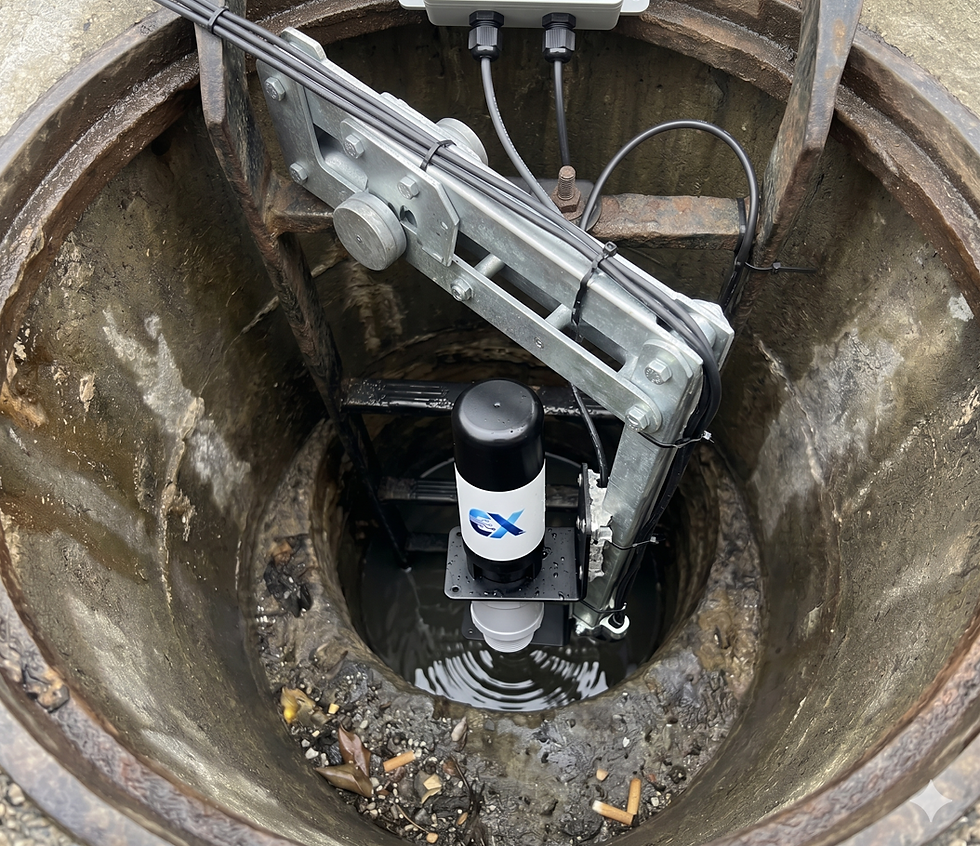
Wastewater Wet Well Level Monitoring Without Floats That Foul


Key Takeaways
Measure from below, not above. A submersible sensor reads the pressure of the liquid over its head, so foam, grease caps, splashing and a closed hatch do not distort the level it reports.
Fit the sensor to the well you actually have. Cable length and measuring range should follow the working depth of each wet well, from the pump-off level to the overflow line.
Treat reading frequency as a battery budget. How often a sensor reads and reports decides how long the cell lasts, so sample faster only where the process justifies it.
Pick the route by geography. LoRaWAN with a private gateway suits stations clustered in one service area, while NB-IoT/LTE-M suits stations spread across a region.
Alert people, not just screens. High and low thresholds with multi-channel alerts turn a level curve into a call that someone answers before the well overflows.
A Wet Well Does Its Work Out of Sight, and That Is the Trouble
A wet well is the buried chamber where sewage collects until pumps lift it toward treatment. Its level rises with every flush, storm surge and industrial discharge, then falls each time a pump starts. Wastewater wet well level monitoring is the practice of watching that rise and fall continuously, so the station's health is known without lifting the hatch.
Most stations are still checked on a schedule: a crew drives out, opens the cover, looks down and writes a note. That snapshot says little about the hours in between, which is exactly when pumps fail, floats stick and inflow surges. Ellenex builds a battery-powered answer around a submersible level transmitter, described on the Remote Wastewater Tank Level Monitoring solution page.
This guide follows one reading from the bottom of the well to the phone of the person on call. It also explains where the usual sensing methods struggle with sewage, and how to choose between the LoRaWAN and NB-IoT/LTE-M versions. For the wider picture of how utilities use connected sensors, see Water Infrastructure Monitoring.
The Overflow Nobody Saw Coming and Other Costs of Blind Wells
When a wet well has no continuous record, problems announce themselves late and expensively. The usual failure modes look like this:
Overflows that reach the street or a waterway. A pump fails or inflow outruns it, the level climbs unseen, and the first alarm is a complaint from the public or a regulator.
Pumps that cycle badly for weeks. Short cycling and long dry runs wear motors and starters, yet look normal at a quarterly visit.
Wasted site visits. Crews drive to healthy stations while the one in trouble waits, because nothing indicates which is which.
Fouled instruments that lie quietly. A float jammed in grease or a wall coated with deposits reports a comfortable level when the well is not comfortable at all.
Cleanup and reporting burdens. An overflow brings cleanup work, paperwork and reputational damage that a single early alert could have avoided.
Why Sewage Is Harder to Measure Than Clean Water
A clear tank of drinking water is forgiving. A wet well is not, and the same obstacles tend to repeat across stations:
Grease and scum. A floating layer coats anything that rides the surface and can jam moving parts.
Solids and rags. Debris wraps around cables and snags anything that hangs in the flow.
Foam and turbulence. Inflow churns the surface, so methods that bounce a signal off the top produce noisy or false readings.
Corrosive atmosphere. Gases and moisture attack ordinary metals and electronics.
Confined, hazardous access. Opening a wet well means a permit, a trained crew and safety equipment, so frequent manual checks are costly.
Remote, scattered stations. Many sit at the edge of a network, with no mains power and uneven coverage.
Wastewater Wet Well Level Monitoring From Diaphragm to Dashboard, Reading by Reading
The principle is simple, and the details are what make it dependable. Each stage below follows the reading on its journey, and the same chain applies to either connectivity route.
Sensing: Depth Becomes Pressure Under the Scum
Liquid exerts pressure in proportion to its depth. A submersible sensor head sits at the bottom of the well and measures that pressure with a sensing diaphragm, so it reads the weight of the liquid above it rather than the position of the surface. Grease, foam and ripples on top do not change that weight, which is why the method suits a messy wet well. The principle is covered in more detail in the post on remote water tank level monitoring.
Reference: A Vented Cable Keeps Weather Out of the Reading
Air pressure presses on the liquid too, and it changes with the weather. A vented cable carries a reference path to the sensor so that atmospheric pressure is cancelled out, leaving only the depth of the liquid. Without that reference, a passing front could look like a change in level.
Sizing: Fitting Range and Cable to the Wet Well
The measuring range should cover the working depth between the pump-off level and the overflow line, with sensible headroom. The cable should reach the bottom without slack that can snag. Ellenex offers a choice of ranges and cable lengths, and the right combination depends on the individual well rather than a catalog average.
Decisions at the Transmitter: Which Readings Are Worth Sending
The transmitter samples on a schedule that can be changed remotely, and it can also send on a condition, such as a level crossing a threshold. That means calm periods stay quiet to save battery, while rising levels trigger immediate reports. Battery capacity is quoted as a count of readings and transmissions rather than calendar time, so a well that is sampled and reported more often drains its cell sooner than one on a relaxed schedule.
Transmission: Two Routes Out of a Concrete Chamber
On the LoRaWAN route, the transmitter sends a short radio message to a private Ellenex outdoor gateway, which forwards it through a network server to the platform. On the cellular route, the transmitter talks directly to a carrier tower over NB-IoT or LTE-M, with no gateway at all, and needs an active carrier data plan. Both routes encrypt the data in transit. Background on each is available in the Ellenex guides to LoRaWAN and NB-IoT and LTE-M.
The Platform: Turning Depth Into Pump and Overflow Context
Readings arrive at the Ellenex Software Platform, where they appear on dashboards and in history charts. Depth can be converted into volume, high and low alarm thresholds can be set per station, and alerts can go out over several channels. Data can also be forwarded through an open API or into SCADA and other business systems. Mobile access is available through the Ellenex mobile app, and the station fits into a wider infrastructure monitoring program.
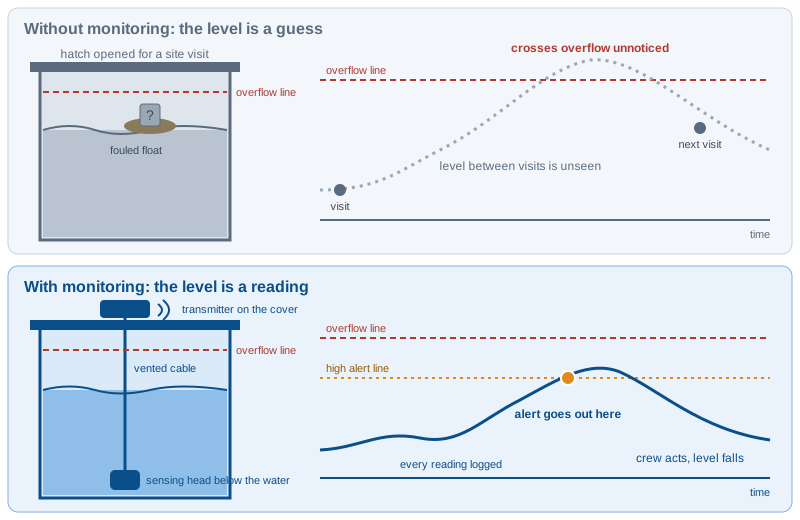
Pump Stations That Report Their Own Wet Wells
Once every well reports its own level, the working week changes in ways that crews notice quickly:
Visits follow the data. Crews are sent where a curve looks wrong, not where the calendar says to go.
Pump behavior becomes visible. The sawtooth of fill and drawdown shows whether pumps start, stop and recover as expected.
Storm response gets earlier. A steep climb in level during heavy inflow is seen as it happens, not discovered afterward.
Remote stations stop being blind spots. A well at the edge of the network is as visible as one beside the depot.
Thresholds can be tuned. If alerts prove too chatty or too late, limits are changed from the platform without a trip to site.
History accumulates. Seasonal patterns and slow drifts build into a record that supports maintenance and planning.
Counting the Return in Trips, Pumps and Penalties
The case for monitoring rests on avoided cost more than new revenue, and it can be described without inventing numbers. Utilities that want a structured way to weigh it, alongside their wider water infrastructure monitoring plans, can use the Ellenex page on the financial case for IoT implementation.
Fewer Trips to Remote Stations
Routine inspection drives are replaced by visits triggered by evidence. Fuel, vehicle wear and labor hours shift toward the stations that need attention.
Pumps That Stop Cycling Badly
When short cycling or dry running shows up in the level curve, it can be corrected before motors and starters wear out early.
Overflows Caught While They Are Still Small
An early high-level alert gives a crew time to act while the well is still within its limits, which is far cheaper than cleanup and reporting afterward.
Fewer Entries Into Confined Spaces
Every inspection avoided is one fewer hatch opened above a hazardous atmosphere, which supports worker safety.
Maintenance Scheduled From Evidence
Pump and well maintenance can be planned from observed behavior rather than a fixed interval, which spends effort where it matters.
Light Effort to Deploy
A factory-configured, battery-powered transmitter does not need trenching, mains wiring or a control cabinet at the well, so installation is mostly a matter of lowering the sensor and mounting the transmitter.
Records for Planning and Reporting
Continuous history helps justify capacity upgrades and supports conversations with regulators about how a station behaves during storms.
Wet Well Headaches, Paired With the Hardware That Fits
Ellenex covers this application with the PLC2 pair: PLC2-L for LoRaWAN and PLC2-N for NB-IoT and LTE-M. Each challenge below maps to a specific design choice.
Wetted Parts Chosen for Harsh Liquids
Both variants are built as level transmitters for corrosive liquids, with wetted parts in corrosion-resistant materials such as Hastelloy or PVDF and a choice of seals, and a sensor head that is fully submersible. The transmitter sits in a weather-sealed, UV-protected enclosure on the cover, away from the liquid. Cable options include polyurethane and Teflon-coated types.
A Cable and Range That Match the Well
Ranges and cable lengths can be specified to suit each well, and non-standard ranges are available on request. That avoids both a sensor too short to reach the bottom and a range so wide that resolution is wasted. The PLC2-L product page sets out the options.
Reading Often Enough Without Draining the Battery
Sampling is configurable by downlink, so a station can read relaxed in dry weather and quicker when conditions demand. Event-triggered reporting is also available. A built-in replaceable lithium battery powers the transmitter, with options on the cellular variant for external power with battery backup or a larger battery. More detail is on the PLC2-N product page.
Alarms That Reach the On-Call Person
High and low thresholds can be set on the platform, with alerts delivered over several channels. Roles can be assigned so that operators, supervisors and contractors see what they need.
A Private Gateway or the Cellular Tower
Clustered stations in one service area suit LoRaWAN with a private Ellenex outdoor gateway, which avoids per-device carrier fees on a private network. Scattered stations suit NB-IoT/LTE-M, which connects straight to the tower and needs a carrier data plan. The route is set by where the wells are, and both are managed in the same platform.
The Wet Well Package, Mechanism by Mechanism
Mechanism: a submersible sensor measures liquid pressure and a vented cable removes weather effects. Outcome: a stable depth reading that ignores grease, foam and a closed hatch.
Mechanism: a transmitter samples on a schedule or on a condition. Outcome: quiet periods save battery, and rising levels report at once.
Mechanism: LoRaWAN through a private gateway, or NB-IoT/LTE-M straight to the tower. Outcome: coverage that fits the geography of the estate.
Mechanism: the platform stores readings, applies thresholds and routes alerts. Outcome: the right person hears about trouble early, and history supports planning.
The full package, including the gateway for the LoRaWAN option and a standard platform license, is described on the solution page.
Lowering the Sensor Into a Working Wet Well: Habits From the Field
These tips reflect widely accepted industry practice, not Ellenex procedures, and local safety rules always come first.
Plan the entry. Follow confined-space procedures before anyone opens a wet well, and think about how to hang the sensor from the cover so nobody needs to go below.
Keep the head clear of the inlet. Place it where turbulence from incoming flow is mild and away from the pump suction.
Fix the cable. Secure it so that it cannot swing into moving parts or tangle in rags.
Mind the vent. The vented cable needs a clean path to air, so protect the vent from water and debris.
Locate the antenna thoughtfully. Metal covers and buried chambers weaken radio, so mount the antenna where it has the clearest path.
Record the setup. Note the sensor depth, range and reference level for later comparison with manual checks.
Four Wet Well Myths That Cost Money
Myth: a float switch is all a station needs. Floats give a few fixed points and can stick in grease, while continuous level shows the whole curve.
Myth: sewage always fouls a pressure sensor. Fouling is a risk to manage with materials, placement and inspection, not a reason to stay blind.
Myth: a buried chamber cannot report by radio. With an external antenna and a sensible route, wells report reliably, and the cellular route skips the gateway entirely.
Myth: more frequent readings are always better. Faster sampling uses battery and bandwidth, so speed it up where the process demands and relax it elsewhere.
Wet Wells That Speak Up Before the Alarm Panel Does
A well-monitored estate runs differently. Each wet well reports its own level, trends show where pumps are tiring, and alerts reach the right person while the well still has room. The same hydrostatic approach also serves nearby applications, including chemical tank level monitoring, manhole level monitoring and stormwater drain level monitoring, so a utility can build one habit across its network. Broader context sits under Infrastructure Monitoring.
Frequently Asked Questions
Can a pressure sensor cope with grease, ragging and sludge in a wet well?
It measures the weight of liquid above the diaphragm, so a layer of grease on the surface does not shift the reading. The diaphragm itself can still gather film or debris over time.
Choose wetted materials suited to the liquid and inspect the head at planned intervals, because the sensor reads what the diaphragm feels. Placement away from direct inflow also reduces buildup.
Where in the well should the sensor hang?
General practice is to place the head low in the well, clear of the inlet stream and the pump suction. That keeps turbulence and debris away while still covering the full working range.
Secure the cable so it cannot move into the pumps, and record where the sensor sits so later readings can be compared with manual measurements.
How do I avoid false alarms when pumps start and stop?
Pump starts and stops create a regular rise and fall, so thresholds belong above the normal working band rather than inside it. Study a few cycles of history before fixing limits.
If alerts prove too frequent or too late, the limits can be adjusted from the platform as experience builds, without a trip to the well.
Will a buried chamber or metal cover block the signal?
Covers and buried chambers do weaken radio, but the transmitter can use an external antenna and the antenna can be mounted where it has the best path. Cellular coverage at the site is worth confirming before choosing that route.
On the LoRaWAN route, the gateway position matters more than the transmitter, so plan gateway placement for the cluster as a whole.
Can reporting speed up when a storm pushes inflow up?
Yes, sampling is configurable and the transmitter can also report on a condition, such as a level rising past a set point. That lets dry weather stay quiet and storms get attention.
The trade-off is battery use, since more readings and transmissions draw more from the cell, so set the fast mode to apply only when the situation needs it.
Can several teams use the same data with different permissions?
The platform supports role-based access, so operators, supervisors and contractors can each see only what they need. Data can also be forwarded through an open API or into SCADA and other systems.
For larger organizations, multi-tenant accounts keep different departments or regions separate within one platform.
What does the reading show if the well runs low or the sensor is briefly uncovered?
A submersible sensor reports the pressure it feels, so as the liquid falls toward the head the reading drops with it. Below the head, the sensor can no longer describe the depth.
For that reason, set the low threshold above the sensor head and confirm the sensor position during commissioning so the lowest useful reading is known.
Related Reading
Catalyzing Progress: How Ellenex Level Sensors Transformed Wastewater Tank Level Monitoring: an earlier look at level sensing in wastewater tanks.
Monitoring Made Smarter: Harnessing IoT for Manhole and Wastewater Level Tracking: how level data supports manholes and sewer networks.
Remote Water Tank Level Monitoring: End the Surprise of a Dry Tank: the hydrostatic principle explained for outdoor water tanks.
Enlighten Energy Efficiency in Water and Wastewater Industry: wireless level monitoring across water and wastewater operations.
Useful Links
Talk to Ellenex
The sales inquiry page is where a wet well turns into a monitoring plan: describe the station, its liquid and how far it sits from the nearest road, and an Ellenex engineer will reply with a suggested sensor, route and layout.