Why Bore Drawdown Monitoring Spots Trouble Before the Pump Does


Key Takeaways
Measure three things, not one. The resting level, the dip while the pump runs and the speed of recovery afterward tell you far more about a bore than a single depth reading ever could.
Judge each bore against its own season. A level that is normal in the dry months can be a warning in the wet ones, so baselines belong to the individual bore rather than to the whole field.
Insist on a vented reference. A vented cable keeps barometric swings out of the reading, which matters when the goal is to see slow trends.
Plan the sampling like a budget. Every reading and every transmission draws from a fixed battery allowance, so the sampling plan decides how long a probe can go unattended.
Match the network to the layout. LoRaWAN through a private gateway suits bores grouped around a farm or wellfield, while NB-IoT/LTE-M suits bores spread across a district.
The Pump Still Runs, So the Bore Must Be Fine
The pump still runs, so the bore must be fine. That assumption holds right up until the day it does not, and by then the water table has often been sliding for months. Bore drawdown monitoring replaces the assumption with a record of how deep the water sits at rest, how far it falls while the pump works and how quickly it climbs back once the pump stops. Ellenex builds this around a slimline submersible sensor, described on the Remote Ground Water Level Monitoring solution page.
Most bores are still checked by hand. A technician lowers a dip tape down the casing, writes a number on a clipboard and moves on to the next site. The method is sound, but it yields a handful of numbers a year from a system that changes every time the pump starts. Seasonal swings, neighboring extraction and a slowly clogging screen all leave their mark in the gaps between visits.
This article follows a reading from the bottom of a casing to an alert on a screen, then covers what changes in daily work, where the value shows up and how the Ellenex PLM2-L and PLM2-N probes suit different bore problems. It belongs to Ellenex's wider water infrastructure monitoring work, and the same thinking applies to any asset that infrastructure monitoring can reach with a small battery-powered device.
Declining Levels Nobody Logged Cost More Than They Look
Without a record, trouble in a bore stays invisible until it shows up as a failed pump or a dry tap. The costs tend to arrive in the same few forms:
Pumps that run dry. When the water drops toward the pump intake unnoticed, the pump draws air, overheats and wears out early, often when demand is at its highest.
Yield lost to over-pumping. Pumping harder than the aquifer can recharge deepens the dip each season. The bore keeps delivering right up to the point where it does not.
Disputes without evidence. When a neighbor, an irrigation district or a regulator is involved, a claim about who lowered the water table is only as strong as the records behind it.
Emergency drilling and re-casing. A bore that fails without warning means short-notice contractors, lost production and, in the worst case, a deeper replacement that earlier data might have avoided.
Gaps in compliance records. Abstraction licenses and drought restrictions often ask for levels over time, and missing months turn into awkward questions at audit time.
Boreholes Hide Their Behavior Behind Casing and Distance
Bores are hard to watch for reasons that have little to do with the water itself:
Out of sight by design. The water surface sits far below ground inside a narrow casing, so nobody sees it move.
Remote and scattered. Bores serve paddocks, wellfields and rural supplies that sit far from the office and far from each other.
Tight casings. Many monitoring bores and older wells leave little room, so a bulky instrument is a non-starter.
No mains power or cabling. The nearest outlet is often a long way off, so the instrument has to run on a battery and report wirelessly.
Several causes at once. Water levels move because of this bore's pump, nearby pumps, rainfall recharge and the seasons together, and a single snapshot cannot untangle them.
Weather in the signal. A pressure-based sensor feels the atmosphere above the water, so slow trends can be buried under barometric swings unless the sensor compensates for them.
Bore Drawdown Monitoring From Resting Level to Recovery Curve
Drawdown is the distance the water surface falls inside a bore while it is being pumped. Bore drawdown monitoring tracks that dip together with the resting level before it and the recovery after it. The steps below follow the signal from the aquifer to the dashboard.
Resting Level: The Baseline Every Bore Has
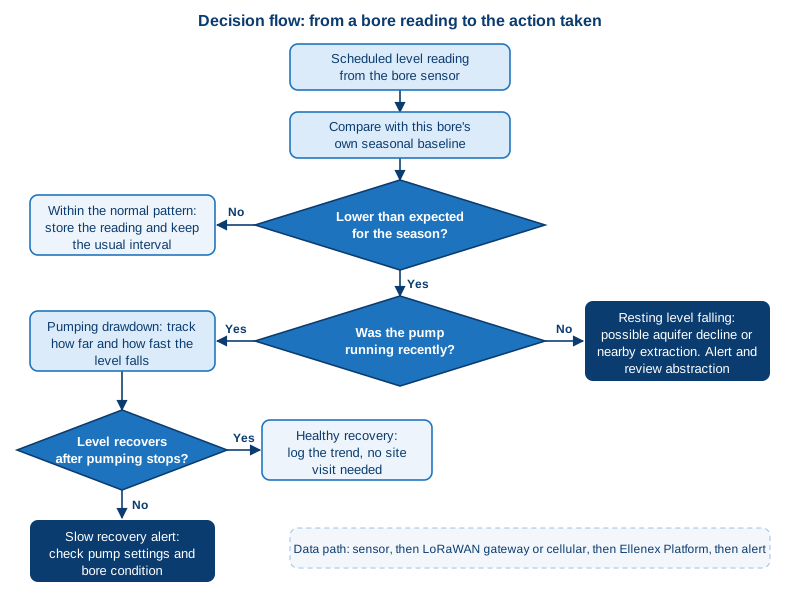
When no pump has run for a while, the water inside the casing settles at a resting level that reflects the aquifer around it. This is the baseline. It rises after wet seasons and sinks through dry ones, and a probe that logs it regularly turns that seasonal pattern into a reference line unique to the bore. Pairing it with local rainfall from remote rain level monitoring helps explain why the line moves.
Drawdown: The Dip Pumping Leaves Behind
Each time the pump starts, the water inside the casing falls below its resting level. How deep the dip goes depends on how hard the pump works, how readily the aquifer supplies water and how clean the screen is. Logged cycle after cycle, the dip shows whether a bore is coping or straining.
Recovery: How Fast the Water Climbs Back
After the pump stops, the water climbs toward the resting level again. A bore that recovers briskly is drawing on healthy reserves. A bore whose recovery slows, or stalls short of its old resting level, is telling you that something has changed in the aquifer, the screen or the neighborhood. Recovery is the most informative part of the curve and the part a dip tape almost never catches.
A Vented Reference So Weather Stays Out of the Reading
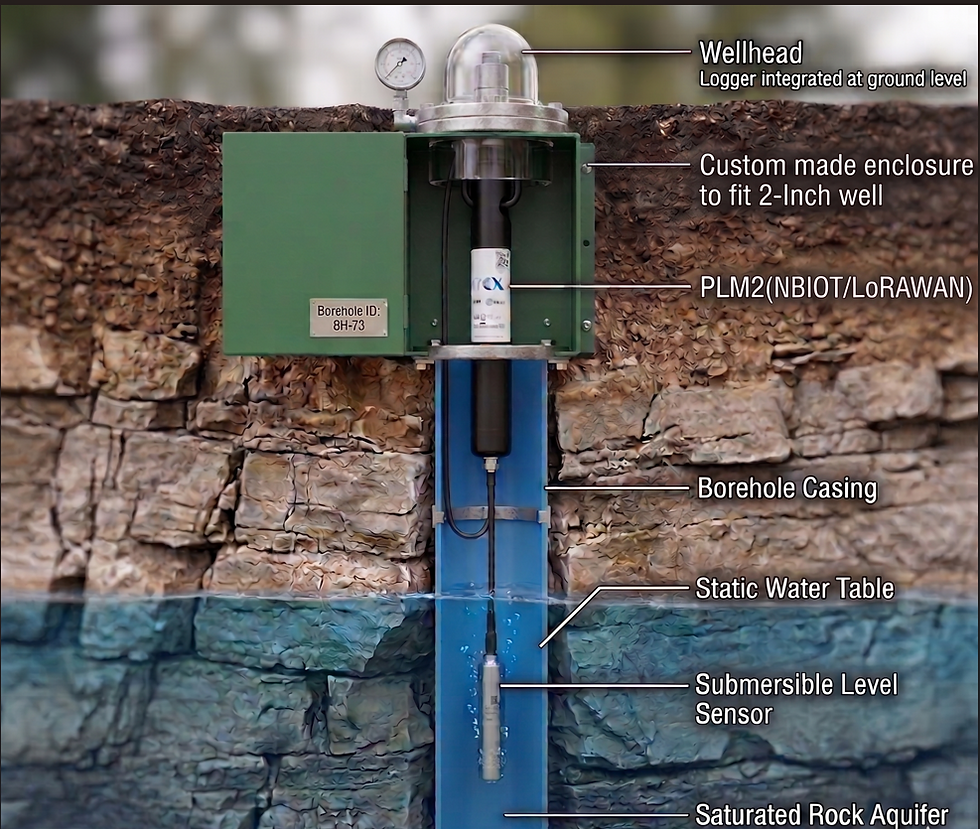
The sensor head hangs below the water surface and measures the pressure of the water column above it, a principle explained further in the guide to ultrasonic, radar and submersible level sensing. The cable is vented, so the sensor compares water pressure against the atmosphere and barometric swings do not masquerade as changes in water level. A slow trend then reflects the aquifer rather than the weather.
Fitting a Slim Sensor Into a Narrow Casing
The PLM2-L and PLM2-N use a narrow sensor head made for tight wells, with a fully submersible head and a polyurethane cable carrying the signal up to the transmitter. The transmitter sits at the wellhead in a sealed, UV-protected enclosure, and a narrow cylindrical enclosure option exists for slim installations.
Sampling and Sending Without Draining the Battery
The transmitter wakes on a schedule, takes a reading, applies its factory calibration and goes back to sleep. Sampling can follow a regular interval or respond to events, and the datasheets describe sending every sample, sending on an event or sending only when a condition is met. That flexibility lets a quiet bore report sparingly and a heavily pumped bore report in more detail, and the settings can be changed later over the air.
Two Routes From Casing to Platform
The PLM2-L speaks LoRaWAN. Its packets reach a pre-configured outdoor gateway, which hands them to the network server. The PLM2-N speaks NB-IoT, with LTE-M available as an option, and sends its data straight to the public cellular tower with no gateway at all. Either way the payload is encrypted in the field and decoded in the Ellenex network core, which also removes duplicate messages. The trade-offs between the two families are covered in what LoRaWAN is, what NB-IoT and LTE-M are and the LoRaWAN versus NB-IoT comparison for industrial monitoring.
What the Platform Does With Each Reading
The Ellenex Software Platform turns each reading into a point on a dashboard, a trend line and, when needed, an alert. It keeps the history that makes drawdown and recovery comparisons possible, tracks device health and lets teams set high and low thresholds with notifications through several channels. Role-based access lets different people see different bores, and data can move onward through export, webhooks or an open API.
Dip Tapes Retire: Life Once Every Bore Reports Itself
Once readings arrive on their own, the working week changes in ways that are easy to underestimate:
Visits follow need. Crews go to a bore when the data shows a problem or a service is due, not because the calendar says so.
Trends arrive with context. Each reading sits beside the bore's own history, so a dip that is normal for the season stops raising alarms.
Pumping is scheduled with evidence. Operators can see how a bore responds to a longer run and choose rest periods that let it recover.
Problems get a shape. A sudden step looks different from a gradual slide, and both look different from a pump fault, so the first phone call goes to the right person.
Everyone sees the same numbers. Farm managers, utility engineers and consultants read one dashboard instead of swapping spreadsheets.
Where Continuous Bore Data Pays Back
The wider financial argument for sensors is set out on the financial case for IoT implementation page. For bores, the payback tends to show up in the following places.
Fewer Long Drives to Distant Paddocks
A dip-tape round can eat a whole day for a handful of bores. When readings arrive by themselves, the same crew visits only the bores that need attention.
Groundwater Preserved by Pacing Abstraction
Seeing how a bore responds to a long pumping run lets operators ease off before the aquifer is stressed. The same discipline applies to shared supplies, and it sits comfortably beside irrigation channel water level monitoring when surface and groundwater are managed together.
Pumps Spared From Running Dry
A low-level alert gives a pump time to be switched off before it draws air. Fewer dry runs mean fewer burned-out motors and fewer emergency call-outs.
Staff Kept Off Remote Tracks and Away From Open Casings
Every avoided visit is one less drive on a rough access road and one less moment leaning over an open casing. Reducing exposure is a safety gain that never appears on an invoice.
Allocations and Pumping Schedules Planned on Evidence
Season-long records support conversations with neighbors, councils and regulators, because the argument rests on measured levels rather than recollection.
Existing Bores Reused as They Stand
A slimline probe lowers into an existing casing, and the transmitter is mounted at the wellhead. Most bores can be instrumented without drilling anything new.
Hydrogeological Data for Long-Term Decisions
Years of resting levels and recovery curves inform decisions about new bores, treatment capacity and storage, including the planning discussed under dam and water resource level and volume monitoring.
Fitting Ellenex Probes to Bore Problems
Each common obstacle in the field has a matching feature in the Ellenex range.
Narrow Casings Need a Slimline Probe
Both the PLM2-L and the PLM2-N are designed around narrow wells. The slimline sensor head goes where bulky instruments cannot, and the Remote Ground Water Level Monitoring solution was developed for boreholes, piezometers and monitoring wells.
Cable Length and Range Matched to the Bore
Bores differ in depth, so measuring range and cable length are specified per bore instead of taken from a catalog average. Standard ranges cover shallow monitoring wells through to deep bores, with custom options on request. Leaving margin for a long dry spell avoids a probe that runs out of range exactly when the water is lowest.
Sampling That Follows Pumping Cycles
Event-based sampling and conditional transmission let a probe stay quiet while the water sits still and report more when it moves. Intervals and conditions can be retuned from the platform, so a pumping season and a rest season can run different plans without a site visit.
Planning Battery Around How Often the Bore Reports
A replaceable lithium battery powers each probe, and the datasheets rate its life in readings and transmissions rather than calendar time. Reporting more often draws the allowance down faster, so the right interval balances detail against the gap between battery changes. Ellenex sales can help set an interval for a specific bore.
Alerts for Falling Resting Levels and Slow Recoveries
High and low thresholds trigger notifications through several channels, and the platform also offers sudden-drop detection and anomaly alerts. A low-level warning protects the pump, while a slow-recovery pattern can prompt a screen inspection long before yield suffers.
LoRaWAN Gateway for Clustered Fields, Cellular for Scattered Bores
Where bores cluster around a farm, a wellfield or a campus, the PLM2-L with one private outdoor gateway avoids per-device airtime fees. Where bores spread across a district, the PLM2-N reports straight to the cellular network and needs no gateway, with a data subscription in place. A mixed estate can run both on one platform, and what LPWAN is explains the family they belong to.
The Remote Ground Water Package: Mechanism and Outcome
Mechanism. A battery-powered submersible probe measures hydrostatic pressure through a vented cable, the transmitter applies calibration and encrypts the reading, and it travels by LoRaWAN through a private gateway or by NB-IoT/LTE-M straight to the cellular network. The Ellenex network core authenticates it, and the platform stores, charts and alerts on it.
Outcome. Operators see the resting level, drawdown and recovery of every bore without a site visit, receive a warning when a bore leaves its seasonal pattern and hold a running record for pumping and abstraction decisions. More detail sits on the solution page.
Hanging the Probe: Habits That Hold Up in Deep Casings
The points below are general field practice for submersible probes, not an Ellenex procedure. Follow the product datasheet and any local drilling or abstraction rules first.
Record a hand measurement at installation. Take a dip-tape reading when the probe goes in and note the cable length, so the first transmitted value can be checked against a known reference.
Keep the vent working. A vented cable needs a protected path to the atmosphere, so seal the cable entry against insects and moisture without blocking the vent.
Keep clear of the pump. Hang the probe away from the pump intake and its power cable, and hold the cable so it cannot tangle when the pump is pulled for service.
Choose the transmitter spot for radio. Mount it above ground with a clear view of the sky or the gateway, away from metal walls that block signal.
Write down the geometry. Keep notes of cable length, probe depth and the ground reference so future readings tie back to the same datum.
Bore Water Terms in Plain Language
Resting level. The depth at which water sits in a bore when no pump has run for a while.
Pumping level. The depth of the water surface while the pump is working.
Drawdown. The distance the water falls between the resting level and the pumping level.
Recovery. The climb back toward the resting level after pumping stops.
Cone of depression. The bowl-shaped dip in the water table around a pumped bore, which can overlap with neighboring bores.
Vented cable. A cable with a path to the atmosphere that lets a pressure sensor cancel out air pressure changes.
Bores That Report Their Own Decline
A bore network that reports its own resting levels, dips and recoveries changes the question from "did anyone check?" to "what does the curve say?" Crews attend the bores that need them, pumps are protected, and managers hold a record that stands up when neighbors or regulators ask hard questions. The same approach scales across a catchment through the Water Infrastructure Monitoring range and wider Infrastructure Monitoring work.
Frequently Asked Questions
Does a falling level always mean the aquifer is running low?
Not necessarily. Levels fall for several reasons, including a long pumping run, a neighbor's bore starting up, a dry season or a partly blocked screen. The aquifer is the culprit only if the resting level itself keeps sinking from one season to the next.
The way to tell is to compare like with like. Look at the resting level in the same month across years, and look at recovery after comparable pumping runs. If both worsen together, the cause is probably the aquifer. If only recovery slows, the screen or pump deserves a look first.
What if a neighbor's bore starts pumping and my readings change?
You may see small steps or dips that line up with times you did not pump. A continuous record makes this visible, because the timing of the dips can be compared with your own pump schedule.
This is where a long history is valuable. A pattern that repeats at the same hours each day suggests interference from a nearby bore, and the data gives you a factual basis for a conversation with the neighboring operator or the regulator.
Can the probe stay in a bore that has a submersible pump?
In many bores it can, provided there is room for both. The probe should hang clear of the pump intake and the pump's power cable, and the cable should be secured so it cannot snag when the pump is lifted for service.
Narrow casings leave little margin, so check the clearances before ordering.
How do I choose a cable length and measuring range for a bore I have not measured recently?
Start with a fresh hand measurement of the resting level and, if possible, the lowest level recorded in past dry seasons. The cable must be long enough to reach below the lowest expected level with room to spare, and the range should cover the full swing between the wettest and driest conditions.
If the history is thin, ask for advice before ordering. The Ellenex sales team can review the details of the bore and propose a length and range, with custom options available when standard ones do not fit.
Will rainfall or barometric pressure changes distort the reading?
Rainfall does change the water table, but that is a genuine signal rather than distortion, and it is part of what the resting-level baseline captures. Barometric pressure is different: it would distort an unvented pressure sensor, which is why a vented reference matters.
With a vented cable, air pressure acts on both sides of the measurement and cancels out. The remaining movement reflects water, which makes seasonal and pumping patterns easier to trust.
How do I tell a blocked screen or failing pump from a real water table decline?
Compare the shape of the curve. A gradual fall in the resting level across seasons points to the aquifer. A pumping dip that gets deeper while the resting level stays put suggests a screen losing capacity or a pump working harder than before.
A sudden step change is a different clue again, often tied to a fault or a change in how the bore is operated. Logging the date of any service or pump change alongside the readings helps separate these causes.
Can readings be shared with a regulator or a catchment authority without handing over control?
Yes. Role-based, multi-tenant access lets you give another party read access to chosen bores while keeping configuration and alert settings to yourself. Data can also be exported or pushed onward through webhooks and an open API.
That separation suits shared aquifers, where several users need the same numbers but only the owner should change sampling or thresholds.
Related Reading
Optimizing Energy Efficiency in Water Resource Management: Underground Bore Monitoring: how the PLM2 series fits regional bore networks and the connectivity choices behind them.
Proactive decision-making derived from effective Groundwater Level Monitoring: a look at how continuous level data supports water utility decisions.
NEW DEVELOPMENT: Enhancing Groundwater Level Monitoring with Our New 2-Inch IoT Sensor Housings: the housing work behind probes made for narrow wells.
Groundwater Monitoring, often out of sight, should never be out of mind: the wider case for watching what lies below the surface.
Useful Links
Talk to Ellenex
A sales conversation can begin with a single bore: its depth, how it is pumped and who needs to hear when the level slips. Ellenex will answer with a probe and network suggestion shaped around that bore, which you can then repeat across the rest of the field. Start on the Ellenex sales inquiry page.