

Optimizing Energy Efficiency in Water Resource Management: Underground Bore Monitoring and Sustainable Practices

Updated: Sep 6
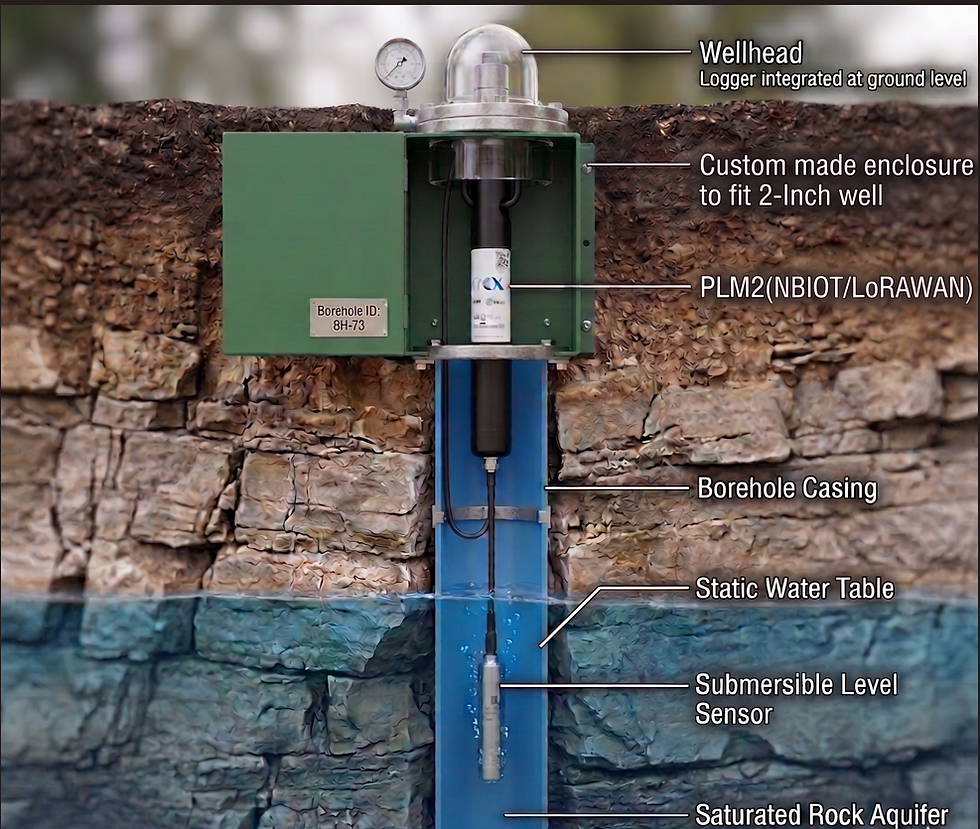
The management of global groundwater resources has evolved from a localized utility function into a critical pillar of environmental sustainability and industrial stability. Groundwater represents a vital source for urban centers, agricultural corridors, and heavy industries, often serving as the primary water source for remote townships and commercial operations. The transition from manual, periodic measurement to automated, real-time monitoring via the Industrial Internet of Things (IIoT) marks a transformative era in hydro-informatics. This report examines the technical, operational, and strategic frameworks required to implement robust borehole monitoring solutions, with a specific focus on the integration of high-precision sensors like the PLM2 series, advanced cellular and LoRaWAN connectivity, and data-driven energy optimization.
The Strategic Importance of Groundwater in Regional Management
Groundwater is one of the world's most essential natural resources, supporting a significant portion of total water usage across diverse geographical regions. Large aquifer systems are foundational to food security and economic health. However, these resources are under increasing strain due to population growth, changing climate patterns, and intensive abstraction.
The difficulty in managing these resources stems from their invisibility. Unlike surface water, aquifers are complex geological formations where water moves through porous rock or fractures. Over-extraction can lead to long-term water table decline, land subsidence, and the degradation of groundwater-dependent ecosystems (GDEs). Furthermore, the slow response times of many groundwater systems mean that unsustainable extraction may not manifest as an observable impact for years, necessitating a proactive monitoring regime rather than reactive crisis management.
Aquifer System Type | Primary Usage | Vulnerability Factors |
Vast Sedimentary Basins | Livestock, Mining, Rural Towns | Immense geography, remote monitoring challenges |
Alluvial Aquifers | Intensive Irrigation | High abstraction rates, surface-water interaction |
Urban Aquifer Systems | Municipal Water Supply | High urban demand, climate-driven recharge decline |
Shallow Karst Formations | Agriculture, Ecosystems | Low seasonal rainfall, rapid level declines |
Effective management requires accurate statistics on abstraction and usage, which have historically been difficult to obtain due to inconsistent reporting and limited monitoring infrastructure. The deployment of automated IoT sensors addresses these gaps by providing high-resolution, continuous data that informs numerical groundwater models and water allocation plans.
Challenges in Borehole Monitoring and Operational Solutions
The deployment of a remote monitoring system is not without significant hurdles. Water authorities overseeing vast territories face logistical, technical, and environmental obstacles that can undermine the success of a monitoring project if not addressed during the design phase.
Sensor Selection and Installation Complexity
The first challenge involves the diversity of borehole configurations. Each site may require a different measurement range—from shallow aquifers near the surface to deep production bores hundreds of meters down. An undersized pressure range will lead to sensor saturation, while an oversized range will sacrifice accuracy at low levels.
Proper placement is also a critical factor. Sensors must be positioned deep enough to capture fluctuations but high enough to avoid the accumulation of silt or debris at the bottom of the bore. In bores with high-capacity pumps, the sensor must be shielded from the turbulence and electrical interference generated by the motor.
Data Connectivity in Remote Landscapes
Underground bores are frequently located in isolated areas with limited or no cellular reception. Traditional wireless technologies like Wi-Fi or standard 4G (LTE) are often insufficient for underground or remote applications due to high power consumption and poor signal penetration. To overcome these issues, the PLM2 series utilizes Low-Power Wide-Area Network (LPWAN) technologies.
LPWAN Architectures: Cellular vs. LoRaWAN
Modern LPWAN technologies ensure longevity and compatibility with future infrastructure. The choice between cellular (PLM2-N) and LoRaWAN (PLM2-L) depends on the specific operational requirements and existing infrastructure.
Licensed Cellular: NB-IoT and LTE-Cat M1
NB-IoT and LTE-Cat M1 are cellular technologies standardized by 3GPP that operate on licensed spectrum.
LTE-Cat M1 (LTE-M): Offers medium data rates (up to 1 Mbps) and supports mobility, making it suitable for near real-time monitoring and assets that move.
NB-IoT: Optimized for stationary sensors that transmit small amounts of data. Its primary advantage is a 20 dB link budget improvement, reaching deep into underground wells and challenging indoor environments.
Unlicensed Autonomy: LoRaWAN
LoRaWAN is an open, unlicensed networking protocol ideal for building private, low-cost networks.
Private Network Capability: Organizations can deploy their own gateways and become their own network operators, eliminating monthly SIM fees and ensuring data sovereignty.
Superior Penetration: LoRaWAN’s sub-GHz signals excel at passing through concrete and underground structures.
Battery Longevity: Because the protocol is asynchronous (devices only "wake up" to transmit), sensors like the PLM2-L can achieve a battery life of 10+ years.
Feature | Cellular (PLM2-N) | LoRaWAN (PLM2-L) |
Spectrum | Licensed (Operator required) | Unlicensed (Private/Public) |
Network Type | Public/Operator Managed | Private or Public Managed |
Sub-Surface Reach | High (NB-IoT +20dB) | High (Sub-GHz penetration) |
Mobility | Full Support (Cat-M1) | Limited Support |
Control/Costs | Monthly Subscription | Ownership of infrastructure, No fees |
Engineering and Material Science in the PLM2 Design
To overcome these challenges, Ellenex proposed the one and only PLM2-N: Submersible Miniature Level Sensor which is a customized variant of the PLS2-N: Submersible Level Sensor – Standard Model. The PLM2-N was capable of measuring the level of several different bores. Each deployed device had a different measurement range and cable length. The device was housed with a narrow-body C-type enclosure that allowed it to be inserted into multiple bores. The Water Authority provided the SIMs based on which the device network settings were configured to transmit data at regular intervals via LTE-CAT M1 to the Ellenex Software Platform, from which a RESTful API was used to extract the data to Water Authority Platform.
Sensors deployed in underground bores must be engineered for extreme durability. While standard industrial models are often constructed from Stainless Steel (SS316L) for compatibility with clean water, diesel, and light oils, borehole environments often present specific challenges, including spatial constraints and narrow physical dimensions.
The PLM2 series was specifically developed as a "miniature" level sensor to address these spatial limitations. With a sensor head diameter of only 15.8mm, the PLM2 can be inserted into narrow observation wells or bores that are already crowded with pumping equipment and electrical lines. This series includes two primary communication variants:
Sensor Series | Form Factor | Specialty Feature | Target Media |
PLS2-N/L | Standard Submersible | High Accuracy, Ultra-Low Power | Clean Water, Oil |
PLM2-N/L | Miniature (15.8mm) | Narrow Bore Entry | Groundwater |
PLC2-N/L | Corrosion Resistant | Chemical Compatibility | Wastewater, Acid |
PLD2-N/L | Multi-Parameter | Level + Temperature | Thermal/Geothermal |
PLV3-N/L | Floating Head | Surface Water Stability | Dams, Reservoirs |
The PLM2 series maintains a high typical accuracy of ±0.25% Span and is designed for long-term durable performance in harsh environments with an IP68-rated sensor head. Beyond the sensor itself, the choice of cable material (such as PUR or PE) is vital for ensuring longevity. Cable lengths must be carefully selected to match the maximum expected drawdown of the aquifer.
Case Study Analysis: Regional Water Authority Deployment
A real-life implementation by a regional water authority provides a blueprint for successful bore monitoring. The authority faced challenges including diverse bore depths and high manual inspection costs.
Implementation Strategy
The authority deployed a fleet of PLM2 miniature level sensors. Depending on local connectivity, the PLM2-N (Cellular) or PLM2-L (LoRaWAN) can be utilized. The choice of the miniature enclosure allowed the sensors to be installed alongside existing production pumps without requiring expensive well modifications.
Results
The authority utilized a RESTful API to pull data directly into its proprietary platform, allowing the operations team to:
Visualize Real-Time Trends: Monitoring the dynamic response of the aquifer to pumping loads.
Optimize Allocation: Adjusting abstraction rates across different bores to ensure equitable distribution.
Plan for Sustainability: Accurate historical data enabled the modeling of groundwater recharge initiatives.

Conclusions and Practical Recommendations
At Ellenex, we are committed to pushing the boundaries of technology to provide innovative solutions for the ever-evolving industrial landscape. Our high-performance PLM2-N for outdoor applications exemplifies this commitment. By eliminating uncertainties and inefficiencies, our solution empowers industries like this water Authority to optimize their operations and make data-driven decisions.
This Water Authority's use case demonstrates the immense value of measuring water levels in underground bores for effective water resource management. By implementing advanced monitoring technologies and utilizing data analysis, they optimize water allocation, plan groundwater recharge initiatives, and safeguard the health of groundwater ecosystems. This case study serves as an inspiring example of how accurate and timely data collection, coupled with informed decision-making, can lead to sustainable water management practices, ensuring the availability of this vital resource for future generations.
The implementation of the PLM2 series and LPWAN connectivity addresses the fundamental challenges of groundwater management.
Precision: The 15.8mm narrow sensor head ensures data collection in constrained environments.
Efficiency: Automated monitoring and VFD integration capture energy savings of up to 50%.
Connectivity Choice: Organizations can choose between reliable licensed cellular (PLM2-N) or autonomous private LoRaWAN (PLM2-L) based on their remote landscape requirements.
Strategic Intelligence: APIs and MQTT protocols empower authorities to transition to proactive, data-driven resource planning.
Organizations seeking to optimize water resource management should adopt modular sensors like the PLM2, invest in LPWAN connectivity, and leverage API-driven architectures to eliminate data silos.
Frequently Asked Questions
Why is the narrow diameter of a Miniature level sensor [PLM2-N or PLM2-L] critical for borehole monitoring?
Boreholes and monitoring wells are characterized by extremely restricted diameters, often requiring instrumentation that can fit within a space smaller than 1 inch. Standard level probes are often too bulky for these specialized applications, particularly in geotechnical investigations where access is limited to small-diameter piezometers or where well casings are already crowded with other equipment.
A Miniature level sensor [PLM2-N] or Miniature level sensor [PLM2-L] features a narrow 15.8mm diameter head specifically engineered to navigate these tight tolerances. This slim profile allows the sensor to be lowered deep into narrow openings and follow curves in the underground tubing without getting stuck, making it ideal for retrofitting monitoring capabilities into existing industrial or environmental infrastructure.
How does a hydrostatic Miniature level sensor [PLM2-N or PLM2-L] calculate water depth underground?
These devices operate on the principle of hydrostatic pressure, measuring the weight of the water column resting above the sensor's diaphragm. The sensor continuously detects this pressure and converts the readings into standard units like meters or feet of water to show the exact depth. This method is favored for its convenience and ability to provide continuous, high-resolution data on the status of a groundwater resource.
To ensure the data remains accurate, the system must compensate for changes in atmospheric pressure, which could otherwise distort the level readings. A Miniature level sensor [PLM2-N] or Miniature level sensor [PLM2-L] is typically configured with either a vented gauge system or a secondary barometric sensor to isolate the actual water level fluctuations from surface weather changes.
Should I choose a cellular or LoRaWAN Miniature level sensor for my remote monitoring site?
The decision depends on your existing infrastructure and whether you require a managed or private network. A Miniature level sensor [PLM2-N] utilizes licensed cellular networks such as NB-IoT or LTE-Cat M1, which are maintained by major telecommunications providers. These cellular options offer superior signal penetration into underground wells and are ideal for sites within regional or urban coverage areas where high reliability is needed without managing your own network hardware.
In contrast, a Miniature level sensor [PLM2-L] uses LoRaWAN technology, an open protocol perfect for building private, autonomous networks in areas where cellular reception is unavailable. Because LoRaWAN operates on an unlicensed spectrum, organizations can deploy their own gateways to eliminate monthly subscription fees and maintain total data sovereignty. This option is particularly efficient for long-term, ultra-low power applications, with batteries often lasting over a decade.
How can a Miniature level sensor [PLM2-N or PLM2-L] help reduce the operational costs of a water utility?
By providing real-time level data, these sensors enable the optimization of pumping systems through the use of Variable Frequency Drives (VFDs). Traditional pumps often run at a fixed speed regardless of actual demand, wasting significant energy and causing mechanical wear. When integrated with a Miniature level sensor [PLM2-N] or Miniature level sensor [PLM2-L], a VFD can automatically adjust the pump speed to match the sustainable yield of the borehole or the specific demand of a reservoir.
The physical principles of the Affinity Laws mean that reducing pump speed can lead to exponential energy savings, often cutting electricity costs by 30% to 50%. Furthermore, these systems facilitate "soft starts," which eliminate the mechanical shock and high inrush currents that typically damage motor windings and shorten the lifespan of the pump.
What makes a Miniature level sensor [PLM2-N or PLM2-L] suitable for long-term deployment in harsh underground environments?
These devices are engineered for high durability, featuring IP68-rated submersible sensor heads and rugged enclosures designed to withstand industrial-grade pressure and exposure to various liquids. Their construction from materials like stainless steel ensures compatibility with groundwater and a range of non-corrosive industrial fluids.
Beyond physical toughness, the sensors are designed for extreme energy efficiency, utilizing ultra-low-power electronics that allow them to operate for up to 10 years on a single internal battery. This long-term autonomy is essential for "set-and-forget" installations in remote or difficult-to-access boreholes, significantly reducing the labor costs and logistical challenges associated with manual site inspections and frequent maintenance visits.
Useful Links
Miniature Level Sensor: PLM2-N and PLM2-L


