

Hydronic System Pressure Monitoring Turns Make-Up Water Into a Warning Sign


Key Takeaways
Treat make-up water as a signal. A sealed loop that keeps asking for top-ups is losing water somewhere, and the pressure trend shows it long before a comfort complaint does.
Learn the loop's own baseline first. Cold-fill pressure, the climb as the water warms and the settle after a pump change describe a healthy loop; every alert is a judgment against that picture.
Place sensors where they answer a question. Pump discharge, the vessel connection and either side of a strainer each tell a different part of the story.
Budget the readings. Battery capacity is rated in readings and transmissions, so the reporting interval is a design decision rather than a default.
Choose the route by site spread. LoRaWAN through a private gateway suits a dense campus or a cluster of plant rooms, while NB-IoT/LTE-M suits boiler houses scattered across a district.
A Closed Loop Should Never Ask for Water
A sealed heating or chilled water circuit is designed to hold the same fluid for years, which is why hydronic system pressure monitoring starts from a simple premise: any water the loop asks for needs an explanation. When pressure sags and an automatic filler quietly tops it up, the gauge on the wall looks fine while the real story, whether a weeping joint, a tired expansion vessel or a pump pulling air, goes unrecorded.
Most plant rooms are still checked by a technician reading a dial during a walk-round. That catches the loop in the one minute of the week the engineer is standing there, and it misses everything that happens overnight, over a weekend or during the changeover between heating and cooling seasons.
Ellenex addresses this with a battery-powered transmitter that threads onto an existing tapping, records pressure and a built-in temperature reading, and reports over LoRaWAN or cellular. The approach is described on the Pressure Monitoring in Heating and Cooling Systems solution page, and it applies to hydronic heating loops, chilled water circuits, boiler and chiller plants, circulating pumps, heat exchangers, balance valves, strainer baskets and closed-loop cooling towers.
This guide covers what goes wrong without monitoring, how a reading travels from the pipe to the dashboard and how to choose between the two connectivity routes. It sits alongside earlier Ellenex material on heating system efficiency and chiller pressure, and it concentrates on the sealed-loop behavior those posts leave aside.
Slow Losses That Warm Buildings and Wear Plant
Water lost a little at a time. A weeping flange or a pinhole in a coil never makes a puddle worth reporting, yet the loop keeps drawing replacement water, and each top-up carries fresh oxygen and minerals into the system.
Treatment chemistry diluted without notice. Corrosion inhibitors and glycol are mixed for a given volume of fluid, so repeated fresh make-up thins them out and the protection fades while the loop still looks normal.
Pumps working against air. Low pressure at a pump inlet invites air, noise and cavitation, and a pump that runs rough for weeks will fail sooner than one that never sees it.
Relief valves that lift. A waterlogged or undercharged vessel lets pressure climb with temperature until the relief valve discharges, wasting water and leaving a stain nobody connects to its cause.
Complaints as the first alarm. When a branch loses flow or an air pocket blocks a coil, the first sign is an occupant's phone call, and by then the fault has been developing for days.
Why Hydronic Loops Keep Their Troubles Quiet
Pressure moves for harmless reasons. Heating a fixed volume of water raises pressure and cooling lowers it, so one reading means little without knowing the loop's temperature and the time of day.
Plant rooms are out of sight. Boilers, chillers and pumps sit in basements, roof plant areas and service tunnels, visited on a schedule rather than on demand.
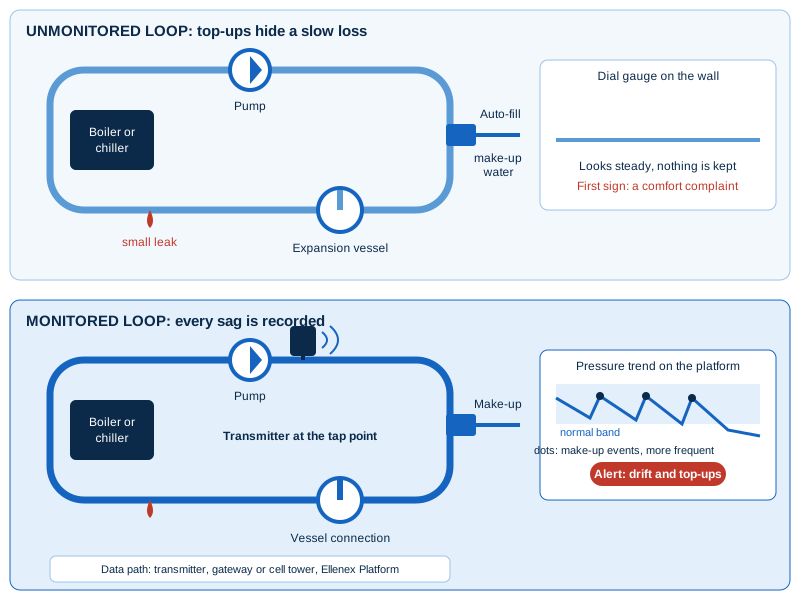
Automatic fillers hide losses. A make-up valve keeps the gauge steady, which is exactly what it is built to do, so the symptom disappears while the cause carries on.
Dial gauges keep no history. A mechanical gauge shows the present moment and leaves nothing to compare against last week or last winter.
Estates are spread out. A campus, a district energy scheme or a property portfolio means many loops and few people to read them.
Cabling is slow to add. Running wire through finished buildings to reach a controller is disruptive, so many loops never receive a permanent sensor.
Hydronic System Pressure Monitoring, Traced From the Expansion Vessel Outward
The explanation below follows one loop from its cushion of gas to the platform that keeps its history. Each step ties to a choice made when specifying or installing a sensor. Battery capacity and the two connectivity families get only a short recap here, because the hydraulic circuit post and the LPWAN technology comparison cover them in more depth.
The Cold-Fill Baseline and the Cushion Behind It
A pressurized loop is charged cold to a set pressure, and an expansion vessel with a gas cushion absorbs the extra volume when the water heats. That cushion is why pressure rises gently as the loop warms and falls back as it cools. A healthy loop therefore draws a repeatable curve: a resting level when cold, a modest climb when warm and a quick settle after the pump changes speed. Monitoring begins by recording that curve over a few operating cycles, because every later alert is a judgment about departure from it.
A Gauge-Type Element Listening at the Pipe Tapping
The Ellenex transmitter senses pressure with a stainless steel diaphragm behind a threaded process port that screws into an existing tapping. For a pressurized loop the reference matters, since the transmitter family offers vented gauge, sealed gauge and absolute references. A sealed reference is the usual general-practice match for a closed circuit, though the right choice for a given tapping is worth confirming with Ellenex alongside the port thread and pressure range for the loop's height and pump duty.
Choosing Where a Sensor Earns Its Place
General practice puts one transmitter at the pump discharge, where pressure shows pump behavior, and a second near the expansion vessel connection, where it shows the loop's static state. Adding a transmitter on each side of a strainer lets you plot the two readings together, and a widening gap points to a clogged basket. Sensors on remote branches reveal which leg is starved when a zone loses heat. These placements are industry habits rather than Ellenex procedures, and the right set depends on which pressure points your loop already exposes.
A Temperature Reading That Rides Along
Each transmitter also carries a built-in temperature sensor. The datasheets note that this sensor sits behind the pressure element, so it reflects the temperature of the device rather than of the water itself. Treat it as context for interpreting a pressure swing, such as whether the loop was warm or cold at the time, and not as a replacement for a dedicated fluid temperature probe.
Reading Often Enough Without Keeping the Radio Busy
The transmitter sleeps between readings, wakes to measure and then sends according to its configuration. The LoRaWAN version supports periodic and event-triggered sampling, and sampling and transmission intervals can be changed remotely, so a relaxed routine interval can be tightened during commissioning or a suspected fault. Loop pressure drifts slowly most of the day and moves sharply at pump starts and refills, so a moderate routine interval combined with an event trigger captures both behaviors.
Two Ways Off the Plant Room Floor
The LoRaWAN version talks to an Ellenex outdoor gateway, which forwards readings through a network server to the platform. One gateway can serve many plant rooms across a campus or a dense urban block, and a private network avoids per-device airtime fees. The cellular version uses NB-IoT or LTE-M to reach the public network directly, so no gateway is required, which suits boiler houses scattered across a district. Payloads are encrypted on both routes. Background on each technology is on the Ellenex pages about LPWAN, LoRaWAN and NB-IoT and LTE-M.
What the Platform Does Once Readings Land
The Ellenex platform stores the history, draws trend charts, applies high and low thresholds and sends alerts by SMS, email and app notification. It supports device inventory, role-based access for several teams, white-label branding, data export and an open API with webhooks for connecting to a building management or SCADA system. Access is through a browser or the Ellenex mobile app, and the full feature set is described on the Ellenex software platform page and at ellenex.net.
Plant Rooms That Report on Themselves
Rounds become exceptions. Engineers open a dashboard instead of walking every basement and visit a plant room when its trend asks for it.
Top-ups become visible events. Each pressure dip and recovery lands on a chart, so a loop that needs frequent filling stands out in a fleet view.
Alerts arrive with context. A threshold breach comes with the curve that preceded it, which helps a technician decide whether to bring tools, a spare vessel or nothing at all.
Commissioning leaves a record. The first weeks of readings document how a new or refurbished loop behaves, which gives later faults something concrete to be compared against.
Seasonal changeover gets watched. The switch between heating and cooling, when valves move and air can enter, is exactly when pressure behaves unusually, and now it is recorded.
Several teams see one picture. Facilities staff, a controls contractor and a mechanical service company can each have their own view without sharing a login.
Reckoning the Payoff for a Heating and Cooling Estate
Savings differ from one estate to the next, so they are described here in general terms. The financial case for IoT implementation page shows how to build the numbers for your own sites.
Fewer Rounds Through Warm, Noisy Plant Rooms
Routine dial-reading trips shrink to the visits a trend actually justifies. Staff time moves from checking healthy loops to fixing the ones that need attention.
Make-Up Water and Treatment Chemicals Kept in the Loop
Finding a slow leak early means less replacement water and less diluted inhibitor to correct afterward. The loop's chemistry stays closer to what it was designed to be.
Pumps, Boilers and Chillers Spared Pressure Stress
Catching low-pressure operation and relief valve events early reduces the time equipment spends running outside its comfortable range. Fewer hard starts and less air in the circuit are gentler on seals and bearings.
Technicians Kept Away From Hot Pipework
Every visit avoided is one fewer moment beside hot pipes, rooftop edges and cramped service spaces. Remote readings let a person decide whether a visit is needed before climbing the stairs.
Comfort Complaints Answered Before They Arrive
A branch losing flow shows up in its pressure trend ahead of the tenant's call. Fixing it quietly protects comfort and the working relationship with building occupants.
A Light Job to Install
The transmitters are battery-powered and thread onto an existing tapping, so there is no cable run to a controller. A factory-configured unit can be brought into service without special software on site.
Evidence for Retrofit and Efficiency Plans
Months of pressure history show how loops behave through seasons and load changes. That record supports decisions on vessel replacement, pump upgrades and balancing work with data instead of anecdote.
Answering Each Loop Problem With PTD2-L or PTD2-N
The PTD2-L is the LoRaWAN transmitter and the PTD2-N is the cellular one, and both are covered by the heating and cooling solution page. Each heading below pairs a loop problem with the feature that addresses it.
A Pressure Range and Reference Chosen for the Loop
Loops differ in height, pump duty and relief setting, so the transmitter is ordered with a measuring range, reference type and port thread that fit. A range matched to the loop gives a useful resolution on the small swings that matter, rather than a wide range that flattens them.
Stainless Steel Wetted Parts for Treated Water
The pressure body and diaphragm are stainless steel, which suits treated water and compatible liquids and gases. Check any unusual additive with Ellenex before specifying.
Housings for Damp Plant Rooms and Rooftop Pipework
Both the PTD2-L and the PTD2-N are offered in a compact housing or an extended version on a cable, with weather-sealed, UV-protected enclosures. The cable version lets the radio sit away from a hot pipe or in a better signal position.
Battery Capacity Counted in Readings, Not Years
The datasheets rate the battery by how many readings and transmissions it can support, and the real figure for your loop depends on how often the unit measures and sends. A slow routine interval stretches the same battery much further than a fast one, so settle the interval before promising a replacement date. Options such as a high-capacity battery or an external supply with battery backup exist for the extended housing.
Alerts That Reach the Duty Engineer
Thresholds are set on the platform and can be edited remotely, with alerts through SMS, email and app notification. A first band can be loose and then tightened as the loop's baseline becomes clear.
A Private Gateway or the Cellular Network, Chosen by Site Spread
For plant rooms clustered on one campus, the PTD2-L with a private Ellenex gateway keeps running costs low and coverage under your control. For boiler houses scattered across a district, the PTD2-N connects straight to the cellular network and avoids gateway planning entirely, with a carrier data plan behind it.
The Ellenex Loop Package: Mechanism and Outcome
Mechanism: a battery-powered transmitter with a stainless steel sensing element threads onto an existing tapping and records pressure plus a built-in temperature reading at an interval you choose.
Mechanism: readings travel by LoRaWAN through a private gateway, or by NB-IoT/LTE-M straight to the cellular network, with encrypted payloads, into the Ellenex platform.
Outcome: thresholds and trends turn slow water loss, vessel trouble and pump distress into alerts instead of surprises.
Outcome: stored history supports maintenance planning and efficiency conversations backed by evidence.
Configuration Choices for a Loop Sensor, Said Plainly
Ordering a transmitter involves a handful of decisions, all of which can be described without codes. A short brief to Ellenex covering the points below is usually enough to get a recommendation.
Pressure range: pick a span that comfortably covers the loop's static pressure, the extra from the pump and the relief valve setting, without being so wide that small movements disappear.
Reference type: vented, sealed and absolute options exist, and a closed loop commonly suits a sealed reference.
Process port: several standard threads are available, so match the tapping already on the pipe.
Housing: a compact housing mounts the radio on the sensor, while the extended housing moves it to a cable-connected enclosure for hot pipes or poor signal spots.
Activation and antenna: an on/off switch helps with storage and commissioning, and an internal or external antenna can be chosen to suit the plant room.
Power: a replaceable battery is standard, and the extended housing can take an external supply with backup or a high-capacity battery.
Connectivity: LoRaWAN where a private gateway makes sense, cellular where sites are scattered.
From Plant Room to Building Management System: How the Pieces Connect
A deployment has four layers. At the pipe, the transmitter measures and decides what to send. Between the pipe and the cloud, a LoRaWAN gateway and network server, or the cellular network, carries the readings. In the cloud, the Ellenex platform stores them, draws trends and raises alerts. At the edge of the platform, an open API and webhooks pass data to a building management or SCADA system that already runs the loop.
That separation matters in practice. The sensing layer does not need to know which building system will consume the data, and the building system does not need to know which radio the sensor uses, so either side can change without redoing the other.
A Building Whose Loops Raise Their Own Hand
A property with hydronic loops monitored this way stops depending on luck and on dial-reading rounds. Loops report their own pressure history, top-ups stand out as events, and the first conversation about a fault takes place with a chart on the screen. The people who maintain the plant spend their time on the loops that need it, and the people who occupy the building notice fewer problems.
Frequently Asked Questions
Why does loop pressure climb when the system warms up and fall when it cools?
Water expands as it warms, and the expansion vessel's gas cushion compresses to take the extra volume, which raises the pressure a little. When the loop cools the volume shrinks and the cushion pushes back. A steady, repeatable swing like this is normal.
What deserves attention is a change in the swing itself: a lower resting level, a bigger climb or a slower return. Those changes mean something about the loop has shifted, such as a leak or a vessel losing charge.
Does a falling pressure always mean the loop has a leak?
Not always. Air leaving solution, a vessel losing its cushion, a closed valve isolating a section or a temperature change can all lower the reading. A leak is more likely when pressure keeps falling across several comparable cycles and make-up water events become more frequent.
Compare the trend with the temperature and with any maintenance activity logged around that time. If the pattern persists after those explanations are ruled out, a physical inspection is justified.
Can pressure readings alone show that an expansion vessel has lost its air charge?
They can point toward it. A vessel that has lost its cushion tends to produce a larger and faster pressure swing as the loop heats and cools, and it may push the loop toward the relief setting. A very small cushion also shows in how quickly pressure falls back.
Pressure data cannot prove the diagnosis. A technician still needs to check the vessel's charge, but the trend tells you which vessel to visit first.
How should I set the first alert band on a loop I have not logged before?
Start generously. Set a low threshold comfortably below the lowest level the loop has shown and a high threshold comfortably below the relief setting, then watch several operating cycles on the platform.
Once the baseline is clear, tighten the bands to sit just outside normal behavior. Thresholds can be edited remotely, so refining them takes minutes and does not require a visit.
Does hot water or glycol shorten the life of a transmitter on the loop?
The wetted parts are stainless steel, which suits treated water and compatible liquids, and the datasheets specify compensated temperature ranges. Unusual additives or very hot service should be discussed with Ellenex before ordering.
General practice on hot lines is to use a siphon or short impulse line so the electronics sit away from the hottest pipe surface. The extended housing, with its cable-connected enclosure, also helps here.
What does the temperature reading on the transmitter actually represent?
It reports the temperature of the sensor body, since the temperature sensor sits behind the pressure element. It follows the water temperature loosely, but it lags and it can be influenced by ambient conditions around the pipe.
Use it as context, for example to tell whether a pressure change happened while the loop was warm or cold, and fit a dedicated fluid temperature probe where the exact water temperature matters.
Is one sensor per loop enough, or does each pump and strainer need its own?
One transmitter at the pump discharge is a sound starting point and already reveals most make-up and pressure trends. It cannot tell you where along the loop a restriction sits.
Adding transmitters on each side of a strainer, or on a remote branch, answers location questions. Many teams begin with a single sensor per loop and add points where the first trends raise questions.
Related Reading
Embracing Cleaner Heating Systems: how monitoring supports efficiency in heating plant.
Pressure's On! How Pressure Sensors Keep Chillers in Check for Building Comfort: the cooling-side view of pressure monitoring in building plant.
Why the Next Generation of BMS Needs Smarter Differential Pressure Sensors (PDT2): how wireless pressure data feeds a building management system.
An Igniting Success: LoRaWAN Boiler Pressure & Temperature Monitoring System: an earlier look at wireless boiler monitoring.
Useful Links
Talk to Ellenex
A plant schematic and a short list of the loops that worry you most are enough to begin. Send both through the Ellenex sales inquiry page and the team will reply with a suggested transmitter, connectivity route and first alert setup. If the same buildings form part of a wider infrastructure monitoring plan, mention that too.


