

Hydraulic System Pressure Monitoring: Read the Spikes Before the Pump Fails


Key Takeaways
Read the pressure at the line, not at the gauge on the wall. A transmitter on the working port records spikes, sags and slow drift that a walk-round with a dial gauge will never catch.
Watch the shape, not just the number. Pump wear, aeration and valve trouble each change how pressure rises, holds and falls, so a trend over weeks says more than any single reading.
Treat sampling as a budget. Battery capacity is rated in readings and transmissions, so the reporting interval you choose decides how long a unit can run unattended.
Let alerts do the watching. Configurable high and low thresholds turn a quiet circuit into a work order only when something actually moves.
Choose the route to match the fleet. LoRaWAN through a private gateway suits dense plant areas, while NB-IoT/LTE-M suits machines spread across sites with no gateway at all.
Heat, Contamination, Cavitation: Three Wear Drivers That Show Up in Pressure
Three things shorten the life of a hydraulic pump more than any others: heat, dirty oil and cavitation. Each one leaves a trace in line pressure long before a pump seizes or a seal lets go. Hydraulic system pressure monitoring turns those traces into a record that a maintenance team can read, compare and act on, instead of a surprise that arrives with a stopped machine.
Ellenex builds this around a battery-powered pressure transmitter that threads straight onto the circuit and reports over LoRaWAN or cellular. The approach is described on the Remote Hydraulic Systems Performance Monitoring solution page, and it fits hydraulic power units, press lines, mobile plant and valve actuation alike.
The difficulty is that most hydraulic circuits are monitored, if at all, by a local gauge and the operator's ears. A gauge shows what pressure is at the moment someone looks. It says nothing about the dip that happens every time a load lands, the spike that follows a fast valve closure, or the slow sag that develops across a season of heavy use.
This article follows a pressure reading from the port to the dashboard and explains what it can reveal about a pump and its circuit. For the broader picture of tuning hydraulic and pneumatic equipment, our earlier post on performance tuning of hydraulic and pneumatic systems is a useful companion. Here the focus is on remote, continuous visibility and what it does for maintenance planning.
Unplanned Stops and Slow Damage: The Price of Flying Blind
When nobody sees the pressure curve, problems tend to surface in one of a few expensive ways. These examples are general patterns rather than any particular site.
A pump that wears out quietly. Internal leakage grows gradually, the circuit takes longer to build pressure, and the first symptom is often a machine that feels slow rather than one that fails.
Spikes that fatigue components. Fast valve closures and sudden load changes send pressure peaks through hoses, fittings and seals, and the damage accumulates with every cycle.
Cavitation that destroys a pump from the inside. Air or vapor in the supply side causes erratic pressure and noisy running, and a pump can lose much of its life before anyone connects the noise to a cause.
Overheated oil that ages seals and fluid. Pressure that sags as oil thins out is a clue to heat, yet a gauge reading taken once a shift will rarely show it.
Stoppages found at the worst moment. A press line or machine that fails mid-shift costs production time, rushed repairs and sometimes spoiled work.
Hydraulic Circuits Are Fast, Hot, Sealed and Often Far Away
Hydraulic equipment resists easy measurement for reasons that have little to do with the sensor itself. Six practical obstacles come up again and again.
Events are fast. A pressure spike can rise and fall in a fraction of a second, so a slow check or a rarely reporting sensor can miss exactly what matters.
The fluid is sealed in. Oil sits behind steel, hoses and fittings, so the only honest way to see its pressure is through a port on the circuit.
Conditions are harsh. Vibration, heat, oil mist, dust and washdown surround most power units, which is hard on delicate electronics and cabling.
Machines are spread out. Mobile plant, remote pumping stations and equipment on distant sites are not places where a technician can read a gauge every day.
Wiring is costly. Running cable to a control cabinet for every pressure point is slow, disruptive and often impractical on equipment that already exists.
Data rarely reaches maintenance. Even where a wired transmitter exists, its signal often stays inside a machine controller and never becomes a trend anyone reviews.
Hydraulic System Pressure Monitoring From Port to Platform, Layer by Layer
Hydraulic system pressure monitoring works by placing a transmitter on the circuit, reading pressure on a schedule, and sending what it finds to a platform where trends and alerts live. The sections below follow that chain in order.
Port Pressure: What the Transducer Actually Feels
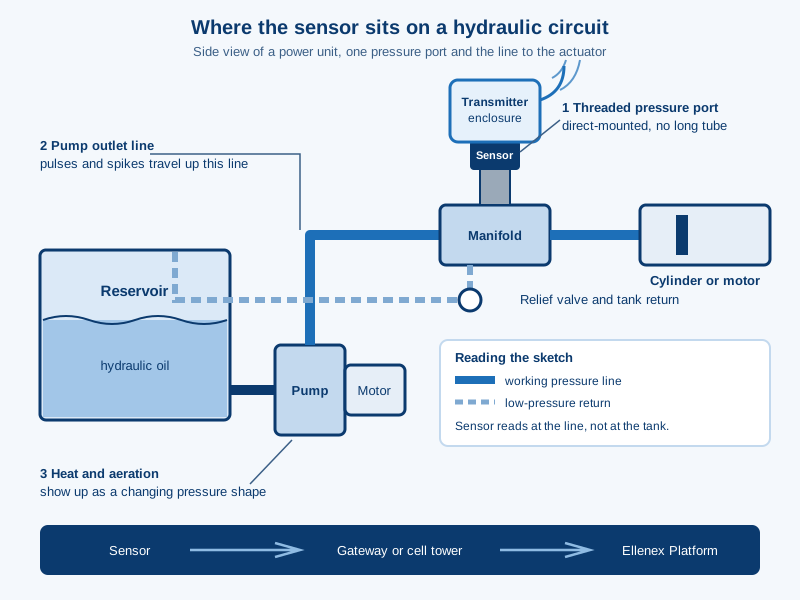
A pressure transmitter has a stainless steel wetted surface that flexes slightly under fluid pressure, and that tiny movement is converted into an electrical signal. On a hydraulic circuit the best place to read is a threaded port on the line or manifold, because the transmitter then sees the same pressure the actuators see. The Ellenex transmitters are designed to thread directly onto the port, which keeps the connection short and avoids long tubing that can smooth out the very events you want to catch.
Choosing the Pressure Reference for a Closed Circuit
Pressure is always measured against a reference. The Ellenex PTS2 family offers vented gauge, sealed gauge and absolute references, and the choice depends on the application. As general practice, a closed hydraulic circuit working at high pressure makes ambient swings a small part of the reading, but the reference still decides how the zero behaves. Confirm the option with Ellenex when you specify a unit rather than assuming a default.
Sampling Interval and Alert Thresholds: Two Dials, Both Remote
Two settings shape what a transmitter tells you. The sampling interval decides how often it reads, and the thresholds decide when a reading becomes an alert. Both are configurable, so a unit on a steady power pack can read gently while one on a duty-cycle-heavy press can be tuned to look closer. Tightening either costs battery, which is why the plan should start from the failures you most want to catch.
What a Reading Looks Like Over Time
A single reading is a snapshot, but a series of readings becomes a signature. A healthy circuit builds pressure in a consistent way and holds it steady under load. As a pump wears, the same circuit can take longer to reach working pressure or sag more under load. Aeration tends to show up as erratic readings, and heat as pressure that drifts across a shift. The Platform stores these readings so that last month's normal can be compared with this week's behavior.
Two Routes Out of the Machine Bay
Readings leave the transmitter by one of two routes. The LoRaWAN variant, the PTS2-L, sends to an Ellenex gateway, which passes data on through a network server to the Platform. The cellular variant, the PTS2-N, uses NB-IoT or LTE-M and talks straight to the carrier tower with no gateway at all. If you want a refresher on the radio technologies themselves, our knowledge centre pages on LPWAN, LoRaWAN and NB-IoT and LTE-M cover them in plain terms.
What the Platform Does With the Trend
Once readings arrive, the Ellenex Platform shows them on dashboards, applies threshold alerts, keeps device management in one place and stores history for later analysis. Data can be exported or passed to other systems through an API, including SCADA and ERP tools. Teams can work in a browser at ellenex.net or on the Ellenex mobile app, with role-based access so each person sees what their job needs. Communication between device and Platform is encrypted.
Maintenance Moves From the Calendar to the Curve
Once a circuit reports its own pressure, the weekly rhythm of a maintenance team begins to change. Several shifts tend to follow.
Inspection becomes exception-based. Instead of visiting every power unit on a rota, a team looks first at the units whose curves have changed.
Baselines replace guesswork. Each machine builds its own record of normal, so a slow drift stands out against that machine's own history rather than a generic expectation.
Spikes get names and times. A pressure peak that coincides with a particular operation or shift becomes something you can discuss and fix.
Component swaps follow evidence. Pumps, seals and hoses are replaced when the data says they are tiring, not simply because the calendar says so.
Remote units stop being blind spots. Equipment on distant sites reports to the same screen as the machines in the main yard.
Conversations get shorter. Operators, maintenance and managers all look at the same trend, which makes the case for a repair or a replacement much easier to make.
What Earlier Warning Is Worth on a Hydraulic Fleet
The return on remote pressure monitoring is easiest to see in the work that stops happening and the failures that stop being surprises. The points below are general descriptions, and the financial framework behind them is set out on the financial case for IoT implementation page.
Fewer Gauge Walks Through Noisy Plant Rooms
Reading a gauge means a person standing next to a running power unit. A transmitter that reports on its own removes many of those visits, especially for equipment on remote or hard-to-reach sites.
Oil, Seals and Hoses Replaced on Evidence
When pressure behavior shows where wear is heading, consumables can be changed at a sensible time rather than too early or too late. Both extremes cost money, and data is what tells them apart.
Pumps and Motors Spared Repeated Abuse
A pump running through cavitation or against a relief valve that opens too often is being damaged every minute. Spotting that pattern early protects one of the most expensive parts of the circuit.
Technicians Kept Clear of Pressurized Lines
Every visit to a live hydraulic circuit carries some risk, from hot oil to stored energy in lines. Fewer visits mean fewer exposures, and a reading taken remotely puts nobody near a fitting.
Downtime Booked Rather Than Suffered
A repair planned for a quiet period costs far less than the same repair forced on a busy shift. Trend data gives the maintenance team the notice it needs to book the work.
Fitting to Ports Already on the Machine
Because the transmitters thread directly onto a port and run on battery power with no cabling, they suit equipment that is already installed. There is no need to open a control cabinet or run new wiring.
Data for Fleet and Replacement Decisions
Months of pressure history across a fleet show which machines work hardest and which are approaching the end of their useful life. That evidence supports a budget conversation far better than anecdote.
Putting PTS2-L and PTS2-N to Work on Hydraulic Problems
Each challenge above has a matching answer in the Ellenex range. The PTS2-L is the LoRaWAN variant and the PTS2-N is the NB-IoT/LTE-M variant, and they are built to the same idea with different ways of reaching the Platform.
Stainless Steel Wetted Parts for the Pressure Port
Both variants use stainless steel in contact with the fluid and thread directly onto the circuit. They suit liquids and gases that are compatible with stainless steel, so check the fluid in your system before specifying. The PTS2-L and PTS2-N product pages list the process connection options.
Weather-Sealed, UV-Protected Housings
The transmitter sits in a weather-sealed enclosure that is protected against UV, which suits outdoor equipment and washdown areas.
Battery Planning Around Readings, Not Calendar Years
The built-in lithium battery is replaceable and its capacity is rated in readings and transmissions. A transmitter that reads often and reports every reading will use that allowance faster than one that reads gently and sends only what matters. Plan the interval around the failure you want to catch, then let the Platform's history show whether it is working.
Thresholds You Can Change Without a Panel Visit
High and low alert thresholds are configurable, and the Platform delivers alerts to the right people. If a circuit's normal behavior changes, the thresholds can follow it without a trip to open an enclosure.
Choosing Between a Private Gateway and the Cellular Tower
For power units clustered on one site, a private LoRaWAN gateway with PTS2-L transmitters keeps everything on your own network with no per-device carrier fees. For machines scattered across sites or regions, PTS2-N reports directly over NB-IoT or LTE-M, and no gateway is needed. NB-IoT suits static equipment, while LTE-M also suits equipment that moves.
Solution Snapshot: Ellenex Hydraulic Monitoring, Mechanism and Outcome
Mechanism: a battery-powered stainless steel pressure transmitter threads onto the hydraulic circuit, reads on a configurable schedule and sends readings over LoRaWAN through a gateway or over NB-IoT/LTE-M directly to the tower.
Mechanism: the Ellenex Platform stores readings, shows trends, applies threshold alerts and passes data to other systems through an API.
Outcome: continuous line pressure tracking, a view of pump efficiency over time and early warning of cavitation, all without cabling or software on site.
Outcome: maintenance that follows the pressure curve, so planned work replaces emergency stops.
Port, Adapter, Orientation: Mounting Habits for High-Pressure Lines
The notes below are general industry practice for fitting pressure instruments to hydraulic circuits, not Ellenex procedures. Always follow the equipment maker's guidance and your own site safety rules.
Depressurize and isolate first. Never fit or remove an instrument on a live line, and make sure stored energy in accumulators is released.
Use a clean, correct port. Check the thread type, clean the port and use the sealing method the thread calls for.
Consider a snubber or restrictor where spikes are severe. Protecting the element from violent transients can extend its life, but remember that heavy damping hides the events you may want to see.
Mount where the reading is representative. A port close to the pump outlet or the actuator side tells different stories, so pick the point that answers your question.
Keep the enclosure clear of heat and spray. Where possible, position the transmitter away from hot surfaces and direct jets of oil or water, and leave room for the antenna.
Record what you fitted. Note the port, the date and the settings so later readings can be interpreted correctly.
Reading the Curve: Common Misreadings of Hydraulic Pressure Data
Even good data can mislead if it is read without context. Watch for these common mistakes.
Blaming the pump for a sensor-placement effect. A reading taken downstream of a restriction can look very different from one at the pump outlet.
Treating one spike as a trend. A single peak during a known event is not the same as peaks that grow week by week.
Ignoring duty cycle. A circuit under heavy load will not look the same as one idling, so compare like with like.
Confusing temperature with wear. Oil thins as it warms, so a pressure change across a shift may be heat rather than a worn pump.
Setting thresholds too tight on day one. Collect a few weeks of readings first so alerts reflect real behavior and not guesswork.
A Fleet That Flags Its Own Fatigue
A hydraulic fleet that reports its own pressure, as set out in the Ellenex remote hydraulic monitoring solution, gives maintenance a steady stream of evidence instead of a pile of surprises. Pump wear shows up as a slower climb to working pressure, aeration as erratic readings, spikes as peaks tied to particular operations, and heat as drift across a shift. The Platform keeps all of it in one place, alerts fire only when thresholds are crossed, and the maintenance schedule starts to follow the equipment rather than the calendar.
Frequently Asked Questions
How often should a hydraulic transmitter read?
It depends on what you are trying to catch. Slow trends such as wear and heat are well served by a gentle schedule, while fast events call for tighter sampling. Because every reading draws on the battery allowance, start modestly, review what the Platform shows and tighten only where the data justifies it.
The sampling interval is configurable, so you can change it later without replacing the unit. A sensible approach is to set a baseline schedule for the whole fleet and adjust the machines that matter most.
Can the transmitter catch very short pressure spikes?
A transmitter reports what it samples, so a spike shorter than the sampling interval may fall between readings. If short transients are your main concern, plan the sampling accordingly and be realistic about what a battery-powered unit can capture.
For many maintenance goals, the pattern of readings over days and weeks matters more than catching every instant. If a particular event needs detailed capture, speak to Ellenex about the best configuration.
Does the transmitter work on fluids other than hydraulic oil?
The PTS2 family is designed for liquids and gases that are compatible with stainless steel. That includes many hydraulic fluids, but compatibility should be confirmed against the fluid you actually use.
If your fluid is unusual or aggressive, check it with Ellenex before specifying. The product pages and datasheets list the materials that touch the fluid.
Where on the circuit should the transmitter go?
Choose the point that answers your question. A port near the pump outlet shows what the pump delivers, while one on the actuator side shows what the load receives. Many teams monitor both on important units and compare the two.
General practice is to avoid ports downstream of heavy restrictions if you want to see true system pressure. When in doubt, review the circuit diagram with the equipment maker.
Will vibration and heat harm the electronics?
Hydraulic equipment is a tough place for any instrument. The transmitter sits in a weather-sealed, UV-protected enclosure, but good practice still applies: keep it away from hot surfaces and heavy vibration where you can.
If a mounting point is unavoidable, a short adapter can move the enclosure away from the worst conditions. Ask Ellenex if you need help with an awkward location.
How do alerts reach my team?
Thresholds are configured on the Platform, and alerts are delivered to the people you choose. You can adjust who is notified and what triggers an alert as the fleet's behavior becomes clearer.
For teams that already use a control or maintenance system, the Platform can pass data on through its API. That keeps pressure trends in the tools people already use.
Can I mix LoRaWAN and cellular units in one fleet?
Yes, because both feed the same Platform. A plant with clustered power units can use a private LoRaWAN gateway, while remote machines on other sites use the cellular variant, and the whole fleet shows on one dashboard.
The choice is made unit by unit, based on where each machine sits and what coverage is available there.
Related Reading
Safeguarding Industrial Strength: Performance Tuning of Hydraulic and Pneumatic Systems: an earlier look at tuning hydraulic and pneumatic equipment with pressure sensors.
Top 11 Applications for Ellenex PTS2 and PTS3 Ruggedized Pressure Sensors: a tour of industrial uses for the same sensor family.
Innovative Solution for Diesel Generator Monitoring: how remote monitoring protects another critical piece of heavy equipment.
Useful Links
Talk to Ellenex
Ellenex sales engineers can sketch a first monitoring plan from three facts: what the circuit does, how hard it cycles and how far it sits from a gateway or a tower. Share those on the sales inquiry page, and the team will reply with a suggested transmitter, connectivity route and alert approach for your equipment. You can also read more about infrastructure monitoring across other asset types.


