

Keep the Sensor, Cut the Cable: Wireless Retrofit for Industrial Sensors


Key Takeaways
Audit before you buy: list the instruments you already own and the signal each one outputs; most can be connected as they are, without replacement.
Let the interface power the sensor: a switched sensor supply feeds a loop-powered transmitter only while it is being read, which removes the need for a separate field power supply.
Pick the network per site, not per project: LoRaWAN with a private gateway suits instruments clustered on one plant; NB-IoT or LTE-M suits instruments scattered across separate locations.
Set scaling once, centrally: convert raw milliamps or volts into engineering units on the platform so every user sees bar, meters or liters, not electrical values.
Match reporting rhythm to the process: frequent readings drain the battery faster, so read often only where the process changes quickly and use event-triggered sending elsewhere.
Plants Already Measure Plenty; the Data Just Stops at the Cable
Most industrial sites are not short of measurements. Pressure transmitters, level probes, temperature sensors and flowmeters were installed for good reasons, and many of them still work perfectly. What they lack is a route out of the field. Wireless retrofit for industrial sensors solves that specific gap: it takes the signal an existing instrument already produces and carries it to people who need it, without trenching cable or replacing the instrument.
The usual barrier is not the sensor at all. It is the distance between a pump skid and a control room, the cost of a new cable run across a live plant, or the fact that a remote tank or bore was never wired to anything in the first place. Many of these instruments end up feeding a local display that someone reads on a round, or a chart recorder that is checked when there is time.
Ellenex built its Wireless Retrofit Monitoring for Existing Industrial Sensors solution for this situation. A battery-powered interface connects to the instrument's output, digitizes it, and sends encrypted readings over a low-power wide-area network to the Ellenex Platform.
Stranded Signals: Missed Faults, Clipboard Errors and Costly Trenches
When an instrument can only be read where it is mounted, its value is limited to whoever happens to walk past. The consequences are familiar to most maintenance teams:
Faults found after the damage is done: a falling suction pressure or a rising bearing temperature is easy to catch on a trend and easy to miss on a weekly round, so pumps and compressors run in distress until something fails.
Manual readings that cannot be trusted: transcription slips, readings taken at different times of day and gauges read at an angle all creep into the log, which makes it hard to compare one week with the next.
Wiring projects that never get approved: pulling new cable under roads or across a working plant is slow and disruptive, so useful measurements stay local.
Replacement purchases that were not needed: sites sometimes buy a new "smart" instrument simply to get data out, discarding a sensor that was measuring perfectly well.
No evidence for decisions: without a history, it is difficult to justify a maintenance change, prove a process improvement or explain an incident afterward.
Why Legacy Instruments Resist Being Connected
Connecting old instruments sounds simple, but several practical obstacles get in the way:
A mix of signal types: a single site can hold current-loop transmitters, voltage outputs, millivolt bridge sensors, resistance temperature probes, pulse outputs and Modbus devices, each needing a different input.
Loop-powered sensors need power from somewhere: many transmitters expect a powered current loop, and a remote location may have no supply to provide it.
No mains power at the measurement point: remote tanks, bores, valve pits and pipeline points rarely have an electrical outlet nearby, and installing one can cost more than the measurement itself.
Harsh mounting conditions: outdoor skids, wash-down areas and pump rooms expose electronics to rain, sun, dust and condensation.
Patchy site networks: plant Wi-Fi rarely reaches the far corners of a site or isolated assets.
IT and security concerns: operations teams are understandably wary of adding devices to plant networks or sending process data over channels that are not encrypted.
Wireless Retrofit for Industrial Sensors, From Terminal to Dashboard
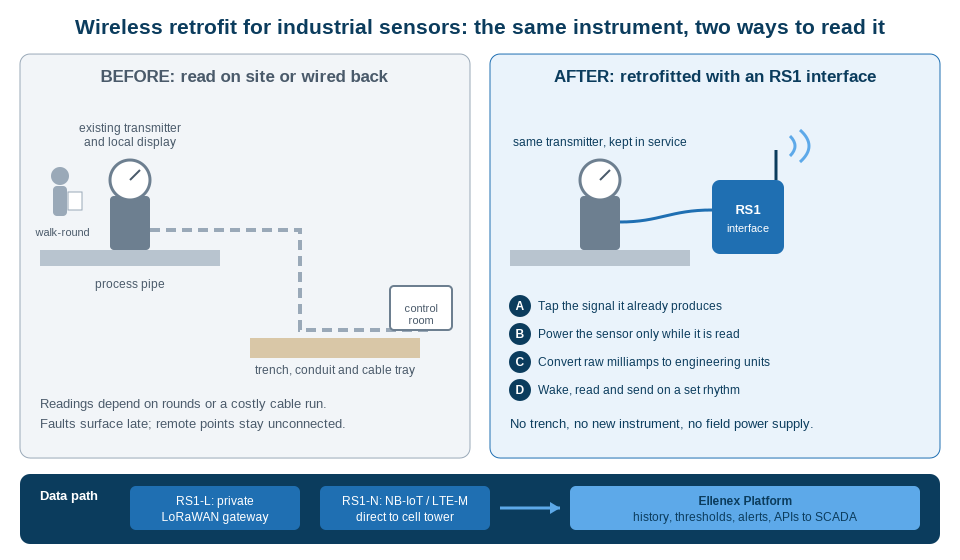
A retrofit adds a small interface beside the existing instrument. The instrument keeps measuring as before; the interface simply listens to its output and passes the result on. The steps below follow a reading from the sensor's terminals to the screen.
Tapping the Signal the Instrument Already Produces
The interface connects to the instrument's output through a short cable or pin connector. The Ellenex RS1-L and RS1-N datasheets list a broad set of inputs on a single channel: analog current-loop, voltage, millivolt and bridge signals; two-wire and three-wire platinum resistance temperature detectors; pulse inputs; and digital interfaces including Modbus, HART and several serial links. Other customized inputs are available on request. The RS1-L pulse input accepts reed switches and digital on/off signals, while the RS1-N pulse input is listed for reed switches.
Powering a Loop-Powered Sensor Only When It Is Read
Many legacy transmitters cannot produce a signal unless something powers their loop. The Ellenex solution datasheet describes an integrated switched sensor power supply that energizes the connected third-party sensor during each sampling cycle and then switches it off. That removes the need for a separate field power supply, and it keeps the energy budget focused on the moments that matter. The solution also reports the status of that sensor excitation power, which helps separate a wiring problem from a genuine process change.
Converting Raw Milliamps Into Engineering Units
The interface digitizes the signal and the solution converts it into scaled engineering units, so the reading arrives as pressure, level, flow or temperature rather than milliamps or volts. Scaling is set once for each instrument, using the range printed on its nameplate, and every user then sees the same meaningful number.
Choosing When to Wake, Read and Send
The RS1-L can sample on a fixed schedule or when an event occurs, and it can send every sample, send on an event, or send only when a condition is met. Both variants allow the sampling period to be changed remotely through a downlink. This matters for the battery: the transmitter's capacity is stated as two counts, readings taken and messages sent, not as a span of time, so how long a cell lasts depends entirely on how often the device is asked to measure and report.
Two Routes Off Site: Private Gateway or Cellular Tower
The RS1-L sends readings over LoRaWAN. In the Ellenex package, an industrial outdoor gateway collects transmissions from instruments across a plant and forwards them to a LoRaWAN network server; the RS1-L ships pre-configured for the Ellenex network server, which passes the data on to the platform. The RS1-N uses NB-IoT and LTE-M to send directly to a public cellular tower, with no gateway to install, which suits instruments spread across separate sites. Both are forms of LPWAN, and the trade-offs between them are covered in more detail in our compressed air pressure monitoring article.
What the Platform Does Once the Reading Lands
On the Ellenex Software Platform, each reading joins a history for that instrument. The platform checks each value against upper and lower alarm limits, notifies people through several channels, keeps a device inventory, offers multi-tenant role-based access, and supports data export and import. Integration APIs let the same readings flow into SCADA, maintenance or enterprise systems.
Field Instruments That Report Without a Walk-Round
Once existing instruments report on their own, the daily routine on site changes in practical ways:
Rounds become targeted visits: technicians go to the instruments that show something unusual instead of walking a fixed loop to read every gauge.
Trends replace snapshots: a continuous record shows how a value moves through a shift or a season, which is far more useful than a single reading taken on a good day.
Alerts reach the right person quickly: a threshold breach is sent to the person responsible for that asset, wherever they are, rather than waiting for the next round.
Remote assets join the picture: bores, tanks and valve pits that were never connected sit on the same dashboard as plant instruments.
Upgrades happen gradually: a site can connect its most important instruments first and add others as budget allows, without a large shutdown or a single big project.
Why Retrofitting Beats Replacing on the Balance Sheet
The financial case for a retrofit rests on using equipment the site already owns. Ellenex's IoT implementation cost guide explains how to frame those savings.
Rounds Cut to the Instruments That Need a Visit
Every gauge that reports by itself is one nobody needs to drive to or climb up to, freeing labor for work that fixes problems.
Process Losses Spotted While They Are Small
A slow pressure decline or a flow that no longer matches demand often signals a leak, a blocked strainer or a valve left in the wrong position. Seeing it early limits the water, product or energy lost.
Pumps, Compressors and Motors Caught Before Damage
Abnormal readings from existing transmitters often precede mechanical failure. Catching them gives maintenance teams the chance to intervene before a minor fault becomes a rebuild.
Fewer People Reading Gauges in Hazardous Corners
Instruments sit in confined spaces, on elevated platforms, beside rotating machinery and on roadside assets. Remote reading reduces how often people need to enter those places just to note a value.
Maintenance Planned Around Measured Trends
Historical data lets teams schedule service based on how equipment is actually behaving, rather than on fixed intervals that are sometimes too early and sometimes too late.
No Trenching, No Replacement Instruments
A battery-powered interface avoids cable runs, conduit and new power supplies, and it keeps working instruments in service. That keeps both installation cost and disruption to the plant low.
A Data Record Behind Every Upgrade Decision
When the time comes to justify a new pump, a larger tank or a process change, a measured history provides evidence that is far stronger than estimates or recollection.
RS1-L and RS1-N Against Each Retrofit Obstacle
A Mix of Signal Types on One Site
Each Ellenex interface is a single-channel device, so every instrument gets its own input configured for its signal. The RS1-L product page and its datasheet list analog, digital, resistance-temperature and pulse options, so one product family can cover current-loop transmitters, Modbus meters and temperature probes across the same plant.
Loop-Powered Sensors Without a Field Supply
The solution's switched sensor power supply energizes the connected sensor only during sampling. For locations where a permanent supply is available, the rectangular enclosure of both variants can take external power, and an option pairs an external supply connector with an internal battery as backup.
No Mains Power at the Measurement Point
Both variants run on a built-in, replaceable lithium battery. With the cell's capacity expressed as counts of readings and of transmissions, sites can trade reporting frequency against service intervals instrument by instrument, and a high-capacity battery option is offered for the rectangular enclosure.
Harsh Mounting Conditions
The datasheets describe UV-protected, weather-sealed enclosures in two styles: a cylindrical housing for battery operation with clamp mounting, and a rectangular housing for battery or external power with wall mounting. Internal, external and high-gain antenna options suit difficult radio paths.
Patchy Site Networks and Scattered Assets
For instruments clustered on one plant or campus, the RS1-L works with a private LoRaWAN gateway, which keeps the network under the site's control without per-device SIM fees on private deployments. For instruments spread across towns, farms or pipeline routes, the RS1-N connects directly to NB-IoT or LTE-M towers, with an optional GPRS fallback, and accepts a nano SIM from any network provider.
IT and Security Concerns
Both datasheets list an encrypted ultra-low-power communication protocol, and the solution sends encrypted telemetry to the platform. The interfaces do not need to join the plant's own IT network. The RS1-L can be pointed at Ellenex's network server or at the main third-party LoRaWAN network servers, and the RS1-N can talk MQTT, LwM2M and other standard protocols.
Retrofit Package in Brief: Mechanism and Outcome
A single or multi-channel RS1 interface connects to the instrument's existing output.
Outcome: working sensors stay in service and nothing is rewired back to a control room.
The switched sensor supply powers the instrument only during each sample. Outcome: loop-powered transmitters run at remote points without a separate field power supply.
Readings are digitized and scaled into engineering units.
Outcome: operators see pressure, level, flow or temperature directly, not raw electrical values.
LoRaWAN through a private gateway (RS1-L) or NB-IoT/LTE-M direct to the tower (RS1-N).
Outcome: clustered and scattered instruments can both be connected with the right network for each.
The Ellenex Platform stores history, applies thresholds and offers APIs. Outcome: alerts reach the right people and the data flows into existing systems.
Matching Interface, Enclosure and Network to Each Instrument
A good retrofit starts with a short survey of each instrument rather than a single specification for the whole site. The choices below are the ones that shape the order, described in words rather than codes.
Input type. Read the instrument's nameplate or manual to confirm what it outputs: a current loop, a voltage, a millivolt bridge signal, a resistance temperature element, pulses or a digital protocol such as Modbus. Each interface is configured for one input, so the survey decides which interface goes where.
Enclosure style. The cylindrical housing suits battery-only installations clamped to a pipe or post. The rectangular housing suits wall mounting and is the one to choose when an external supply, battery backup or a high-capacity battery is wanted.
Connection. A fixed cable or a pin connector is available; a connector makes swapping an instrument later easier.
Network. LoRaWAN suits dense clusters within one site; NB-IoT or LTE-M suits single instruments at separate locations. Some sites use both, with a gateway on the main plant and cellular units on outlying assets.
Reporting rhythm. Decide how quickly each process can change. Fast processes justify frequent readings or event-triggered sends; slow ones such as storage levels can report far less often, which extends battery service.
For several signals at one location, see our post on the multi-channel sensor interface.
Wiring Slips and Scaling Errors That Spoil Retrofit Data
Most poor retrofit data traces back to avoidable mistakes; these points reflect general field practice.
Scaling entered from memory. Always take the range from the instrument's nameplate or calibration record. A mismatch between the configured range and the real one produces readings that look plausible but are consistently wrong.
Two power sources on one loop. If an instrument is already powered by an existing loop or panel, adding a second supply can upset the signal. Confirm how the instrument is powered before connecting, and isolate the loop according to site procedures.
Readings stuck at the bottom of the scale. A value pinned at zero or at the bottom of the range usually points to an open circuit, a reversed connection or a sensor that is not receiving power, rather than an empty tank or an idle line. The sensor excitation status reported by the solution helps narrow this down.
Reporting intervals copied across every instrument. Using the same fast interval everywhere drains batteries on instruments that rarely change. Review each instrument's process and set its interval individually.
Antenna placed inside a metal cabinet. Metal enclosures and pits block radio signals; use an external or high-gain antenna, or move the interface, before blaming coverage.
No baseline after installation. Compare the first remote readings with a local display or a handheld check. That confirms scaling and wiring before anyone relies on the data for decisions.
The RS1 interface guide walks through setup in more detail.
Existing Instruments, Newly Accountable
A site that retrofits its existing instruments gains a continuous, searchable record from equipment it has already paid for. Operators see live values without walking a round, maintenance teams spot abnormal trends before equipment fails, and managers can compare assets across a whole site or region. The work can start with the instruments that matter most and grow as budget allows, from hydraulic systems and air compressors to industrial flowmeters, all feeding one view of the operation through Ellenex's wider approach to infrastructure monitoring.
Frequently Asked Questions
What does it mean to retrofit an industrial sensor for wireless monitoring?
Retrofitting an industrial sensor for wireless monitoring means keeping an instrument that is already installed and adding a separate device that reads its output and transmits it over a radio network. The original sensor continues to measure exactly as before, whether it is a pressure transmitter, a level probe, a temperature element or a flowmeter. What changes is where its data goes. Instead of feeding only a local display, a chart recorder or a long hard-wired cable back to a control system, the reading is digitized at the instrument and sent to software that people can open from an office, a control room or a phone. As general practice, it is chosen when the instrument is still accurate but cabling it would be costly or disruptive.
The Ellenex Wireless Retrofit Monitoring for Existing Industrial Sensors solution follows this model. A single-channel RS1 interface is mounted beside the instrument and connected to its output with a short cable or pin connector. It digitizes the signal, converts it into engineering units and sends encrypted readings over LoRaWAN with the RS1-L or over NB-IoT and LTE-M with the RS1-N. The readings arrive on the Ellenex Platform, where they are stored, trended and checked against alarm thresholds. Units are pre-configured before shipping, so the work on site is mainly mounting the interface and connecting the instrument.
Which types of existing sensors and signals can be connected to a wireless interface?
Most industrial instruments communicate in a small number of established ways. The most common is the analog current loop, used by a large share of pressure, level and flow transmitters because it tolerates long cable runs and electrical noise. Others output a voltage, a low-level millivolt signal from a bridge circuit, a changing resistance from a platinum temperature element, or a series of pulses from a meter or switch. Many newer devices communicate digitally, most often through Modbus over a serial connection, or through HART, which layers digital data on top of a current loop. Checking each nameplate or manual for its signal type is the first step in any retrofit survey.
According to their datasheets, the RS1-L and RS1-N accept analog current, voltage, millivolt and bridge inputs; two-wire and three-wire platinum resistance temperature detectors; pulse inputs; and digital interfaces including Modbus, HART and several serial options. The RS1-L pulse input covers reed switches and digital on/off signals, and the RS1-N pulse input is listed for reed switches. Each interface handles one channel, so a site connects one interface per instrument and configures it for that instrument's signal. Ellenex also offers customized input options on request when an instrument uses something less common, and the survey that maps each signal to an input is the natural starting point for a quote.
Can a loop-powered transmitter run from a battery-powered wireless device?
Many industrial transmitters are loop-powered, meaning they draw their operating power from the same circuit that carries their output signal. In a traditional installation, a control system or a panel-mounted power supply energizes that loop continuously. At a remote tank, valve pit or bore, there may be no such supply, and running mains power to a single instrument is rarely justified. The general solution is to power the transmitter only when a reading is needed: the supply is switched on, the sensor is given a moment to settle, the output is measured, and power is switched off again. Done well, this keeps sensor energy use small enough for battery operation.
The Ellenex solution datasheet describes exactly this arrangement as an integrated switched sensor power supply, which energizes the connected third-party sensor during each sampling cycle and removes the need for external wiring loops and auxiliary supplies. The solution also reports the status of the sensor excitation power alongside each reading, which helps diagnose wiring problems. Both RS1 variants carry a replaceable lithium cell, and the rectangular housing can also take an outside supply. Because the battery is rated by readings and transmissions, the interval chosen for each instrument on the Ellenex Software Platform is what decides how often a battery change is due.
Is a wireless retrofit cheaper than running new cable or replacing instruments?
In most cases, the largest cost in connecting a field instrument is not the instrument itself but the path between it and the system that reads it. Hard-wiring typically involves cable, conduit or cable tray, trenching or road crossings, terminations, marshalling, and sometimes a new input card in a control system, along with the labor and plant disruption that come with each. Replacing the instrument with a connected model removes some of that work but discards a sensor that may still be sound. A battery-powered wireless interface avoids most of these costs, which is why it is widely used for instruments at the edges of a plant or at remote sites.
The Ellenex approach is designed to keep the retrofit itself small. The interfaces arrive pre-configured, need no trenching or new power supply, and leave the existing instrument in place. For sites with many instruments in one area, the RS1-L with a private LoRaWAN gateway avoids per-device SIM fees on private deployments; for isolated points, the RS1-N connects straight to a cellular tower with no gateway. Both variants run on replaceable batteries, so no mains supply is needed at the instrument. The financial guide to IoT implementation shows how to compare these options against a wired project.
When should an existing sensor be replaced rather than retrofitted?
A retrofit only makes sense if the instrument behind it is sound. General practice is to replace rather than connect an instrument when it no longer meets the accuracy the process requires, when it has failed calibration checks repeatedly, when its wetted materials are not compatible with the process fluid, or when its range no longer matches how the process actually operates. On the other hand, a transmitter that reads correctly, suits the process and simply cannot be reached by a cable is usually the ideal candidate, because connecting it preserves an asset that has already been paid for and validated on site.
The Ellenex retrofit solution is built to serve the large group of instruments that are working well but are not connected. During a survey, the input options listed in the RS1 datasheets help confirm whether each instrument's output can be read, and Ellenex can discuss customized inputs for less common signals. Once connected, the history kept on the Ellenex Platform also helps answer the replacement question over time: a sensor whose readings drift, stick or diverge from manual checks becomes visible on its trend, so replacement decisions can be based on evidence rather than age alone. More detail is on the solution page.
Related Reading
Ellenex RS1 Interface Guide: Understanding the Ellenex Sensor Interface RS1: a setup walkthrough for the RS1 interface, from preparing sensors to deployment.
Retrofitting Reimagined: The Multi-Channel Sensor Interface: how a multi-channel interface connects several signals at one location.
Compressed Air Pressure Monitoring Finds the Leaks Your Compressor Pays For: an example of pressure data turning into leak and energy savings in plant air systems.
Hydraulic System Pressure Monitoring: Read the Spikes Before the Pump Fails: a look at what hydraulic pressure spikes say about pump health.
Useful Links
Talk to Ellenex
The quickest retrofit plans begin with an instrument list, not a product catalog. Note the instruments you most want to see from the office, the signal each one outputs and whether they sit together on one plant or apart at separate sites, then send that list through the Ellenex sales inquiry page; our engineers will match each instrument to an interface, a network and a reporting rhythm.


