

Compressed Air Pressure Monitoring Finds the Leaks Your Compressor Pays For


Key Takeaways
Measure at more than one point. A single gauge on the compressor discharge cannot show where pressure is being lost; pair it with readings on the main header and at the machines that complain first.
Use quiet hours as a free leak test. When production stops, any steady fall in network pressure is air escaping, and a logged trend shows how quickly it happens night after night.
Watch the gap, not just the level. A widening difference between the receiver and the far end of the header points to clogging filters, an undersized pipe run or a dryer that needs attention.
Lower setpoints only with evidence. Continuous readings at the point of use show how much headroom the machines really need before anyone turns the compressor down.
Choose the network by plant layout. A private LoRaWAN gateway suits several buildings on one site, while cellular NB-IoT/LTE-M transmitters suit compressors scattered across separate sites.
Air Costs Money Long Before It Reaches a Tool
According to the Compressed Air Challenge fact sheet on system leaks, leaks can waste 20-30% of a compressor's output in some plants. That loss rarely shows up on any report, because most factories meter electricity, water and gas but treat compressed air as something that simply arrives at the wall. Compressed air pressure monitoring changes that by recording what the network does between the compressor and every machine it feeds.
Pressure is the most useful single signal in an air system. It rises and falls with demand, sags when filters load up, drifts down overnight when fittings leak and climbs when a compressor runs at a higher setting than the plant needs. Read at the right places and kept as a continuous record, those movements describe where energy is being lost and why.
Ellenex packages this as a battery-powered approach on the Pneumatic System and Air Compressor Performance Monitoring solution page: rugged pressure transmitters thread into existing ports on receivers, headers and machine drops, then report over LoRaWAN or cellular to the Ellenex Platform. No signal cabling has to be run back to a control room. This article follows the air from receiver to machine, explains what each reading means and shows how a continuous record turns into decisions about leaks, filters and compressor settings.
Hissing Fittings, Starved Machines and Compressors That Never Rest
Leaks that run every hour of the year. Push-in fittings, worn hoses, quick couplers and drain valves bleed air whether the line is busy or idle, so the compressor keeps paying for air nobody uses.
Machines that stall at the end of the line. When pressure at a far workstation dips below what a cylinder or tool needs, cycle times lengthen, clamps slip and rejects rise, and the fault is often blamed on the machine rather than the network.
Setpoints raised to hide a problem. A common reaction to low pressure at one machine is to turn up the compressor for the whole plant, which costs energy everywhere and makes every leak blow harder.
Short cycling that wears out compressors. Frequent load and unload swings, driven by leaks and poor storage, add starts, heat and wear to motors and valves that were sized for steadier work.
Capacity bought for the wrong reason. Without data, a plant that seems short of air may buy another compressor when the real cause is leakage or pressure drop that could have been fixed for far less.
Air Networks Hide Their Losses in Plain Sight
Leaks are mostly inaudible during production. Machine noise covers the hiss, so leak surveys often happen only on weekends, if they happen at all.
Local gauges show a moment, not a trend. A dial on a receiver tells whoever walks past what the pressure is now, but nothing about the slow sag overnight or the dip during a busy shift.
Drops happen between rooms. Filters, dryers, long headers and small drop lines each take a share of pressure, and the loss only becomes visible when two points are read at the same time.
Compressor rooms and machines sit far apart. Air often travels across several halls or buildings, which makes running new signal cable for a few measurement points slow and expensive.
Demand changes from minute to minute. Pressure swings with each tool, cylinder and blow-off, so a single spot reading can look alarming or reassuring depending purely on timing.
Nobody owns the air. Maintenance looks after the compressor, production looks after the machines and energy costs land in a general bill, so the network between them gets little attention.
Compressed Air Pressure Monitoring at Three Points: Receiver, Header and Machine
The technical idea is simple: measure pressure where air is stored, where it is distributed and where it is used, and let the differences between those points tell the story. Each step below follows one reading from the stainless diaphragm to an alert on a phone.
A Stainless Diaphragm Threaded Into the Air Line
The PTS2-L LoRaWAN pressure transmitter and the PTS2-N transmitter for NB-IoT and LTE-M both use a piezoresistive sensing element behind a stainless steel diaphragm. Air pressure flexes the diaphragm very slightly, the element turns that movement into an electrical signal, and the transmitter converts it into a pressure value. Wetted parts are stainless steel, and the datasheets list the sensors as suitable for liquids and gases compatible with stainless steel.
Gauge Reference: Reading Against the Room, Not a Vacuum
Plant air is usually discussed as pressure above the surrounding atmosphere, because that is what pushes a cylinder or spins a tool. Both transmitters are offered with vented gauge, sealed gauge or absolute references. For air networks, a gauge reference keeps readings in the same terms as the dials and setpoints the maintenance team already uses.
Picking a Range That Suits Plant Air
Each transmitter is ordered with a measuring range selected for the job. Choosing a range a little above the highest pressure the network is expected to see keeps resolution useful at normal operating levels while leaving room for the peaks that follow a compressor loading up.
Three Readings That Tell One Story
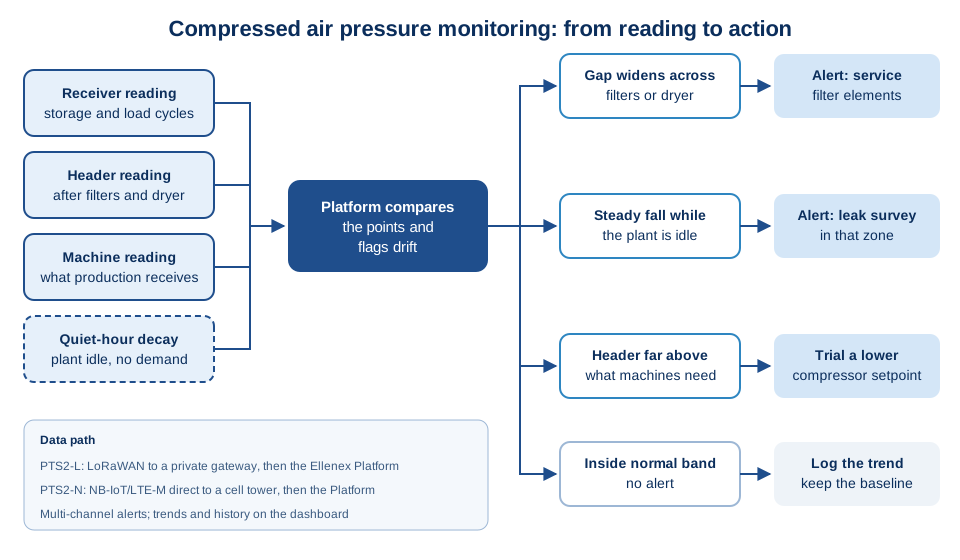
A transmitter on the receiver shows storage pressure and how the compressor loads and unloads. A second on the main header, after filters and dryer, shows what treatment equipment costs in pressure. A third at the far end of the network or at a sensitive machine shows what production actually receives. Read together, the three describe the full pressure profile: a growing gap between receiver and header points to treatment equipment, and a growing gap between header and machine points to distribution piping or drop lines.
Quiet-Hour Decay: Letting the Network Report Its Own Leaks
When production stops and the compressor is isolated, a tight network holds its pressure well, while a leaky one bleeds down steadily. Timing this pressure decay with no demand on the system is an established way to estimate leakage, described in the Compressed Air Challenge fact sheet cited above. With transmitters already installed, every shutdown becomes a leak check, and the platform record shows whether repairs actually slowed the decline.
Deciding at the Transmitter What Deserves Airtime
Both transmitters read at intervals adjustable by downlink, and the PTS2-L can also take a reading when an event occurs. Transmission conditions and intervals are set on the platform, so a reading that stays inside its normal band does not have to cost a radio message. Ellenex states battery capacity in readings and transmissions, not years, so a unit that wakes often during busy shifts draws on that budget faster than one checking in a few times a day; Ellenex's battery modeling article explains why reporting habits matter so much.
Private Gateway or Cellular Tower Out of the Compressor Room
The PTS2-L sends its readings over LoRaWAN to a private gateway, which the solution datasheet describes as an industrial outdoor unit pre-configured to forward data to the Ellenex Platform. The PTS2-N connects over NB-IoT or LTE-M straight to a public cellular tower using a standard nano-SIM. Ellenex has already compared the two routes in detail in LoRaWAN vs NB-IoT for Industrial Monitoring; for air systems, the deciding factor is usually whether the compressors and machines share one site.
Platform Work: Comparing Points and Flagging Drift
On the Ellenex software platform, readings from each point are stored, trended and compared. The solution datasheet lists telemetry such as system pressure, minimum and maximum values, rapid pressure drop warnings and compressor cycling frequency, alongside battery voltage and signal strength. High and low thresholds trigger multi-channel alerts, and dashboards show the gap between points so a widening loss stands out before production feels it.
A Compressor Room That Explains Itself Each Morning
Overnight decay becomes a daily report. Instead of an annual leak survey, the team sees each morning how fast the network bled down while the plant was idle.
Complaints arrive with data attached. When an operator reports weak air at a machine, the record shows whether the header sagged, the drop line choked or the machine itself is at fault.
Filter and dryer service follows evidence. Maintenance replaces elements when the pressure gap across treatment equipment grows, not simply because a calendar date arrived.
Setpoint changes are tested, not guessed. A trial reduction in compressor pressure can be watched at the far machines in real time and reversed if any of them suffers.
Compressor behavior is visible from anywhere. Load and unload patterns, cycling and pressure peaks appear on the Ellenex mobile app without a walk to the compressor house.
Where Better Air Pressure Data Pays for Itself
The general economics of sensor projects are covered in Ellenex's IoT implementation cost guide. For compressed air, the returns tend to fall into the areas below.
Leak Hunts Aimed at the Right Building
Readings at several points show which part of the network loses pressure fastest, so surveys with ultrasonic detectors start in the zone most likely to repay the effort rather than covering the whole plant every time.
Air Kept in the Pipe, Energy Kept off the Bill
Every leak repaired and every unnecessary pressure point removed reduces the work the compressor has to do. Because the pressure record continues after repairs, the improvement can be confirmed rather than assumed.
Compressors Spared From Short Cycling
Steadier demand and smaller leakage mean fewer load and unload swings, which reduces starts, heat and wear on motors, valves and controls.
Fewer Surprises Around Pressurized Lines
Alerts on sudden pressure loss draw attention to burst hoses or failed fittings quickly, and fewer manual gauge rounds mean less time spent in noisy, hot compressor rooms.
Setpoints Lowered With Confidence
Knowing exactly what the furthest machines receive allows engineers to run the compressor closer to real need, with a record to show nothing downstream suffered.
Fitted to Existing Ports Without New Wiring
Transmitters thread into standard process ports and run on batteries, so a monitoring point can go in during a short stop without trenching, conduit or new power.
Evidence Before Buying Another Compressor
A long pressure record separates genuine capacity shortfall from losses caused by leaks, dryers or piping, giving managers facts before they approve major spending.
Each Air System Headache, Answered by a PTS2 Transmitter
The PTS2 pair covers the same measurement with two connectivity options. Both are listed for pump, hydraulic and pneumatic system monitoring and for air compressors on the PTS2-L product page and the PTS2-N product page.
Oily, Wet Air Meets Stainless Wetted Parts
Compressed air often carries moisture and traces of lubricant. Both transmitters have a stainless steel diaphragm and body, which suits gases compatible with stainless steel, and the sensing element sits behind the diaphragm rather than in the air stream.
Compressor Houses, Rooftops and Yard Receivers
Each variant is available in a compact housing that mounts directly on the port or a wired version with the sensor head on a cable and the electronics in a separate enclosure, which helps where a receiver drain or hot pipework leaves little room. Enclosures are weather-sealed and UV-protected for receivers that stand outdoors.
Reading Rhythm and the Battery Budget
Both run on a replaceable lithium battery, with an optional external power supply for points that need to report very often. Sampling intervals and transmission conditions can be changed remotely as the team learns how the network behaves.
Alerts That Wake the Right Shift
Alert limits live on the platform, where they can be edited without a trip to the transmitter. Night alerts can go to whoever is on call, while daytime trend reports go to the energy or maintenance lead.
Clustered Plants on LoRaWAN, Scattered Sites on Cellular
Where a compressor house serves several halls on one site, PTS2-L transmitters and a single private gateway keep every reading on a network the plant controls. Where compressors sit at separate depots, workshops or remote sites, PTS2-N transmitters reach the nearest cellular tower directly, with no gateway to install or maintain. The PTS2-N supports UDP, LwM2M, MQTT and NIDD, and the PTS2-L supports over-the-air or ABP activation, so each fits the network arrangement already in place.
Feeding Air Data to SCADA and Energy Reports
The platform's open API passes readings to SCADA, ERP or energy reporting systems, so compressed air can sit alongside electricity and production data instead of in a separate silo.
Inside the Ellenex Compressor Package: Mechanism and Outcome
Stainless steel piezoresistive pressure transmitters on receivers, headers and machine drops.
Outcome: One continuous pressure profile from storage to point of use.
Remote sampling control and condition-based transmission.
Outcome: Readings that follow how the plant runs while conserving battery capacity.
Two radio routes: a site-owned LoRaWAN gateway or a cellular NB-IoT/LTE-M link.
Outcome: Connectivity matched to whether air assets share a site or are spread out.
Platform thresholds, rapid pressure drop warnings and cycling data. Outcome: Leaks, blocked filters and wasteful setpoints flagged while they are still cheap to fix.
Open API and multi-tenant role-based access.
Outcome: Air data shared with maintenance, energy and management teams in the tools they already use.
Tapping Into a Live Air Main: General Fitting Practice
These habits come from common industry practice for fitting pressure instruments on air lines. Treat them as general advice rather than Ellenex procedures.
Isolate and vent first. Close the isolation valve and bleed the branch before removing a plug or gauge, and never loosen a fitting under pressure.
Use an isolation valve on every tapping. A small ball valve below the transmitter allows later removal without draining the main.
Tap from the top of the pipe. Connections on the upper side of a header take less condensate and debris than those underneath.
Measure both sides of treatment equipment. Points before and after filters and dryers make it possible to separate treatment loss from distribution loss.
Keep away from pulsation sources. Mount header transmitters a short distance from compressor discharge and quick-acting valves so readings represent the network rather than local turbulence.
Record the location and baseline. Note where each transmitter sits and its first stable readings, so later trends have a clear reference.
Same Transmitter, Neighboring Problems
Pressure on air and fluid lines tells similar stories in other parts of a plant. Hydraulic presses and power units are covered in Hydraulic System Pressure Monitoring and in the Ellenex hydraulic systems performance solution. Dust collectors that rely on pulse-jet cleaning air are addressed by dust collection systems monitoring, and loaded filters in plant ventilation by industrial HVAC filter monitoring.
Earlier posts show the same principle in other settings: pressure monitoring in the gas manufacturing industry, pressure consistency monitoring for irrigation and differential pressure monitoring in critical environments. Each fits within the wider Ellenex approach to infrastructure monitoring.
Plant Air Run on Evidence Instead of Habit
With pressure recorded at the receiver, the header and the machines, compressed air stops being an invisible overhead and becomes a system with measurable behavior. Leak work is directed by the overnight decay record, filter and dryer service by the pressure gap across them, and compressor settings by what the furthest machine actually receives. Production gets steadier air, maintenance gets fewer surprises and the energy bill reflects air that was used rather than air that escaped. The Pneumatic System and Air Compressor Performance Monitoring solution brings these pieces together within the broader Ellenex infrastructure monitoring portfolio.
Frequently Asked Questions
How much pressure does a compressed air system actually need?
The right pressure is set by the most demanding end use on the network, plus the losses that occur as air passes through filters, dryers, headers, hoses and fittings on its way there. Many plants run their compressors well above that figure, often because a single machine once complained of weak air and the simplest fix was to raise the setpoint for everyone. Every step up in generation pressure makes the compressor work harder and makes every leak in the plant blow faster, so excess pressure carries a cost around the clock. The practical goal is to deliver what the critical machines need at their inlet, reduce avoidable losses in between, and then lower the compressor setting until it matches real demand rather than habit.
Reaching that point requires knowing what the furthest and most sensitive machines actually receive, which a gauge in the compressor room cannot show. The Ellenex Pneumatic System and Air Compressor Performance Monitoring solution places battery-powered pressure transmitters at the receiver, on the main header and at points of use, then brings their readings together on the Ellenex Platform. Engineers can trial a lower setpoint and watch the effect at the far end of the network as it happens, with alerts ready to warn if any machine drops below its threshold. The decision to turn the compressor down is then based on measured headroom rather than guesswork.
What causes pressure drop in a compressed air system?
Pressure drop is the loss that occurs between the compressor and the point of use, and it builds up in several places at once. Filters and dryers take a share that grows as elements load with dirt and oil. Long or undersized headers, ring mains with restrictions, sharp bends and partially closed valves add friction. At the machine end, small drop lines, quick couplers, long hoses and regulators frequently cause more loss than all the main piping combined. Because each contribution is modest on its own and changes with demand, the total often goes unnoticed until a machine at the end of the line starts to stall during busy periods and the fault is wrongly blamed on the machine itself.
The way to find pressure drop is to measure at more than one point at the same time. Ellenex PTS2-L and PTS2-N transmitters thread into existing ports before and after treatment equipment, along the header and at sensitive machines, using a stainless steel diaphragm and a piezoresistive sensing element suited to compressed air. On the Ellenex Platform, the gap between those readings is trended continuously, so a widening difference across filters and dryers points to element service, while a growing loss along the distribution piping points to the network itself. Maintenance can then act on the section that is actually causing the problem.
How can you find compressed air leaks in a factory?
Leaks are hard to find during production because machine noise hides the hiss, and many of them sit in fittings, hoses, couplers and drain valves that nobody looks at closely. Common industry practice combines two approaches. An ultrasonic leak detector, which picks up the high-frequency sound of escaping air, is used to locate and tag individual leaks for repair. A pressure decay check, carried out when production stops and the compressor is isolated, measures how quickly the network loses pressure with no demand on it and gives an overall picture of how leaky the system is. Repeating that check over time shows whether repair work is actually making a difference, which is something a one-off survey cannot do.
Ellenex transmitters turn every shutdown into an automatic leak check. With pressure recorded at the receiver, header and machine points, the Ellenex Platform shows how fast each part of the network bleeds down overnight or over a weekend, so ultrasonic surveys can start in the zone that loses pressure fastest instead of covering the whole site every time. After repairs, the same record confirms whether the decline has slowed. The PTS2-L reports through a private LoRaWAN gateway that suits several halls on one site, while the PTS2-N reaches cellular NB-IoT or LTE-M coverage on its own for compressors at separate locations, so the method works across both kinds of operation.
Why does compressor short cycling happen and why does it matter?
Short cycling describes a compressor that loads and unloads, or starts and stops, far more often than it was designed to. It is usually a symptom of the system around the compressor rather than the machine itself: too little storage capacity, a pressure band set too narrow, leaks that keep pulling pressure down between demand peaks, or controls that do not coordinate several compressors well. Each extra cycle adds heat, wear on motors, valves and contactors, and wasted energy during transitions, and over months it shortens equipment life and raises maintenance costs. Because the compressor room is rarely watched closely, short cycling can persist for a long time before anyone connects it to rising power bills or repeated repairs.
A continuous pressure record at the receiver makes cycling visible as a saw-tooth pattern that can be compared across days and shifts. The solution datasheet lists the telemetry the Ellenex Platform can show, including system pressure, minimum and maximum values, rapid pressure drop warnings and compressor cycling frequency, alongside device battery and signal health. Engineers can see whether cycling rises during quiet hours, which points to leaks, or during particular production periods, which points to storage or control settings. Alerts and trends can be viewed remotely on the Ellenex Software Platform, so the compressor room effectively reports on itself without a daily walk-round.
Is wireless pressure monitoring reliable enough for an industrial air system?
Wireless monitoring is well suited to compressed air because the main need is trend data and timely alerts rather than split-second control. Running signal cable across several halls or buildings to a handful of measurement points is often slow and expensive, and small air networks rarely have a control system with spare inputs. Battery-powered transmitters remove that barrier: they can be fitted during a short stop, they do not depend on plant wiring, and they leave the compressor's own safety controls untouched. Reliability then comes down to choosing the right radio route for the site, mounting the devices sensibly and setting a reporting schedule that matches how the system behaves.
Ellenex offers two routes with the same sensing hardware. The PTS2-L uses LoRaWAN and a private industrial gateway, keeping every reading on a network the plant controls, while the PTS2-N talks to a public cell tower directly over NB-IoT or LTE-M, so there is no gateway to maintain. Readings are passed to the Ellenex Platform. Power comes from a replaceable lithium cell whose capacity is quoted as a number of measurements and radio messages, so heavy reporting uses it faster, and an external power option suits points that must report very often. Housings are weather-sealed and UV-protected for outdoor receivers, and the platform's open API can pass readings on to SCADA or energy reporting systems.
Related Reading
Hydraulic System Pressure Monitoring: Read the Spikes Before the Pump Fails: how pressure trends reveal heat, contamination and cavitation in hydraulic circuits.
Safeguarding Industrial Strength: Performance Tuning of Hydraulic and Pneumatic Systems with Ellenex Pressure Sensors: an earlier look at wireless pressure sensing on hydraulic and pneumatic equipment.
Top 11 Applications for Ellenex PTS2 and PTS3 Ruggedized Pressure Sensors: where the same transmitter family is used across industrial assets.
Edge Capability and Conditional Transmission in Low Power IoT Devices: why sending only meaningful readings protects battery capacity.
Useful Links
Talk to Ellenex
Listen to your compressor house during the next weekend shutdown: compressors that keep loading with nobody working are feeding leaks. Tell the Ellenex team through the sales inquiry page how many compressors you run, where the receivers and main headers sit and whether your plants share one site, and they will suggest where the first transmitters should go and which network route suits them.


