

Remote Rain Gauge Monitoring: Five Siting Choices That Decide Your Data


Key Takeaways
Treat every gauge as a local witness. Rain varies from one paddock, ridge or drain inlet to the next, so a gauge is most valuable where decisions are actually made.
Choose a tipping spoon sensor for unattended sites. A self-emptying collector, a screened funnel and a weather-sealed enclosure keep upkeep light between wet seasons.
Alert on intensity and on accumulation. Fast bursts and slow soaking rain cause different problems, and the platform can watch for both.
Match the network to the layout. LoRaWAN with a private gateway suits clustered gauges, while NB-IoT or LTE-M suits lone gauges far from anything.
Site the gauge before you tune the alarm. A level mount in open ground does more for data quality than any later threshold change.
A Gauge Answers for One Funnel, and Only for That Funnel
Remote rain gauge monitoring begins with a modest fact: a rain gauge reports how much water reached one funnel opening, and nothing more. Everything else, from flood risk to irrigation timing, is inferred from that single point and from how many other points you are willing to maintain.
That is why manual gauges disappoint so often. Someone has to visit, tip out the collector, write a number down and carry it back, and by then the storm that mattered has passed. The reading describes yesterday, while the decision it was meant to inform needed to be made while the clouds were still overhead.
A wireless tipping spoon sensor closes that gap. It counts each small increment of rain as it falls, works out totals and intensity on the device, and sends them on a schedule or when a condition is met. Ellenex builds this into its Remote Rain Level Monitoring solution, delivered as a LoRaWAN sensor and an NB-IoT/LTE-M sensor so the network can follow the site rather than the other way round.
This article covers what rainfall data is worth, why it is hard to gather remotely, how the measurement travels from funnel to dashboard, and how to site and maintain a gauge so the numbers can be trusted. It also points to related Ellenex work on flood monitoring on rivers and soil moisture monitoring.
Rainfall Nobody Measured: Costs That Surface Later
When rain goes unrecorded at the place it falls, the bill arrives in other budgets, from irrigation to water infrastructure monitoring programs. These are the general patterns that tend to follow.
Irrigation that runs into a downpour. Pumps keep watering ground that rain has already soaked, which wastes water and pumping energy and can leave crops sitting wet.
Drainage that surprises its owners. Culverts, channels and retention basins fill faster than anyone expected because intensity upstream was never known.
Flood warnings issued late or too broadly. Without local rainfall, forecasters and duty officers fall back on regional estimates that can be wrong for a particular catchment.
Crews dispatched on guesswork. Teams are sent to check sites that stayed dry, or reach flooded sites after access is already cut.
Records that cannot support a claim or a design review. When a dispute or an upgrade decision needs rainfall history, patchy notes carry little weight.
Rain Resists Honest Measurement
Rain looks simple to measure until you try to do it across many sites. The same traits that make weather interesting make it awkward to instrument.
It is intensely local. Two points a short drive apart can record very different totals from the same storm, so one gauge rarely stands in for a district.
Sites are remote and open. Gauges belong in exposed ground, far from mains power, buildings and mobile coverage.
Debris blocks collectors. Leaves, seeds, insects and dust can clog a funnel and quietly skew every reading afterward.
Mounting matters. A gauge that leans, or that sits beside a wall or tree, collects a distorted sample.
Intensity is as important as totals. A running total hides how hard the rain fell, yet intensity is what overwhelms drains and slopes.
Visits are rare. A site checked a few times a year cannot be trusted to still be working when the big storm arrives.
Remote Rain Gauge Monitoring, Traced From Funnel to Dashboard
Here is how a reading is produced and delivered, one stage at a time. The sequence is the same for both Ellenex variants until the radio takes over.
The Funnel Collects, the Spoon Counts
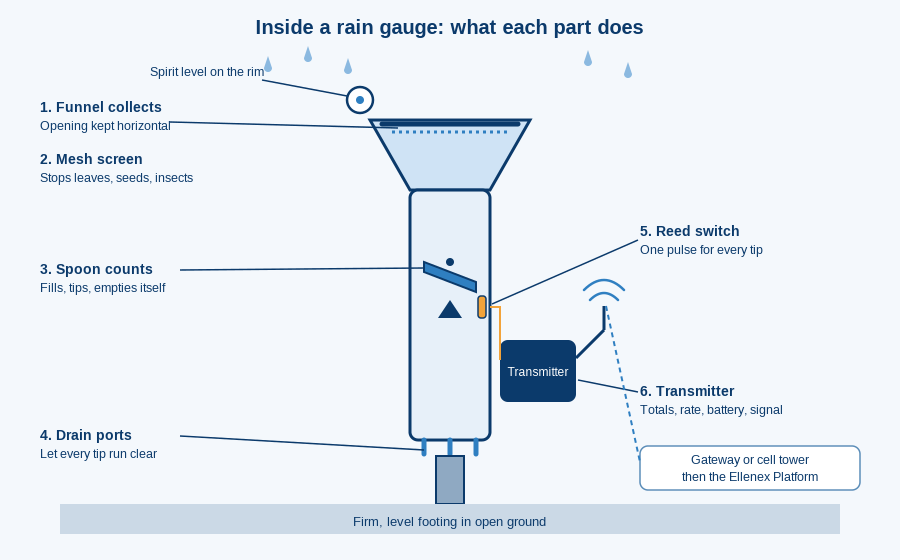
Rain enters through a funnel and falls onto a small balanced spoon inside the sensor. When the spoon has filled to its set point it tips, empties through the drain ports, and the opposite side moves into place to catch the next increment. Every tip stands for the same small depth of rainfall, which is why counting tips gives a rainfall record.
A Reed Switch Turns Each Tip Into a Pulse
A magnet on the spoon passes a sealed reed switch each time it tips. The switch closes briefly, and the sensor's processor registers one pulse. Nothing wears against anything else, and no power is drawn between tips, which suits a battery-powered device left in a field.
Rate and Totals Are Worked Out Inside the Transmitter
Counting pulses over time gives more than a total. The transmitter works out accumulated rainfall, daily and seasonal totals, and the rate at which rain is falling. It also keeps track of its own battery condition and signal strength, and it can log storm events as they happen so that a cluster of tips is understood as one storm.
Levelling and Screening Keep the Count Honest
A built-in spirit level helps the installer set the funnel horizontal, and a removable stainless mesh screen on the funnel keeps leaves, seeds and insects out of the spoon. Both are simple, and both protect the one thing the gauge exists to deliver: a count that reflects what fell.
Reading Often Enough Without Draining the Battery
Battery capacity is rated in readings and transmissions, and real life depends on how often the sensor reads and how often it sends. A short sampling interval tracks a storm closely but uses capacity faster, while a longer one stretches the battery across seasons. Because rain is bursty, event-driven sending, where the sensor reports when rain begins or when a limit is crossed, often beats a rigid schedule.
Two Ways Off the Hillside: Gateway or Tower
LoRaWAN sensors send encrypted radio packets to an Ellenex outdoor gateway, which passes them to a network server that authenticates the device, decrypts the payload and discards duplicates before the data moves on. NB-IoT and LTE-M sensors skip the gateway and send encrypted data straight to a cellular tower. If you want the background on either route, see the Ellenex guides to LoRaWAN and NB-IoT and LTE-M.
From Pulses to Storm Records on the Platform
The Ellenex Platform decodes each message and presents it on dashboards, trend charts and device health views. Teams can set threshold alerts that reach phones by text, email and push notification, and rate-based or cumulative triggers fit rain particularly well. Data can also be exported or forwarded by API and webhook to the systems you already run.
Rainfall Records That Arrive Without a Site Visit
Once gauges report themselves, the work of infrastructure monitoring changes shape.
Storms are watched live. Instead of a total collected days later, duty staff see intensity build and can act while it matters.
Rounds shrink to exceptions. Visits are triggered by a device health flag or a debris warning rather than a calendar.
Irrigation follows the sky. Schedules can be held back when rain is falling or has just fallen.
Local data replaces regional guesses. Operators compare gauge to gauge and see which part of an estate or catchment took the brunt.
History accumulates by itself. Season after season, the record grows without anyone transcribing a notebook.
Everyone sees the same numbers. Operations, planning and compliance teams read one dashboard instead of arguing over spreadsheets.
Tallying Up What Better Rain Data Earns
The sections below describe where the value tends to appear across water assets and water infrastructure monitoring generally. The wider framework for weighing it is in the Ellenex financial case for IoT implementation.
Fewer Trips to Read a Bucket
Manual reading means driving to remote ground, often in poor weather. A gauge that reports on its own removes most of those trips, and the staff time and vehicle use go with them.
Irrigation Paused When the Sky Does the Work
Farms and green spaces can hold watering back when meaningful rain has fallen. Water, pumping energy and plant stress all benefit, and the effect repeats every wet season.
Drainage Cleared Before the Peak Arrives
Operators of channels, culverts and basins can prepare when intensity is climbing instead of reacting once water is already out of bounds. That makes pre-storm clearing and pump readiness a planned task.
Crews Kept Off Flooded Access Tracks
Seeing local rainfall lets managers hold crews back from sites that are about to become unreachable, and send them first to the places that actually received the most rain.
Storm Response Planned on Measured Intensity
Emergency and infrastructure teams can compare measured intensity with their own response triggers. Decisions rest on what fell at the site rather than on a regional outlook.
Quick to Put Up, Light to Run
The sensors ship configured and are designed for fast deployment, with no local software to install. After that the running effort, much like other infrastructure monitoring work, is mostly clearing the screen before a wet season and replacing the battery when the time comes.
Rainfall Records for Allocations and Design Reviews
A continuous local record supports water resource planning, compliance reporting and the sizing of future drainage. Evidence gathered over several seasons carries more weight than recollection.
Matching MRS2-L and MRS2-N to Rain-Gauge Problems
The Ellenex Remote Rain Level Monitoring solution comes in two variants, and each answers the problems above in its own way.
Leaves, Seeds and Insects: A Screen Built In
A removable stainless mesh filter sits at the top of the funnel on both variants, and the internal collector empties itself with each tip. Debris is caught where it is easy to clear, and the spoon keeps working between visits.
Sun, Hail and Heavy Downpours: Hardware for Open Ground
Both the MRS2-L and the MRS2-N use a weather-sealed, UV-protected enclosure and a rain collector built for outdoor exposure. The design targets heavy rain, hail, long sun exposure and wide temperature swings.
Rated in Readings, Spent in Transmissions: Planning the Battery
Both variants run from an internal, replaceable lithium battery, with an external power option available. Their lifetime is rated in readings and transmissions, not in calendar years, so the schedule you choose decides how long a battery lasts. Ellenex can help translate your reporting pattern into a realistic battery expectation.
Intensity and Cumulative Alerts to the Right Phone
The Ellenex Platform supports high and low thresholds, rate-based triggers for intense bursts and cumulative triggers for steady soaking. Alerts can go out by text, email and push notification, and settings can be changed from the platform without a visit.
Private Gateway for Clustered Gauges, Cellular for Lone Ones
Where several gauges sit within reach of one another, such as across a farm, a plant or a council depot, a private LoRaWAN gateway lets the MRS2-L report without SIM fees. Where gauges are scattered over a wide catchment, the MRS2-N connects directly to cellular towers using NB-IoT or LTE-M. Both variants feed the same platform, and a single estate can mix them.
The Ellenex Rain Level Package: Mechanism and Outcome
Mechanism: tipping spoon with a reed switch. Each tip becomes a counted pulse. Outcome: a rainfall record built from the same increment every time.
Mechanism: totals and rate computed on the device. Outcome: accumulated, daily, seasonal and intensity values arrive ready to use.
Mechanism: screened funnel and self-emptying collector. Outcome: less debris trouble and fewer visits.
Mechanism: LoRaWAN with a private gateway, or NB-IoT and LTE-M direct to the tower. Outcome: a route that suits clustered or scattered sites.
Mechanism: threshold, rate and cumulative alerts on the platform. Outcome: the right person hears about heavy rain while there is time to act.
Five Choices That Settle Where a Gauge Should Stand
The following is general siting practice, not an Ellenex procedure. Follow the manufacturer's installation guidance and local rules for your site.
Pick open ground. Keep the gauge well clear of walls, trees, roof edges and anything else that shelters or drips onto the funnel.
Set the funnel level. Use the spirit level while tightening the mount, and recheck after the first strong wind.
Use a firm base. A post or pad that cannot sway or settle keeps the level true for the season.
Think about the network early. For LoRaWAN, test that the spot can reach a gateway; for cellular, check coverage before you commit.
Leave room for upkeep. A gauge that a technician can reach safely gets its screen cleared on time.
Keeping the Funnel Clear Before the Wet Season Arrives
Upkeep is light, and it works best as a habit. Before the rainy months, clear the filter screen, look for anything trapped in the funnel and confirm that the drain ports run free. Check the platform's device health view for battery condition and signal strength, and compare the gauge against any neighbors to spot one that has drifted from the rest.
If a gauge begins to report much less than its neighbors, suspect a blockage or a mount that has shifted before you suspect the electronics. Where Ellenex offers factory calibration on the device, treat site checks as a way to catch these physical causes early.
A Catchment, Field or Drain Network That Counts Its Own Rain
When every important point reports its own rainfall, decisions stop depending on someone remembering to look at a bucket. Irrigation, drainage and emergency teams share one picture of what has fallen and how hard, alerts reach people while they can still act, and the record builds across seasons for the planning that follows. That is the idea behind the Ellenex Remote Rain Level Monitoring solution and its place in wider water infrastructure monitoring.
Frequently Asked Questions
How does a tipping bucket rain gauge work?
A tipping bucket rain gauge, also called a tipping spoon gauge, is the most widely used automatic rainfall sensor. Rain falls into a funnel that channels it onto a small, balanced container divided into two halves. When one side fills with a fixed amount of water, its weight tips the mechanism, empties that side through drain holes and brings the other side into position to collect the next increment. Each tip represents the same small depth of rainfall, so counting the tips over time produces both a running total and the rate at which rain is falling. Because the collector empties itself, the gauge can run unattended for long periods, which is why it is the standard choice for remote and networked rainfall stations.
The Ellenex Remote Rain Level Monitoring solution uses this principle with a magnet on the spoon and a sealed reed switch that closes briefly at every tip, sending a pulse to the transmitter without any parts rubbing together. The transmitter counts those pulses and works out accumulated rainfall, daily and seasonal totals and rainfall rate on the device, then sends the results to the Ellenex Platform. A built-in spirit level helps installers set the funnel horizontal, and a removable stainless mesh screen keeps leaves, seeds and insects out of the spoon.
Why do rainfall readings differ so much between nearby locations?
Rainfall is highly variable over short distances, especially during convective storms and thunderstorms, where an intense cell can drop heavy rain on one area while land a short drive away stays almost dry. Terrain adds to the variation: hills, ridges and valleys change how air rises and where rain falls. Gauge siting also matters. A gauge sheltered by a wall, tree or building, mounted at an angle, or exposed to strong wind can catch noticeably less than one in open ground, and a blocked funnel can quietly under-report for weeks. For decisions about a specific field, drain or catchment, that means regional rainfall estimates are often a poor substitute for a gauge placed where the decision is actually made.
Ellenex makes it practical to run more gauges in more places. The MRS2-L and MRS2-N are battery powered, ship configured and need no local software, so gauges can go where rainfall matters rather than where power and staff happen to be. On the Ellenex Platform, readings from neighboring gauges appear side by side, which shows which part of an estate or catchment took the heaviest rain and also helps spot a gauge that has drifted from its neighbors because of a blockage or a shifted mount.
What is rainfall intensity and why does it matter for drainage and flooding?
Rainfall intensity is the rate at which rain falls over a short period, as opposed to the total depth over a day or a storm. Two storms with the same total can behave very differently: steady rain over many hours may soak into the ground with little runoff, while a short, intense burst can exceed what soil can absorb and what drains, culverts and channels can carry. That is why stormwater systems are designed around intensity, and why flash flooding, erosion on slopes and overflow at retention basins often follow intense bursts rather than large totals. For anyone responsible for drainage, roads or flood response, knowing how hard it is raining right now is often more useful than knowing how much fell yesterday.
The Ellenex rain sensors calculate rainfall rate on the device and can log storm events as they happen. On the Ellenex Software Platform, operators can set rate-based triggers for intense bursts alongside cumulative triggers for long, soaking rain, with alerts sent by text, email and push notification. Sending can also be event driven, so a sensor reports when rain begins or a limit is crossed instead of waiting for its next scheduled message. Combined with flood monitoring on rivers or stormwater level monitoring, that gives duty staff early warning while there is still time to clear drains and prepare pumps.
How can rain gauge data improve irrigation scheduling?
Irrigation that runs during or just after meaningful rain wastes water and pumping energy, and it can leave crops, turf or gardens waterlogged. Many irrigation programs still follow fixed schedules or rely on someone noticing the weather and changing settings by hand, which is easy to miss on large or remote properties. Local rainfall data allows schedules to respond to what actually fell on the site: watering can be delayed when rain is falling, skipped after a significant event, and resumed when the soil has had time to use the water. Over a season, that adjustment adds up across every wet spell, and the same records help farm and grounds managers understand how much of their water need is met by rain.
Ellenex rain gauges report totals and rate to the Ellenex Platform, where thresholds can alert irrigation managers when a set amount of rain has fallen. Data can also be forwarded through the platform's API and webhooks to other systems already in use, so rainfall can sit alongside irrigation records and operational dashboards. Pairing gauges with soil moisture monitoring adds a second view, showing not only how much rain fell but how much reached the root zone, which gives a stronger basis for deciding when to water again.
How much maintenance does an automatic rain gauge need?
Automatic rain gauges are low maintenance, but they are not maintenance free. The most common problem is debris: leaves, seeds, insects, bird droppings and dust can partly or fully block the funnel or the tipping mechanism, causing the gauge to under-report without any obvious fault. General practice is to inspect and clean the funnel and screen before each wet season and after storms that carry a lot of debris, check that drain holes run freely, confirm the gauge is still level and firmly mounted, and compare its readings with nearby gauges to catch drift early. Calibration checks against a known volume of water are also part of good practice for gauges used in formal records.
Ellenex designs its rain sensors to keep that effort light. A removable stainless mesh screen catches debris where it is easy to clear, the collector empties itself with every tip, and the sealed housing, protected against ultraviolet light, is made to cope with sun, hail and heavy downpours. The Ellenex Platform shows device health, including battery condition and signal strength, so visits can be triggered by a real need rather than a calendar. Each sensor runs from a replaceable lithium battery whose capacity is expressed as a count of measurements and uplinks, so how often the gauge reports determines when a fresh cell is due, and an external power option is available.
Related Reading
Rain Sensors in IoT Industries: Enhancing Remote Rain Level Monitoring with Ellenex: an earlier look at rain sensing in industry.
Rain or Shine: Pumps on Demand with Smart IoT Water Management: how weather data can inform pumping decisions.
Unique Product Features With Enhancement in LPWAN Operated Flood Monitoring Solutions: flood monitoring features on LPWAN networks.
Harvesting Success from Fields to Fortune: Nurturing Growth with Level+Rain+Soil Moisture Sensors with Multi-Sensor Interface: combining rain, level and soil moisture on farms.
Useful Links
Talk to Ellenex
Name the places where rainfall surprises you most, add a line about the ground around each one and say who should get the first text when it pours. Send that to the Ellenex team and you will hear back with a gauge, a network route and an alert plan to match.


