

Remote Diesel Generator Monitoring Before the Outage, Not After It


Key Takeaways
Watch two pressures, not one: lube oil pressure shows engine health, while fuel feed line pressure shows whether fuel will keep reaching the engine under load.
Let pressure report run state: the same oil pressure reading tells you when a set started, how long it ran and whether a scheduled test actually happened.
Alert on change, not only on limits: a sudden drop during a run deserves a faster response than a slow drift between services.
Pick the network by site layout: a private LoRaWAN gateway suits yards with several sets close together, while NB-IoT or LTE-M suits generators scattered across a region.
Leave the controller alone: a battery-powered transmitter on an existing tapping point adds visibility without rewiring the generator's own protection.
Standby Power Is Judged in the First Minute After the Grid Drops
A standby generator can sit quietly for weeks, then be asked to carry a pump station, a telecom shelter or a cold room the moment mains power fails. Nobody remembers the long idle stretch; everyone remembers whether it started and held the load. Remote diesel generator monitoring is the practice of watching that readiness continuously, from a distance, so that problems surface on a dashboard during an ordinary week instead of during an emergency.
The most useful signals on a diesel set are pressures. Lube oil pressure confirms that the engine is protecting its own bearings. Fuel line pressure confirms that diesel is moving from the day tank toward the injection system. Together they also reveal something many sites never record properly: whether and when the engine actually ran.
Ellenex approaches this with its Remote Diesel Generator Monitoring solution, which pairs low-power pressure transmitters with the Ellenex Platform. The sections below explain what goes wrong when generators are left unwatched, why they are awkward to monitor, and how pressure readings turn into decisions.
It also sits within the wider family of infrastructure monitoring applications, where assets that matter most are often the ones nobody visits until something breaks.
Generators That Fail When They Are Finally Called On
Failed start on demand: air in the fuel lines, a blocked filter or an empty day tank can stop a set from starting, and the outage it was bought for goes unprotected.
Running with low oil pressure: worn pumps, leaks or low sump levels let oil pressure sag; an engine pushed hard in that state can suffer bearing damage that turns a service job into a rebuild.
Fuel starvation under load: a set may start, then stumble or shut down once the load climbs because the feed line cannot keep up, which is often worse than not starting at all.
Runs nobody knew about: unplanned starts, nuisance runs and long overnight operation draw down fuel and add engine hours that maintenance schedules never accounted for.
Tests that never happened: routine exercise runs get skipped or cut short when a site is remote, and the first sign is a generator that has not turned over in months.
Why Standby Engines Are Hard to Keep an Eye On
They are idle most of the time: a fault can develop on a stationary engine and stay invisible until the next start request.
They live where people do not: water and wastewater pump stations, communications towers, farms and construction compounds rarely have staff on hand to glance at a gauge.
Their alarms stay local: a warning lamp on a control panel inside a locked canopy helps nobody who is miles away.
Engine bays are rough places: heat, vibration, oil mist and condensation punish loose wiring and fragile instruments.
Fleets are mixed: different makes, ages and controllers make a single wired integration expensive and slow.
The generator cannot power its own monitor: when the set is stopped there is no engine power to run a logger, and mains may be the very thing that has failed.
What Remote Diesel Generator Monitoring Reads at the Oil Gallery and Fuel Line
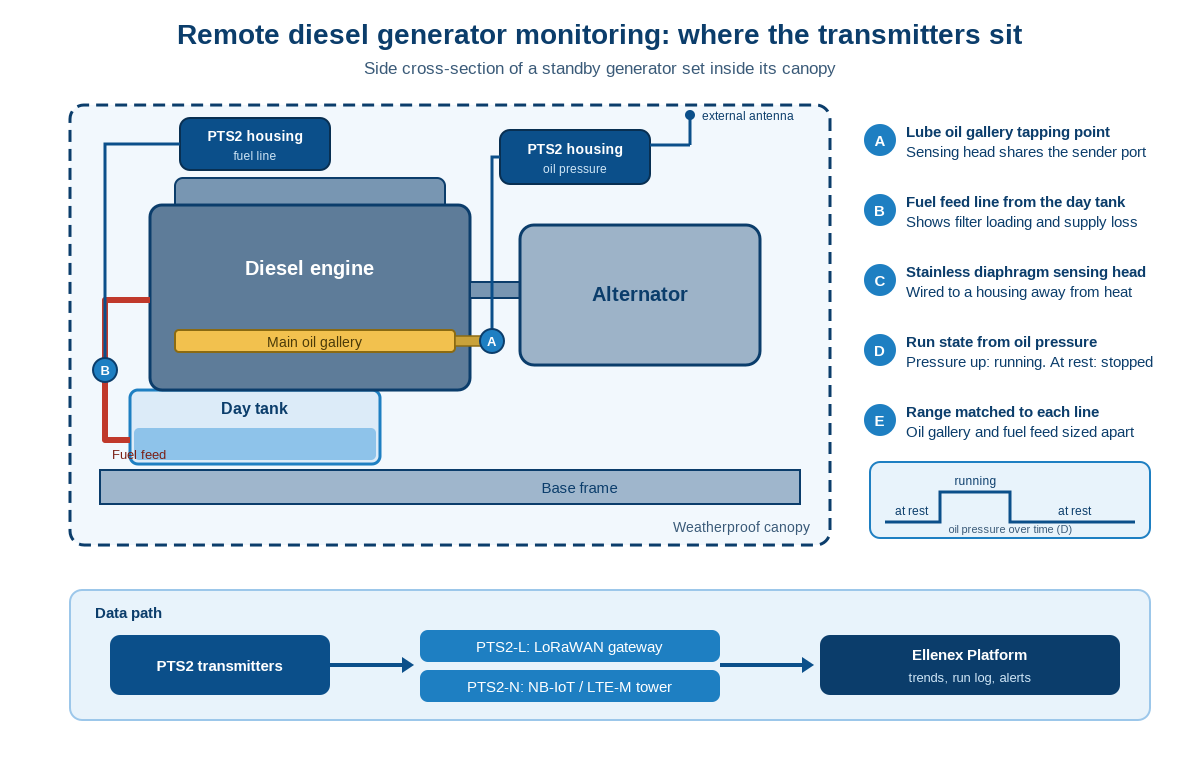
The approach is simple in outline: place a pressure transmitter where the engine already exposes a meaningful pressure, read it on a schedule, and let software interpret the pattern. Each step below matches a label on the installation diagram that follows.
The Lube Oil Gallery: The Engine's Plainest Health Signal
Most diesel engines have a threaded port on the main oil gallery, typically where a factory oil pressure sender or gauge connects. Pressure there rises as soon as the oil pump turns and settles at a steady value while the engine runs. A healthy engine repeats the same pattern start after start, so a reading that comes up slowly, sits lower than usual or wanders during a run is an early warning worth acting on.
The Fuel Feed Line From the Day Tank
A second transmitter on the fuel feed line, between the day tank and the engine's fuel system, watches the supply side. A blocked filter, a collapsing hose or a tank running low all show up as a change in feed pressure, often before the engine itself misbehaves. This is a different question from how much diesel is stored; the Remote Diesel Tank Level Monitoring solution covers tank contents, while the feed line tells you whether fuel is actually flowing.
A Stainless Diaphragm Converts Pressure Into a Signal
Inside the transmitter, oil or fuel pushes on a thin stainless diaphragm, and a piezoresistive sensing element bonded behind it turns that small flex into an electrical signal. The PTS2-L and PTS2-N both handle liquids and gases compatible with stainless steel, and both can be ordered with a vented gauge, sealed gauge or absolute reference, so the reading can be matched to how the line behaves.
Running or Resting: Run State Taken From Pressure
Because oil pressure exists only while the engine turns, the Ellenex solution infers run state from pressure thresholds. When the reading climbs past a set point, the Platform marks the set as running; when it falls back, the run ends. That gives start and stop events, run duration and a record of every exercise test without any connection to the controller.
Matching the Range to Each Line
Oil galleries and low-pressure fuel feeds sit in very different parts of the pressure scale, so the two transmitters are specified separately, each with a span that suits the line it sits on. A range that suits the line keeps normal operation in the useful middle of the scale and leaves headroom for start-up surges.
Sampling Around Test Runs and Real Outages
Both transmitters take readings on a configurable interval, and the interval can be changed remotely by downlink without a site visit. Sampling can also be set to respond to events, and transmission can be made conditional, so a quiet standby day costs little battery while a run is captured in useful detail. Ellenex rates these batteries in readings and transmissions delivered rather than in calendar time, so the life you see on a generator follows directly from how often you set it to sample and report. The Ellenex post on battery behavior in IoT devices explains why that budget matters.
Private Gateway or Straight to the Tower
On the PTS2-L, readings travel by LoRaWAN radio to an Ellenex outdoor gateway at the site; the gateway hands them to a network server, and from there they reach the Platform. That suits depots, treatment works and campuses where several sets stand within reach of one gateway. The PTS2-N skips the gateway entirely and links directly to the public mobile network through NB-IoT or LTE-M, so a lone generator at a telecom site or rural pump station needs nothing else installed. For a fuller comparison, see LoRaWAN vs NB-IoT for industrial monitoring.
What the Platform Builds From Each Reading
On the Ellenex software platform, readings become live dashboards, historical trends and alerts with adjustable high and low thresholds sent through multiple channels. The solution also reports battery voltage and signal strength for each device, logs start and stop cycles, and flags sudden drops and unusual activity. Data can leave through an open API, webhooks or data forwarding to SCADA and enterprise systems, and role-based access lets operators, contractors and managers see what they need.
Generator Fleets Run From a Screen Instead of a Truck
Readiness becomes visible every day: a dashboard shows which sets have healthy oil pressure on their last run and which have not run at all.
Exercise tests prove themselves: run state records confirm that a scheduled test happened and lasted long enough, without anyone signing a sheet on site.
Alerts reach the right person: a low oil pressure warning or falling feed pressure goes straight to the technician on call rather than waiting for the next visit.
Unplanned runs are noticed: a set that starts without a mains failure or a scheduled test is flagged for investigation.
Maintenance follows actual use: logged run time lets service intervals track how hard each engine has really worked.
Outage reviews rest on facts: after an event, the record shows when each generator started, how it behaved and when it stopped.
The Payback From Knowing a Generator Will Start
The value of monitoring standby sets comes from avoided trouble more than from new revenue. For a structured way to compare those savings with what a rollout costs, see the Ellenex knowledge center article on the economics of IoT projects.
Site Trips Booked for Work, Not for Looking
Routine drive-outs simply to read gauges and confirm a test run give way to visits with a purpose, which matters most when generators are hours apart.
Fuel Faults Caught Before They Strand a Run
Feed pressure trends expose clogged filters and supply problems while the engine is still healthy, so the fix is a filter change rather than a failed outage response.
Engines Spared From Running Short of Oil
Early warning on sagging oil pressure gives time to top up, repair a leak or take a set out of service before bearings and crankshafts pay the price.
Fewer Lone Visits to Isolated Compounds
Every avoided trip to a remote enclosure is one less drive on rural roads and one less person working alone around rotating machinery.
Service Planning Based on Logged Run Hours
Start and stop records feed maintenance planning, parts ordering and contractor scheduling with real usage instead of estimates.
A Retrofit That Leaves the Controller Untouched
The transmitters arrive pre-configured, thread into existing tapping points and run on their own batteries, so adding them does not mean rewiring a generator control panel.
Records That Support Replacement and Contract Decisions
Months of run and pressure data show which sets are reliable, which are tired and whether service contracts are delivering what they promise.
Six Standby Challenges, Six Ellenex Responses
Each monitoring challenge above has a matching feature in the Ellenex hardware and Platform.
Long Idle Spells: Readings That Continue Between Runs
Scheduled readings keep arriving while the engine rests, so a stopped set still checks in, and a device that goes silent is noticed through its device health record. The PTS2-L product page and PTS2-N product page list the configuration options for sampling and transmission.
Nobody on Site: Alerts That Travel
Variable high and low alarm settings with multi-channel alerting replace the warning lamp nobody can see. Sudden-drop alerts suit oil pressure during a run, while slower trend alerts suit fuel filters that load up over weeks. Field staff can also follow readings on the Ellenex mobile app.
Heat, Vibration and Oil Mist: Hardware Choices for Engine Bays
Both transmitters come in a compact housing or as a wired version, where the sensing head sits on the tapping point and the electronics housing is mounted on a cable away from the hottest and busiest parts of the engine. The weather-sealed, UV-protected enclosure is built for outdoor use.
No Engine Power When Stopped: Battery Operation
A replaceable internal lithium battery runs each transmitter regardless of whether the generator or mains is available. External power is an option where a site prefers it.
Scattered Sites and Clustered Yards: Choosing the Network
Clustered sets on one property suit the PTS2-L with a private gateway and no per-device SIM fees. Generators spread across a region suit the PTS2-N on public NB-IoT or LTE-M coverage, using a nano-SIM that can come from the network provider of your choice.
Mixed Fleets: A Sensor That Does Not Care About the Controller
Because the transmitter reads pressure directly from the line, it works the same way on any make or age of engine. Process connection options cover common threaded ports, and other fittings can be arranged on request.
From Tapping Point to Alert: Mechanism and Outcome
A pressure transmitter on the oil gallery reads lube oil pressure.
Outcome: engine wear and oil loss are seen before they cause damage.
A second transmitter on the fuel feed line reads supply pressure.
Outcome: fuel restrictions are found while the set can still run.
Pressure thresholds on the Platform mark start and stop events.
Outcome: every test and outage run is recorded with its duration.
A radio link chosen per site, either LoRaWAN via a gateway at the yard or a cellular link that needs no gateway.
Outcome: readings arrive from clustered yards and lone sites alike.
Encrypted payloads, device health data and role-based access on the Platform.
Outcome: trusted data shared with the right people, and integration with SCADA through the API.
Fitting Transmitters to a Generator Without Upsetting It (General Practice)
The points below reflect widely accepted field practice for pressure instruments on engines; they are general guidance, not Ellenex procedures.
Isolate first: lock out the generator and its automatic start before opening any oil or fuel connection.
Keep the factory sender working: where the oil gallery port already carries the controller's own sender, a tee or adapter lets both share the port, so engine protection is unchanged.
Use sealants suited to oil and diesel: thread compounds must resist the fluid and the temperatures around the engine.
Mount electronics away from heat: keep the housing clear of exhaust manifolds and turbochargers, and use the wired version where space is tight.
Secure cables against vibration: clip cables so they cannot chafe against frames or rotating parts.
Think about the canopy: a steel enclosure can weaken radio signals, so an external antenna may be needed.
Check on the first run: start the set, look for weeps at every new fitting, and confirm that the Platform registers the run.
Zero Checks, Battery Swaps and Routine Care for Generator Sensors
Use the natural zero: with the engine stopped and the oil gallery at rest, a gauge-referenced oil reading should return to its resting value; a reading that does not is worth investigating.
Compare against the panel gauge: at each service, note the controller or mechanical gauge reading alongside the transmitter's value during a run.
Watch battery voltage: the Platform reports battery voltage, so cells can be changed during a planned service rather than after a transmitter falls silent.
Inspect tapping points: look for oil or fuel weeps and loose fittings whenever the engine is serviced.
Keep firmware current: updates can be delivered over the air, which avoids an extra visit.
Standby Sets That Prove Their Readiness Every Day
With remote diesel generator monitoring in place, readiness stops being an assumption. Operations teams see which generators ran their tests, which are drifting toward a fault and which need fuel attention, and they act on that during normal working hours. Maintenance spending follows real engine use, outage reviews start from a factual timeline, and the people responsible for critical loads gain confidence that the next mains failure will be met by an engine that starts and keeps running. The same pressure-based approach extends naturally to related assets, from data center and AI infrastructure monitoring to power transformer pressure monitoring, and every site added strengthens the wider infrastructure monitoring picture.
Frequently Asked Questions
Why do standby diesel generators fail to start when they are needed?
Most standby generators that let a site down do so for ordinary reasons rather than dramatic ones. Fuel is the most common culprit: air drawn into the lines, filters clogged with sediment or microbial growth, a day tank that was never refilled after the last run, or diesel that has aged in storage. Starting batteries that have weakened over a long idle period, low coolant or lubricating oil, and controls left in the wrong mode after maintenance are close behind. What these faults share is that they develop quietly while the engine sits unused, and a generator that is only checked on a site visit can carry a hidden problem for weeks before the outage that finally exposes it.
The Ellenex Remote Diesel Generator Monitoring solution is designed to surface those quiet faults early. One pressure transmitter on the lube oil gallery and another on the fuel feed line from the day tank report on a schedule, whether the engine is running or not. On the Ellenex Platform, a falling feed pressure points to a filter or supply problem, an oil pressure that rises slowly or sits low during a test run points to an engine that needs attention, and a set that has not recorded a run when one was due is flagged. Teams can then fix the cause during a normal working day instead of discovering it when the grid goes down.
How often should a standby generator be exercised and tested?
The right testing schedule comes from the generator manufacturer, the site's own risk assessment and any standard that applies to the installation. In the United States, for example, emergency and standby power systems in many facilities follow NFPA 110, the National Fire Protection Association's standard for emergency and standby power systems, which sets out routine inspection, exercising and load testing. Regular exercise keeps seals lubricated, moves fuel through the system, charges starting batteries and reveals faults while there is still time to fix them. The weakness in many programs is not the schedule itself but proving that each test actually happened and ran long enough, especially at remote sites where a technician has to drive out to start the set and sign a log.
Ellenex monitoring provides that proof automatically. Because oil pressure exists only while the engine turns, the Ellenex Platform uses pressure thresholds to record every start, stop and run duration without any connection to the generator controller. A scheduled exercise appears as a logged run with its oil and fuel pressure behavior attached, while a missed or shortened test is easy to spot. The same record gives auditors and asset managers a clear history of testing across a whole fleet, and alerts can notify the responsible technician when a set that should have run on schedule has stayed silent.
What does oil pressure tell you about the health of a diesel engine?
Lubricating oil pressure is one of the most direct indicators of an engine's condition. When the engine starts, the oil pump builds pressure in the main gallery, forcing oil to the bearings, camshaft and other moving parts, and on a healthy engine that pressure rises promptly and settles at a stable value that repeats from one run to the next. A slow rise, a lower settled value, or pressure that wanders during a run can point to worn bearings or pumps, a blocked filter, low oil level, fuel dilution or a leak. Caught early, these are service items; ignored, they can lead to bearing damage and an expensive rebuild, often at the very moment the generator is carrying a critical load.
The PTS2-L and PTS2-N pressure transmitters read oil gallery pressure using a piezoresistive element mounted behind a thin stainless steel diaphragm, and they can share the port with the engine's own sender through a tee or adapter, so factory protection stays in place. On the Ellenex Platform, each run's oil pressure trace can be compared with earlier runs, and adjustable high and low thresholds plus sudden-drop alerts warn the right people through several channels. That turns a gauge nobody watches into a running health record for every engine in the fleet.
Can a generator be monitored remotely without connecting to its controller?
Yes, and for mixed fleets it is often the most practical approach. Generator controllers vary widely between makes, models and ages, and integrating each one with a remote system can mean custom wiring, protocol converters and specialist programming. Many older sets have no communications port at all. Reading physical signals directly from the engine avoids that complexity: pressures at the oil gallery and fuel line behave the same way on almost any diesel engine, so the same sensor and setup can be used across the fleet. It also keeps the monitoring separate from the generator's own protection logic, which many owners and service contractors prefer.
Ellenex transmitters thread into existing tapping points, arrive pre-configured and run from their own replaceable lithium battery, so they keep reporting even when the engine is stopped and mains power has failed. External power is available as an option. The PTS2-L reports over LoRaWAN to a private gateway, which suits yards where several sets stand together, while the PTS2-N reaches the public mobile network over NB-IoT or LTE-M for lone generators at pump stations or telecom sites. Both deliver their readings to the Ellenex Software Platform, where they can also be forwarded to SCADA or enterprise systems through the open API.
How does remote monitoring help with generator maintenance planning?
Traditional generator maintenance is usually calendar-based: a service every set number of months, regardless of how much the engine actually ran. That approach over-services sets that rarely start and under-services those that carried long outages or frequent unplanned runs. It also relies on site logs that are often incomplete, so maintenance teams plan around estimates. With real usage data, service intervals, oil and filter changes, parts orders and contractor visits can be matched to the work each engine has really done, and problems that show up between services can be scheduled before they become breakdowns.
The Ellenex Platform builds that usage record automatically from start and stop events and logged run time, alongside oil and fuel pressure trends that show when a filter is loading up or an engine is starting to wear. It also reports each transmitter's battery voltage and signal strength, so sensor batteries can be swapped during a planned service rather than after a device goes quiet, and new firmware can be delivered remotely. Battery capacity is quoted as a number of readings and radio messages, so the sampling schedule chosen for each set decides how often that swap is needed. Over months, the data also shows which generators are reliable and which are candidates for replacement.
Related Reading
Innovative Solution for Diesel Generator Monitoring: how pressure sensing at a tank outlet tracks fuel stocks for remote generators.
Top 11 Applications for Ellenex PTS2 & PTS3 Ruggedized Pressure Sensors: the wider range of industrial jobs these transmitters perform.
Hydraulic System Pressure Monitoring: reading pressure spikes before a hydraulic pump fails.
LoRaWAN vs NB-IoT for Industrial Monitoring: choosing a connectivity route for industrial sensors.
Useful Links
Talk to Ellenex
Pick the generator you would least like to see fail on demand. Use the Ellenex sales inquiry page to tell us its location, the load it protects and whether it sits near a gateway or within mobile coverage. Ellenex will come back with transmitters for its oil gallery and fuel line, a network route and an alert plan built around the people who answer outages. Full details of the package are on the Remote Diesel Generator Monitoring solution page.


