

Six Blind Spots Refrigerated Transport Monitoring Closes on Every Trip


Key Takeaways
Watch the trip, not just the doors: a load checked only at dispatch and arrival can warm up and recover, or warm up and stay warm, with nobody knowing until it is too late.
Measure in the load, not at the evaporator: the air leaving the refrigeration unit is the coldest in the box, so a probe placed there flatters the reading.
Give every alert a grace period: short rises during loading and delivery stops are normal; alert when a rise lasts longer than the handling routine explains.
Pair temperature with position: a reading stamped with a location shows which stage of the trip caused a problem and who was responsible for it.
Match the reporting rate to the cargo: sensitive loads justify frequent readings; stable ones can report less often and stretch the battery further.
Two Door Checks and a Long Gap Between Them
On most refrigerated trips, the cargo is checked twice: when the doors close at dispatch and when they open at the destination. Everything that happens in between, from highway hours and traffic delays to cross-dock waits and overnight parking, is usually taken on trust. Refrigerated transport monitoring closes that gap by measuring cargo temperature throughout the journey, attaching a location to each reading and sending the data to people who can act on it while the vehicle is still moving.
The goods involved vary widely. Fresh produce, frozen food, dairy, flowers, medicines and specialty chemicals all travel in refrigerated trucks, vans and containers, and each has its own temperature band. The common problem is that heat damage is rarely visible from the outside, so the condition of a load is only as well known as the temperature history that came with it.
Ellenex addresses this with its Cold Chain Temperature & Location Monitoring solution. A cellular temperature transmitter with built-in satellite positioning reports cargo temperature and location to the Ellenex Platform, with no gateway or vehicle wiring required.
Spoiled Loads, Refused Deliveries and Units That Fail Unseen
When nobody can see what happens between dispatch and delivery, the same failures repeat:
Product written off at the destination: a load that warmed on the road may be unsellable or unusable by the time the doors open, and the cost of the goods, the freight and the replacement order all land at once.
Deliveries refused at the dock: receivers that doubt a load's condition may reject it outright, triggering return trips, disposal and short stock for the customer.
Refrigeration faults that run for hours: a unit that trips, loses fuel or loses power on a parked trailer can go unnoticed until someone opens the doors.
Arguments over who is responsible: shipper, carrier and receiver each see only their part of the trip, so disagreements about where a load warmed drag on without a clear answer.
Causes that are never fixed: without data showing which lane, stop or vehicle keeps causing problems, the same warm-ups happen again on the next run.
Six Blind Spots in a Refrigerated Journey
Temperature in transit is harder to keep track of than temperature in a cold room, for several practical reasons:
The asset keeps moving: trucks, vans and containers pass through depots, highways, ports and customer sites, so there is no fixed network or power point to rely on.
Every handoff opens the doors: loading, cross-docking, driver changes and multi-drop deliveries each let warm air in and add waiting time.
The unit display tells only part of the story: it reports air temperature near the evaporator, which can look fine while pallets near the doors or under the roof warm up.
Manual checks happen only at stops: a driver can read a display when the vehicle is parked, but not during the long stretches between, which is when many problems begin.
Cargo spaces are harsh on electronics: cold, condensation, vibration and washdowns all shorten the life of equipment that is not built for them.
Fleets are rarely uniform: owned trucks, leased trailers and subcontracted carriers seldom share a refrigeration controller or telematics system that could carry temperature data.
Refrigerated Transport Monitoring, Reading by Reading
The steps below follow a single temperature reading from the cargo space to the screen of the person responsible for the load. Placement points are general industry practice; settings for a particular application should be agreed with Ellenex.
Choosing Where the Probe Sits in the Load
The TTG2-N datasheet offers three build styles: a sensing head and housing joined by cable, a sensing element in a thermowell fitted to the housing, or a housing with a separate cable. The cabled versions let the electronics sit where they are protected while the probe reaches into the load. As general practice, the probe goes where the product is most likely to warm first, often near the rear doors or high in the box, rather than in the cold airflow leaving the unit. A short temperature mapping exercise on a representative trip is the usual way to find that spot.
A Platinum Element Inside a Stainless Sheath
The TTG2-N measures with a platinum resistance temperature element, whose resistance changes predictably as temperature changes. The element sits inside a stainless steel sheath on silicone rubber cable, a combination suited to cold, damp cargo spaces that are washed down between loads. The transmitter converts the element's signal into a calibrated temperature value.
A Position Fix Stamped on Each Value
A satellite positioning receiver inside the TTG2-N works with GPS, GLONASS, BeiDou, Galileo and QZSS under open sky. According to the solution datasheet, each report can carry latitude and longitude, movement status and speed alongside cargo temperature, and the platform keeps historical route and temperature logs for every trip. That pairing is what turns "the load warmed up" into "the load warmed up while parked at a particular stop".
Thresholds With a Grace Period
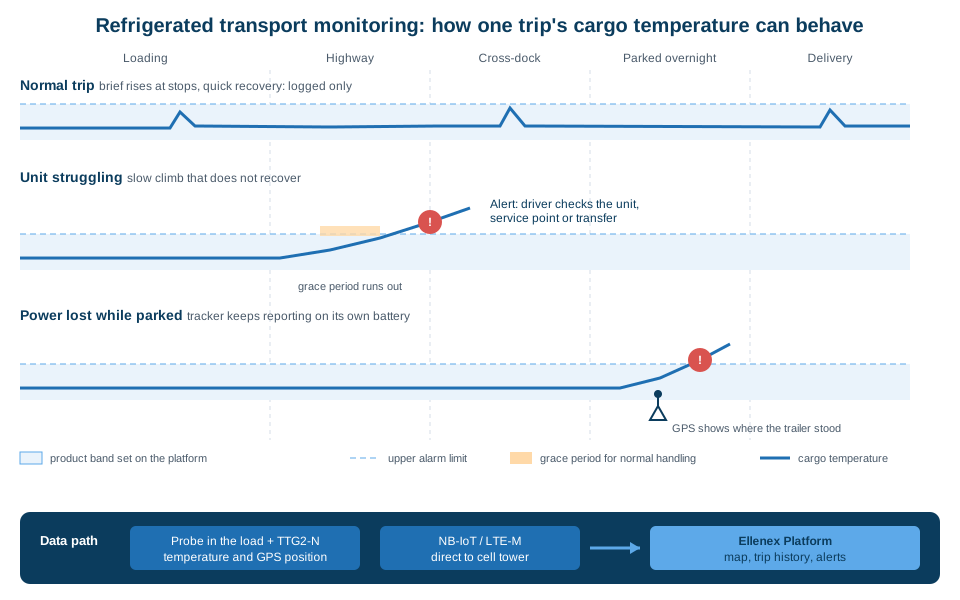
High and low alarm limits are set on the Ellenex Platform. In general practice, a useful alert combines a limit with a time allowance: a short rise that recovers quickly is the typical signature of doors opening at a stop, while a rise that keeps going beyond the allowance points to a unit fault, a power loss or blocked airflow. Setting that allowance for each type of cargo keeps alerts meaningful instead of constant.
How Often to Read, and What That Costs the Battery
The sampling interval can be changed remotely through a downlink, and the platform also lets teams set when a reading should be transmitted. The TTG2-N runs from a replaceable lithium battery, and its endurance is listed as a total of readings and a total of transmissions rather than a period of time. The practical result is that a tracker reporting often on a sensitive lane will need a fresh battery sooner than one reporting occasionally on a stable route.
Straight to the Cell Network, No Gateway Required
The TTG2-N sends its data over NB-IoT and LTE-M directly to public cell towers, so nothing needs to be installed at the depot or in the cab. LTE-M supports mobility, keeping a moving vehicle connected as it passes from one cell to the next. The same direct-to-tower route is described for trucks in our on-board mass monitoring article.
From Raw Message to Map, Trend and Alert
On the Ellenex Software Platform, each message becomes part of a live view and a trip history. The platform raises high and low threshold alerts through several channels, offers role-based access for different teams and companies, supports data export, and reports device health such as battery voltage and signal strength, so a silent tracker can be told apart from an uneventful trip.
Fleet Desks That Act While Wheels Are Still Turning
Once loads report their own temperature and position, day-to-day work in a refrigerated fleet changes:
Problems surface mid-trip: a dispatcher sees a warming trailer while there is still time to call the driver, find a service point or arrange a transfer.
Each vehicle appears with its cargo temperature: the map shows not just where a truck is, but whether its load is within its band.
Handoffs leave a trace: readings around loading, cross-docking and delivery show which stage held the load outside its range.
Drivers stop doing paperwork at every stop: the record builds itself, including the stretches between stops that manual checks never cover.
Receivers can review a trip before unloading: the full history is available when a delivery arrives, so acceptance decisions are based on data.
Recurring trouble becomes visible: over weeks, repeated warm-ups on the same lane, at the same stop or with the same trailer stand out clearly.
Adding Up the Payoff of Watching Loads in Transit
The value of transit monitoring depends on the cargo, the lanes and the fleet. The Ellenex guide to the economics of an IoT rollout helps put figures to the benefits below for a specific operation.
Fewer Roadside Stops to Read a Display
Drivers no longer need to pull over just to check and record a temperature, which saves time and keeps doors closed.
Product Saved Before It Warms Past Its Limit
An alert that arrives while a load is still drifting gives the team a chance to act before the goods are lost.
Refrigeration Faults Caught Early
Slow recovery after door openings or a steady upward creep often shows a unit that is struggling, so the workshop can inspect it before it fails on the road.
Less Time Spent Inside Cold Boxes
Fewer manual probe checks mean fewer trips into cold, slippery cargo spaces for drivers and dock staff.
Schedules Shaped by Measured Lanes
A history of location-tagged readings shows which routes, seasons and dwell points cause trouble, so loading plans and schedules can be adjusted with evidence.
A Tracker That Arrives Ready to Mount
The solution datasheet describes the solution as pre-configured, with the SIM either pre-installed or supplied by the customer, so adding a tracker to a trailer does not require a telematics project.
Data for Carrier and Packaging Choices
Comparable records across vehicles, carriers and packaging types support decisions about contracts, pallet layouts and which lanes need extra protection.
TTG2-N Answers to Each Blind Spot
A Moving Asset: Readings That Travel With the Load
Because the TTG2-N reports over public cellular networks, its record continues between depots, along highways and at customer sites without any local infrastructure.
Doors Opening at Every Handoff: Location-Stamped History
Each reading carries a time and position, so the effect of every stop can be seen and separated from genuine refrigeration problems.
A Misleading Unit Display: A Probe in the Product Zone
Cabled probe options let the sensing element sit among the cargo rather than in the evaporator airflow, so the reading reflects what the product experiences.
Gaps Between Manual Checks: Readings on a Schedule
The tracker reads on a schedule that can be adjusted remotely, so the record covers the whole journey, not just the stops.
Harsh Cargo Spaces: A Sealed, Stainless Build
The stainless sheath, silicone rubber cable and weather-sealed, UV-protected housing suit cargo spaces that see cold, condensation and cleaning. Internal antennas are standard, with external and high-gain antenna options for insulated steel bodies that weaken radio signals.
Mixed Fleets: A Tracker That Needs Nothing From the Vehicle
The TTG2-N runs on its own replaceable battery and talks directly to the cell network, so it works the same way on owned, leased and subcontracted equipment and keeps reporting from a parked, unpowered trailer. Where vehicle power is available, the rectangular housing can be ordered with an external supply connection and internal battery backup.
Cold Chain Package at a Glance: Mechanism and Outcome
A platinum temperature probe in the load feeds the TTG2-N, which adds a satellite position to each reading.
Outcome: every value arrives with a time and place, so a warm-up can be traced to a stage of the trip.
Readings travel over NB-IoT or LTE-M straight to the cell network.
Outcome: nothing needs installing at the depot, and nothing depends on the vehicle's own systems.
Alarm limits, reading intervals and transmission conditions are set remotely on the platform.
Outcome: alerts can be tuned to each cargo type, reducing nuisance alarms from routine stops.
The Ellenex Platform stores trip histories, reports device health and offers integration APIs.
Outcome: the right people get alerts, and trip data can flow into other business systems.
Refrigerated Freight Assumptions Worth Rechecking
Several beliefs about refrigerated transport are widespread but do not always hold up in practice.
"If the unit display is in range, the load is fine." The display usually reports air near the evaporator. Product near the doors or at the top of a tightly packed load can be noticeably warmer, which is why probe position matters.
"A short spike always means trouble." Brief rises during loading and delivery stops are normal. What matters is whether the temperature recovers within the expected time.
"A logger in the box gives the same protection as live monitoring." A logger that is read at the destination records what happened, but it cannot warn anyone while there is still time to act.
"Trackers only make sense on long-haul routes." Multi-drop urban routes open the doors far more often, and those repeated openings are a common source of warm-ups.
"Monitoring means fitting new equipment to every truck's systems." A self-powered cellular tracker works independently of the vehicle and its refrigeration controller.
Getting Trip Data Into Dispatch and Business Systems
Temperature data is most useful where decisions are already made. The Ellenex Platform offers integration APIs and data export, and the TTG2-N datasheet lists compatibility with common IoT protocols and major cloud platforms.
Shipment matching: linking each tracker to an order or consignment lets temperature events appear against the right delivery.
Shared views: multi-tenant, role-based access lets customers and subcontracted carriers see only the shipments that concern them.
Exports for review: trip histories can be exported for quality teams, customers or insurers.
Mobile access: dispatchers and managers can check live readings through the Ellenex mobile app as well as the web dashboard.
Loads That Report Their Own Journey
With location-tagged temperature readings in place, a refrigerated load is no longer known only at the moment its doors open. Dispatchers can step in while a warming trailer is still on the road, workshops see struggling units before they fail, and receivers can review a trip before accepting it. Over time, the same records show which lanes, stops and vehicles cause problems, turning temperature control in transit into a process that can be measured and improved. The same approach underpins other Ellenex fleet and asset applications, from on-board mass monitoring to diesel tank level monitoring and chemical tank level monitoring, all within the wider Ellenex infrastructure monitoring portfolio.
Frequently Asked Questions
What is refrigerated transport monitoring, and how does it work?
Refrigerated transport monitoring is the practice of measuring the temperature of goods while they travel in refrigerated trucks, vans, trailers or containers, and sending those readings to people who can act on them. It sits alongside the refrigeration unit rather than replacing it: the unit keeps the cargo space cold, while the monitoring system checks that it is actually succeeding and records what happened along the way. A typical setup combines a temperature probe in the load, a transmitter that turns each reading into a message, a wireless network that carries the message and software that displays trends and raises alerts. Many systems also record the vehicle's position, so each reading can be linked to a place on the route as well as a moment in time.
The Ellenex Cold Chain Temperature & Location Monitoring solution follows this pattern with the TTG2-N transmitter. A platinum temperature element in a stainless steel sheath measures the cargo space, a built-in satellite receiver adds the vehicle's position, and the transmitter sends readings over NB-IoT or LTE-M directly to the cell network. On the Ellenex Platform, those readings appear on a live view and trip history, with high and low alerts that can be sent to the people responsible for each load. Reading frequency is adjustable from a distance and trip data can be exported, so the level of detail can be matched to each type of cargo.
Why do loads warm up during refrigerated transport?
Most warm-ups come from a handful of familiar causes. Doors opened during loading, cross-docking and delivery let warm air in, and multi-drop routes multiply those openings. Product loaded warmer than its target temperature takes a long time to pull down, because transport units are generally designed to hold temperature rather than to cool goods quickly. Tightly packed pallets or loads stacked against the evaporator or the rear doors can block airflow and create warm pockets. Mechanical and power problems also play a part: a unit that trips, runs low on fuel or loses its power connection while a trailer is parked can let a load warm for hours before anyone notices.
Continuous readings help separate these causes. Because each TTG2-N reading carries a time and position, a team using the Ellenex solution can see whether a rise happened at a stop, during a long highway stretch or while a trailer was parked, and whether it recovered. A quick rise and recovery usually points to a door opening, while a steady climb suggests a unit or airflow problem. Threshold alerts on the Ellenex Software Platform flag the rises that last too long, so attention goes to the events that matter. Over many trips, the same records show which stops, routes or vehicles produce the most warm-ups.
Where should a temperature probe be placed in a refrigerated truck or container?
There is no single correct position, but general practice is to measure where the product is most at risk rather than where the air is coldest. The air leaving the evaporator is the coldest point in the cargo space, so a probe there tends to show a reassuring number even when other parts of the load are warmer. Zones near the rear doors, at the top of the load and in corners with poor airflow are often the first to warm. Many operators run a temperature mapping exercise on a typical trip, with several temporary sensors spread through the load, to find the warmest spot for their vehicle and loading pattern, and then place the permanent probe there.
The TTG2-N supports this approach with build options that separate the probe from the electronics. Cabled versions let the stainless steel sensing head reach into the load while the housing is mounted where it is protected from forklifts and shifting cargo, and a thermowell version suits mounting directly on the housing. Because insulated steel bodies weaken radio signals, the datasheet's external and high-gain antenna options help where the tracker body has to sit inside the cargo space. Position and antenna can both be confirmed on a short trial before a fleet-wide rollout, and the first readings show straight away whether the chosen spot behaves as expected.
Can refrigerated vehicles be monitored in real time without connecting to the truck's own systems?
Yes. Many fleets assume that live temperature data must come from the refrigeration controller or the vehicle's telematics unit, and in some cases it can. But those systems vary between manufacturers, models and ages, and leased or subcontracted equipment may not offer access at all. A self-contained tracker avoids that dependency: it carries its own sensor, its own power and its own network connection, so it can be fitted to almost any refrigerated vehicle or container. As general practice, a trial on a few vehicles of each type is a sensible way to confirm mounting, probe routing and signal strength before wider use.
The TTG2-N is built for this kind of independent installation. It runs from a replaceable lithium battery and keeps reporting from a parked, unpowered trailer, with an external supply and battery backup available on the rectangular housing where vehicle power is convenient. It connects directly to public cell towers over NB-IoT or LTE-M, with no gateway in the depot or the cab, and according to the solution datasheet it is pre-configured before shipping, with the SIM pre-installed or supplied by the customer. Readings appear on the Ellenex Platform without any link to the vehicle's own electronics, and over-the-air firmware updates keep ongoing care light.
Does refrigerated transport monitoring work for mixed fleets and subcontracted carriers?
Mixed fleets are where monitoring is often most needed and hardest to arrange. A shipper may use its own trucks for some routes, leased trailers for others and several subcontracted carriers on top, each with different equipment and record-keeping habits. When something goes wrong, data from these sources is difficult to compare, and some carriers may have no temperature records at all. A common tracker and a shared platform give every load the same type of record, whoever is driving, and make it possible to compare performance across carriers, routes and equipment on equal terms.
The Ellenex solution suits this situation because the TTG2-N does not rely on any particular vehicle or refrigeration unit, and the Ellenex Platform offers multi-tenant, role-based access. A shipper can see every shipment, while each carrier or customer sees only the loads that concern them. Integration APIs and data export let trip histories flow into the shipper's own systems, so temperature events can be reviewed alongside orders and deliveries. Because every tracker reports in the same format, performance can be compared fairly across carriers and lanes, and a new subcontractor can join simply by fitting trackers to its vehicles. More detail on the approach is on the solution page.
Related Reading
Empowering Cold Chain: A Triumph of Precision with Ellenex Temperature Monitoring: temperature monitoring for cold storage.
Temperature Sensor Applications in Cold Chain Logistics: where temperature sensors fit across a cold chain.
Enhancing Frozen Food Delivery: The Role of Real-Time Remote Temperature Control and Spoilage Prevention: keeping frozen deliveries cold to the doorstep.
How On-Board Mass Monitoring Catches an Overloaded Truck Before It Leaves: another truck application built on a cellular transmitter.
Useful Links
Talk to Ellenex
Most fleets already know which route worries them. Tell us that route, the type of cargo it carries, the vehicles that run it and who should hear first when a load starts to warm, using the Ellenex sales inquiry page, and our team will suggest probe positions, alert settings and a reporting rhythm for refrigerated transport monitoring on that lane.


