

How On-Board Mass Monitoring Catches an Overloaded Truck Before It Leaves


Key Takeaways
Treat load as a live reading, not a surprise at the scale. On-board mass monitoring estimates axle group and gross mass while the truck works, so overload becomes something you can act on before the vehicle leaves the loading face.
Let the suspension do the weighing. The hydraulic pressure in the suspension line rises and falls with the weight carried, and one sensor threaded into an existing port can read it without cabling.
Alert on the limit, not on the complaint. Configurable axle group and gross mass thresholds send an overload alert by SMS, email or app message while there is still time to shift or offload material.
Keep location beside every mass reading. The built-in GPS ties each estimate to a place and speed, which turns a number into a record of where a load was picked up and carried.
Plan battery around reporting habits. Capacity is rated in readings and transmissions, so a sensible sampling and sending schedule matters more than any calendar promise.
Weighbridge Surprises Start at the Loading Face
The first time many fleets learn that a truck was overloaded is when somebody else tells them. A weighbridge operator, a roadside inspector or a customer's audit flags the trip, and by then the material is already on the road. On-board mass monitoring moves that moment forward. Instead of finding out at a checkpoint, the vehicle reports its own estimated load as it is filled, so the person holding the loader bucket or the dispatch screen can still change the outcome.
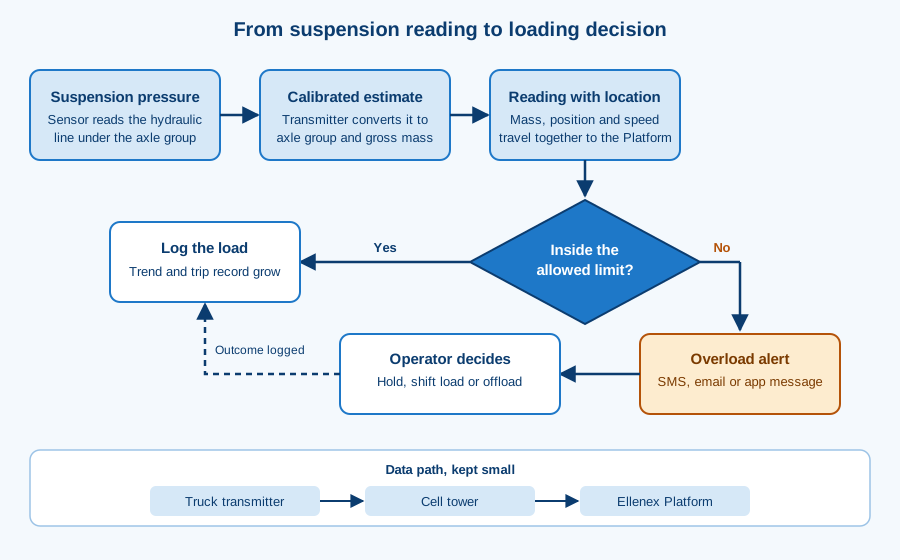
The idea is simple. A loaded truck pushes down on its suspension, and in a hydraulic suspension the pressure in the line follows that weight. A small transmitter measures that pressure, applies calibration to turn it into an estimated axle group and gross vehicle mass, and sends the result over a cellular connection together with the truck's position and speed.
Ellenex builds this idea into its Smart OBM (On Board Mass) Monitoring solution, a battery-powered cellular transmitter with GPS that reports to the Ellenex Platform. This article explains how the measurement works, what it changes for a haulage operation and how to specify it without drowning in options.
It is written for fleet managers, mine and quarry planners, logistics engineers and compliance leads who need a practical picture of the technology before they talk to a supplier. For wider context on the family of devices it belongs to, the Ellenex infrastructure monitoring overview is a useful starting point.
Overloaded Trips Add Up in Fines, Wear and Lost Trust
A truck that is loaded past its limit rarely fails dramatically on the day. The costs arrive in smaller, less visible pieces, and most of them are paid by someone other than the person who loaded the vehicle.
Penalties and held vehicles. Road weight limits are enforced by regulators, and an overloaded trip can mean fines, a vehicle held until material is removed and a driver waiting at the roadside. Some jurisdictions also spread responsibility beyond the driver to other parties in the transport chain, so the exposure is not only on the road.
Accelerated wear. Suspension, axles, brakes and tires are sized for a defined load. Running above it repeatedly shortens their life and brings unplanned repairs forward.
Handling and braking risk. A heavily loaded vehicle takes longer to stop and behaves differently on grades and in corners, which raises safety risk for the driver and for everyone sharing the road.
Damaged roads and site tracks. Overweight axle loads punish haul roads, bridges and gravel access routes, and the repair bill often lands on the operator or the site owner.
Disputes with no evidence. When a customer or inspector questions a load, a fleet without its own records has little to point to. Memory and a loading ticket are weak evidence.
The opposite error also costs money. Trucks sent out well below their allowed load carry less product per trip, which means more trips, more fuel and more driver hours to move the same material.
A Moving Truck Is a Hard Thing to Weigh
Fixed weighbridges are accurate and widely trusted, but they sit in one place and see a truck only when it drives onto them. Everything before and after that moment is invisible.
Weighing happens too late. A weighbridge shows the load after the material is already on the truck, which makes correction slow and sometimes expensive.
Routes and sites change. Haulage in mining, construction, forestry and quarrying moves between loading points, and a fixed scale cannot follow the work.
Loading is uneven. Material can sit heavier over one axle group than another, so a gross figure alone can hide a problem on one set of wheels.
Vehicles work in harsh conditions. Mud, vibration, heat, dust and pressure washing punish anything bolted to the chassis.
Power is limited. Trailers and tipping bodies often have no convenient supply, so a monitoring device must survive on a battery.
Data must stay trustworthy. A reading is only useful if it is tied to the right vehicle, time and location, and if it cannot quietly disappear.
On-Board Mass Monitoring Read Through the Suspension Line
Following one reading from the truck to the dashboard shows where each design choice matters.
Hydraulic Pressure Under the Axle Group Tracks the Load
When material goes into the body, the weight is carried by the suspension, and the pressure in a hydraulic suspension line rises with it. Unload, and the pressure falls. That relationship is stable enough to be useful: given the right calibration, the pressure at a tapping point describes how much weight is bearing down on that axle group.
Threading the Sensor Into an Existing Pressure Port
The sensor head is a media-isolated, stainless steel, sealed gauge element with a direct-threaded fitting, so it screws into a pressurized pipe tapping point on the suspension circuit. Process connection sizes and thread types are chosen to match the port, and the unit arrives pre-configured, which keeps fitting simple and avoids special wiring.
Calibration Turns Pressure Into Axle Group and Gross Mass
Pressure on its own is not a weight. Factory calibration parameters stored on the device convert pressure into an estimated axle group weight and a gross vehicle mass. The Ellenex Platform also provides a calibration and formula configuration interface, so the conversion can be adjusted when a vehicle type, body or suspension arrangement calls for it.
Position and Speed Ride Along With Every Reading
The transmitter includes a GPS receiver. Each mass estimate can therefore be stored with latitude, longitude and speed, along with battery voltage and signal strength for device health. A load number with a place and a time attached is far more useful than a load number alone.
Sampling by Schedule, Sending by Condition
The transmitter does not have to report every reading it takes. The sampling period is configurable, including by downlink, and transmission conditions can be set so the unit sends on a schedule or when something notable happens, such as a threshold being crossed. Reading and sending less often saves battery, while a well-chosen condition keeps the important events visible.
Straight to the Tower: Cellular Without a Gateway
The PTG2-N connects over NB-IoT or LTE Cat-M1 using a SIM card from the carrier you select, and talks directly to public cell towers. There is no gateway to install and no private radio network to plan, which suits vehicles that move across large areas. Cat-M1 supports mobility, which matters for a truck that travels between towers, and payloads are encrypted in transit. Coverage along the route is the one thing to confirm with your carrier before rollout; the what is NB-IoT / LTE-M page explains the two cellular technologies in more detail.
What the Platform Does With a Truck's Readings
Readings arrive at the Ellenex Platform, where they appear on dashboards and in historical trends, and where the device inventory shows each unit's health. High and low alarm thresholds raise alerts through several channels. Role-based, multi-tenant access lets a fleet manager, a site supervisor and a customer each see what they need. Data can be exported, forwarded by webhook or pulled through open APIs into SCADA, ERP and other enterprise systems.
Every Load Visible Before the Gate Opens
Once every vehicle reports its own estimated mass, daily work shifts in ways that are easy to feel.
Loading becomes a controlled step. The loader operator and the dispatcher see the estimate rise and can stop at the limit instead of guessing.
Exceptions come to you. Instead of reviewing every trip, supervisors receive an alert only when a threshold is crossed, and can spend their attention on those cases.
One record serves several teams. Operations, maintenance, compliance and customer service can all work from the same history.
Patterns stand out. Repeated heavy loads at one loading point, on one route or from one crew become visible as a trend instead of an anecdote.
Retrofit is realistic. Because the unit is battery powered and threads into an existing port, a mixed fleet of older and newer vehicles can be brought into the same view.
Counting What Load Awareness Returns on a Haulage Operation
The value of on-board mass monitoring comes from many small improvements that add up. The points below describe where the return typically shows up, and the financial case for IoT implementation page helps frame the wider calculation.
Fewer Weighbridge Detours and Reweighs
Trucks that are close to their limit no longer need to be sent to a scale to confirm it, and corrective reloading becomes less frequent. Time at the scale is time the vehicle is not hauling.
Payload That Reaches the Limit Without Crossing It
Awareness works in both directions. Operators who can see the estimate approach the allowed limit are more likely to fill the body properly, which means more product carried per trip and fewer trips overall.
Axles, Tires and Suspension Spared Repeated Strain
Keeping loads inside design limits reduces the stress that shortens component life, so repairs become less frequent and more predictable.
Safer Stopping and Handling
Trucks that stay inside their intended load behave as their brakes and suspension were designed to, which lowers risk on grades, in wet conditions and when stopping.
Dispatch Planned Around Measured Loads
When dispatchers see actual loads instead of assumed ones, they can plan fleet size, loading cycles and delivery sequences more accurately.
Quick to Fit, Light on Cabling
Pre-configured units that thread into an existing port avoid the cost and downtime of wiring a vehicle. The same device can be moved or replaced without major work.
Records That Support Compliance Conversations
Historical load logs with location give compliance teams a consistent evidence trail for internal reviews and for discussions with customers or regulators.
Answering Haulage Problems With the PTG2-N Transmitter
The Ellenex PTG2-N transmitter is a cellular pressure transmitter with built-in GPS, offered for NB-IoT and LTE Cat-M1. The features below match specific problems from earlier in this article.
A Pressure Range Chosen for the Suspension Circuit
The PTG2-N is available with a range of selectable pressure ranges and reference types, so the sensor can be matched to the working pressure of the suspension circuit instead of forcing every vehicle into one compromise. Matching range to circuit gives the calibration more usable resolution to work with.
Stainless Steel Wetted Parts and a Weather-Sealed Housing
The parts that touch the fluid are stainless steel, and the enclosure is weather-sealed and UV-protected. That combination is aimed at the dirt, vibration, washdown and sunlight a haul truck takes every day.
Why Battery Life Follows Your Reporting Habits
The built-in lithium battery is replaceable, and an external supply is available as an option. Ellenex rates battery capacity as a number of readings and transmissions, not as a fixed span of years, so the real figure depends on how often the unit samples and how often it sends. A fleet that sends only on a condition and keeps routine reports modest will get more from each battery than one that transmits constantly.
Overload Thresholds You Can Change From the Platform
High and low alarm thresholds, sampling intervals and transmission conditions are all configurable. Alerts can go to several channels, so the same event can reach a driver, a supervisor and a dispatcher through the methods each prefers.
GPS in the Same Unit
Because GPS is built in, you do not need a second device to know where a load was taken. Location, speed and mass arrive together, which keeps the record consistent.
Cellular Coverage Along the Haul Route
The unit supports NB-IoT and LTE Cat-M1, accepts a SIM from any network provider and can be updated over the air. That makes it practical for fleets that already have a carrier relationship, and for vehicles whose routes cross several towers. Firmware updates over the air keep a distributed fleet current without a workshop visit.
Smart OBM in One View: Mechanism and Outcome
The Smart OBM solution packages the transmitter, a pre-configured SIM and platform access into one offering.
Mechanism: a media-isolated pressure sensor on the hydraulic suspension line measures pressure, the device applies calibration to estimate axle group and gross mass, GPS adds position and speed, and the reading travels over NB-IoT or LTE Cat-M1 to the Ellenex Platform.
Outcome: supervisors and dispatchers see loads while there is still time to adjust, overload alerts reach the right people quickly, and a historical record builds up for planning, maintenance and compliance review.
Settling Pressure Range, Port and Reporting Before You Order
Specifying a unit is easier when you describe the vehicle in words first and let the supplier translate it into an order. These are the choices to settle.
Pressure range. Choose a range suited to the working pressure of the suspension circuit on the vehicle type, not one range for every truck in a mixed fleet.
Pressure reference. The sensor is available with different reference types, and the one used in the solution is a sealed gauge element. Confirm what suits your circuit.
Process connection. Match the thread type and size to the tapping point on the vehicle, and ask about alternatives if the existing port differs.
Enclosure and activation. Decide whether the unit should have an on and off switch or run continuously, and which enclosure style suits where it will be mounted.
Power. The replaceable battery covers most cases, with an external supply or a larger battery for heavy reporting.
Reporting. Decide how often the unit should sample and what conditions should trigger a transmission, since these choices set battery life.
Keeping Estimates Honest: Calibration Checks Across a Fleet's Life
Estimates are only as good as the calibration behind them, and general industry practice supports regular checks. This advice reflects common good practice, not an Ellenex procedure.
Compare against a trusted scale. Weigh a vehicle on a certified weighbridge and compare it with the on-board estimate, then adjust calibration through the platform if the gap is larger than your tolerance.
Repeat after changes. Re-check after a body change, a suspension repair or a new tapping point, because any of these can shift the relationship between pressure and weight.
Watch for drift. A slow, unexplained change in the estimate for a known load is a reason to inspect the fitting, the circuit and the sensor.
Treat estimates as estimates. An on-board figure supports decisions and early warning. It is not a replacement for a certified weighing where the law requires one.
Hauling Without Surprises: A Truck That Reports Its Own Load
On-board mass monitoring does not remove the weighbridge from a haulage operation. It changes what the weighbridge finds. Instead of delivering bad news, it confirms what the vehicle already reported, and the operator who watched the estimate approach the limit has already acted. For fleets that run heavy trucks, trailers, tipping rigs, logging trucks or mining haulers, that shift from reaction to awareness is where the practical value lies.
Frequently Asked Questions
Will the on-board estimate match a weighbridge reading exactly?
Not exactly, and it is not meant to. The estimate comes from suspension pressure combined with calibration, so it reflects the load as the suspension feels it. Small differences from a certified scale are normal, and comparing the two during commissioning is the way to tune the calibration.
A repeatable, close estimate is what makes the figure useful for loading decisions. Treat the weighbridge as the reference for legal purposes and the on-board figure as the continuous early warning.
Does the on-board record count as a legal weighing?
Requirements vary by jurisdiction, and this article is not legal advice. In general, an on-board estimate supports operational control and internal evidence, while certified weighing is what many authorities rely on for enforcement.
Check with your regulator or compliance adviser about how on-board records are treated where you operate. The platform's history and location data are useful to have either way.
What happens to readings on a slope or while a tipper body is lifting?
Pressure in a suspension line changes with vehicle attitude and motion, so readings taken on a steep grade, during tipping or while the vehicle is bouncing over rough ground can differ from readings taken standing level. The estimate is most meaningful when the truck is stationary or moving steadily.
Many operators set thresholds and transmission conditions with that in mind, so an alert reflects a sustained load and not a momentary spike. Ask Ellenex how best to configure sampling for your vehicle type.
What if the truck drives through an area with weak cellular coverage?
Cellular coverage is the one external dependency, so check your carrier's coverage along the routes the vehicle actually travels. The unit supports both NB-IoT and LTE Cat-M1 and accepts a SIM from any provider, which gives you some freedom to choose the network that serves your routes best.
For vehicles that spend long periods in remote pits or forestry blocks, plan the carrier choice early and discuss expected behavior in gaps with the Ellenex team.
Who can receive overload alerts, and can different vehicles have different thresholds?
Alerts can be delivered through several channels, including SMS, email and app notifications, and thresholds are configurable. That allows a driver, a site supervisor and a dispatcher to receive the same event in the way each prefers.
Role-based, multi-tenant access on the platform also means a customer or contractor can be given a view of their own vehicles without seeing the rest of the fleet.
Can the data feed our existing fleet or enterprise systems?
Yes. The platform offers open APIs, webhooks and data export, and the transmitter supports common protocols such as MQTT and LwM2M. Integration with SCADA, ERP and other enterprise systems is a standard use.
Your integrator can confirm which pathway fits your system, and a white-label option is available for organizations that want the platform under their own branding.
How often should the unit read and send on a long haul?
Reading and sending frequency is configurable, and the right setting depends on how fast loads change. At a loading point, readings matter most while material is being added. On the open road, a longer interval or a condition-based transmission is usually enough.
Because battery capacity is rated in readings and transmissions, a pattern of frequent sampling during loading and sparse reporting in transit tends to protect battery life while still catching the moments that matter.
Related Reading
Hydraulic System Pressure Monitoring: Read the Spikes Before the Pump Fails: how pressure trends reveal wear in a hydraulic circuit, a close relative of the suspension measurement described here.
Safeguarding Industrial Strength: Performance Tuning of Hydraulic and Pneumatic Systems with Ellenex Pressure Sensors: wider guidance on pressure sensing across fluid-power equipment.
Empowering Mines with Smart Monitoring Solutions: Safety, Efficiency, and Innovation: how monitoring supports safer, more efficient mine operations.
Temperature sensor applications in cold chain logistics: how location-aware monitoring protects goods that spend their working life on the move.
Useful Links
Talk to Ellenex
Load limits do not bend, and neither do the questions that follow an overloaded trip. Tell Ellenex through the sales inquiry page which vehicles you run, what suspension they carry and who needs the first alert, and the team will suggest a transmitter configuration and a reporting plan to match. The Smart OBM solution is the place to start reading about the full package.


