

Pressure-Based Leak Detection: Set Baselines Before You Set Alarms

Key Takeaways
Learn the pattern before you set the alarm. A pipeline's pressure follows a daily rhythm, so a threshold only means something once you know what normal looks like at that exact point on the network.
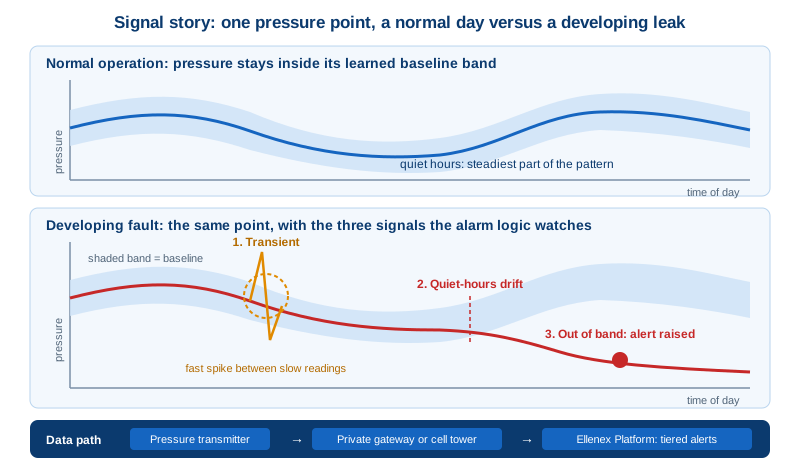
Use the quiet hours as your test bench. When demand is lowest, pressure is steadiest, and a small drift stands out far more clearly than it does at the morning peak.
Match sampling to the event you want to catch. Slow periodic readings reveal trends, while fast transients such as water hammer call for event-triggered sampling or conditional transmission.
Alert on departures from normal, not only on fixed limits. Pairing threshold alarms with anomaly alerts catches slow problems that a single high or low limit lets through.
Let site layout decide connectivity. A private LoRaWAN gateway works well when transmitters sit close together, and direct NB-IoT/LTE-M reporting works better when they are spread across a wide service area.
When Nobody Is Drawing Water, What Should Pressure Do?
In a healthy pipeline, almost nothing happens when nobody is drawing water. Pressure holds close to steady, and that expectation is the foundation of pressure-based leak detection: once you know how the network behaves at its quietest, anything that disturbs the pattern becomes visible.
Most water professionals accept that a pressure drop can signal lost water. The harder question is how large a drop, at which hour and at which point on the network deserves a phone call. Set the alarm too tight and crews spend their week chasing phantom problems. Set it too loose and a slow leak runs for weeks before anyone notices.
This article is about that second layer of the job: building baselines and alarm logic so that the pressure data you collect turns into decisions you trust. It deliberately skips the broad tour of detection methods, which the post on the most common technologies to monitor water pipeline leakage already covers, and the energy angle explored in Advancements in Pipeline Pressure and Leakage Prevention.
Ellenex builds the sensing side of this around the PTS2 pressure transmitter family, which has its own page: Water Pipeline Pressure and Leakage Monitoring. It is one part of the wider water infrastructure monitoring portfolio and of Ellenex's broader infrastructure monitoring offering, and it reports into the Ellenex Software Platform, where the baselines and alarms in this article live.
Leaks That Hide Inside Normal-Looking Pressure
These are the failure patterns that a monitoring plan has to be able to see:
A slow weep that never trips a limit. Small losses lower pressure only slightly, and a fixed low-pressure alarm tuned for bursts will never fire on them. The water is lost every hour, and nobody is told.
Night losses that nobody checks. Leakage is most obvious when customer demand is lowest, yet that is precisely the hour when no one is looking at gauges.
Bursts reported by customers instead of the utility. When the first alert is a call from a resident with no water, the repair is already urgent, the street is already wet and the story is already public.
Repeated shocks that fatigue the pipe. Pressure surges from pump starts and valve closures can pass between periodic readings, yet each one stresses joints and fittings a little more.
Manual gauge rounds that capture one moment. A visit shows what pressure was at that instant. It says nothing about what happened before the technician arrived or after the truck left.
Why One Pressure Number Rarely Tells the Truth
A single reading is easy to collect and surprisingly hard to interpret. Anyone designing alarms for a water network runs into the same obstacles:
Demand moves all day. Morning and evening peaks lower pressure at the same point where the middle of the night raises it, so a figure that is normal at one hour is suspicious at another.
Every location has its own personality. Elevation, distance from the source and the size of the main shape what normal looks like, which means one threshold copied across the whole network will be wrong somewhere.
Operations create pressure events that are not leaks. Pumps starting, reservoirs filling and valves being adjusted all move the line, and an alarm that cannot tell them from a loss will be ignored within weeks.
The measurement points are awkward. Pressure is often taken in buried chambers and roadside cabinets that are wet, cramped and far from mains power.
Reading more often costs battery. The data that would catch a fast event is the same data that drains a battery-powered transmitter, so sampling has to be a deliberate choice.
Pressure-Based Leak Detection in Practice: From Pipe Wall to Ranked Alert
The path from a pressure reading to an alert has six layers. Each is a place where a good decision, or a careless default, shapes the final alarm.
Layer 1: Pressure as a Proxy for Hydraulic Condition
The sensing element inside a PTS2 transmitter is a piezoresistive element behind a stainless steel diaphragm, mounted on a direct-threaded process head. Water pressure flexes the diaphragm, and the electronics convert that tiny movement into a pressure value. The wetted parts are media-isolated stainless steel.
Pressure responds to almost everything that happens inside a pipe: demand, pump behavior, valve position and loss. Each leaves a signature, and the rest of the system exists to tell them apart.
Layer 2: The Reference That Keeps Readings Honest
Pressure is always measured against something. A vented gauge reference compares the water pressure with the atmosphere around the transmitter, a sealed gauge reference compares it with a fixed internal reference, and an absolute reference measures it against a vacuum. The PTS2 family is offered with all three, so the reference can be chosen to suit the chamber and the question being asked.
As general practice rather than an Ellenex procedure, think about where the transmitter will physically sit. A vented reference needs a path to breathe, which can be awkward in a chamber that floods, so many teams prefer a sealed reference for such locations and accept the small trade-offs that come with it.
Layer 3: Learning the Network's Own Daily Rhythm
A baseline is simply a description of normal. To build one, collect readings across several complete weekly cycles, then separate weekdays from weekends and note how the pattern bends with the seasons. The result is a band rather than a single line: the range within which pressure is expected to move at each hour for that specific point.
The Ellenex Platform keeps the historical trend logs and dashboards that make this practical, and the solution is positioned for night-flow leak analysis and pressure zone management. The quiet-hours section of the baseline deserves special attention, because that is where small, persistent departures are easiest to see.
Layer 4: Deciding in the Transmitter What Is Worth Sending
Between the sensing element and the radio sits a set of rules you control. The LoRaWAN version, the PTS2-L, lets you choose a sampling period and whether sampling is periodic or triggered by events, and it can transmit on every sample, on events or only when a condition is met. The cellular version, the PTS2-N, offers a configurable sampling period, adjustable transmission intervals and transmission conditions.
This is where reading frequency becomes a budget. Battery capacity is quoted in readings and transmissions, not in calendar time, so every extra sample or message draws from the same finite store. A pipeline point that mostly sits still can read and report sparingly, while a point near a pump or valve may justify faster sampling and conditional transmission so that the radio fires only when something unusual happens. Settings can be changed remotely, so the schedule can follow what the baseline teaches you.
Layer 5: Two Routes From Pipe to Platform
On a LoRaWAN deployment, the transmitter sends its reading to a private gateway, such as the Ellenex Outdoor LoRaWAN Gateway, which passes it to the network server and on to the platform. The PTS2-L is pre-configured for the Ellenex network server, so a new unit finds its way onto the network without special programming. Background on the technology is in the explainer on what LoRaWAN is.
On a cellular deployment, the PTS2-N speaks NB-IoT or LTE-M directly to the nearest tower, so there is no gateway to build or maintain. It uses a SIM and a carrier data subscription, and it supports common protocols for sending data into other systems. The trade-offs between the two routes are laid out in the guide to NB-IoT and LTE-M and compared in detail in the earlier post, Technical Showdown of LPWAN Devices: NB-IoT and LoRaWAN, which also covers how both routes protect data in transit.
Layer 6: Turning Deviations Into Ranked Alerts
The Platform is where a stream of pressure values becomes a decision. It supports real-time dashboards, historical trends, predictive analytics and customizable alerts for thresholds and anomalies. The solution outputs include pressure surge and water hammer alerts, burst and low-pressure warnings, and housekeeping values such as battery voltage and signal strength that tell you whether a silent sensor is a healthy one.
A practical alert design uses several tiers. A wide band around the baseline raises a low-priority flag, a persistent departure in the quiet hours raises a medium-priority leak suspicion, and a sudden collapse in pressure raises an urgent burst warning. Tiers keep the urgent alarm meaningful because it is rare.
Life on the Network After Continuous Pressure Visibility
Once pressure is watched continuously, the daily rhythm of the operation changes in ways that show up on the roster as much as on the screen:
Crews respond to evidence. A technician is sent because the baseline was broken at a named point, not because a rotation said it was time for a gauge round.
Conversations move from opinions to trends. Disagreements about whether a zone is leaking are settled by the same night-time curve.
Pump and valve behavior becomes visible. Operations that cause shocks can be seen and adjusted instead of remaining a mystery.
Slow drifts surface early. Persistent departures from the quiet-hours band show up within days instead of hiding for weeks.
Alarm settings improve with age. Every false alarm and every genuine find teaches you something, and thresholds can be retuned from the platform without a trip to site.
Where the Savings Show Up Without a Spreadsheet
The business case for pressure-based leak detection does not need elaborate arithmetic to be understood. It shows up in the habits below, and the broader logic of valuing IoT projects is set out on the financial case for IoT implementation page.
Fewer Crews Chasing Phantom Alarms
Alarms tuned to a real baseline fire when something has actually changed, so the visits that do happen are more likely to find a genuine cause.
Product Delivered, Not Lost to the Soil
Every leak caught earlier is water that was treated and pumped and then reaches a customer instead of seeping into the ground.
Valves and Mains That Face Fewer Shocks
Once pressure surges are visible, operators can slow valve closures and soften pump starts. Gentler operation reduces repeated stress on joints, fittings and seals.
Repair Crews Scheduled Ahead of the Failure
A leak found while it is small can be planned for, with parts, traffic control and customer notice organized in advance. A burst found late gets all of that done in a hurry.
Safer Than Hunting Leaks After Dark
When remote data points a crew toward a specific zone, fewer people spend long night hours beside live roads looking for a problem.
Modest Effort to Deploy
Delivery is simple: the solution, detailed on the Water Pipeline Pressure and Leakage Monitoring page, ships pre-configured, runs on replaceable batteries and needs no special tools or programming, so adding a monitoring point does not require a construction project.
Evidence for Capital Planning
A long pressure history makes the case for renewing a failing section far stronger than a hunch.
How the PTS2 Pair Answers Baseline and Alarm Problems
Each obstacle described earlier has a specific answer in the PTS2 family. Both variants share the same sensing approach, and they differ mainly in how they reach the network.
A Range and Reference Matched to Your Mains
A pressure range is chosen to suit the line, so the transmitter is neither stretched by a surge nor barely moved by normal demand. The PTS2-L and the PTS2-N both offer vented gauge, sealed gauge and absolute references, and a choice of process connections for different fittings.
Hardware for Wet Chambers and Roadside Posts
The transmitters use a weather-sealed, UV-protected enclosure and a stainless steel sensing head. A compact version keeps the electronics together with the sensor, while a wired-sensor version places the sensing head on a cable so that the electronics can sit away from the wettest part of the chamber. Antennas can be internal or external, and an on/off switch lets installers keep the unit idle until it is in position.
Sampling That Follows the Pipe's Behavior
The PTS2-L can read periodically or on events and transmit per sample, on events or conditionally. The PTS2-N has a configurable sampling period, adjustable transmission intervals and configurable transmission conditions. That flexibility lets a quiet main and a pump-adjacent point run on different schedules while reporting to the same dashboard. Because how a fast transient is captured depends on configuration, talk to Ellenex about the surge behavior you need before fixing a schedule.
Thresholds You Can Retune Without a Site Visit
Alarm limits and parameters are managed from the platform, along with remote commands, sampling and transmission settings and calibration formulas. Firmware can be updated over the air, so the point you installed this season can grow smarter next season without a ladder.
Gateway Clusters or Cellular Coverage: Choosing the Route
Where many pressure points sit close together, such as a treatment site, a pump station cluster or a dense pressure zone, a private gateway lets LoRaWAN transmitters share one backhaul. Where points are scattered along long transmission routes or across several towns, NB-IoT/LTE-M avoids the need for gateways altogether. Many networks use both, with every device appearing in the same platform, as part of a wider water infrastructure monitoring program.
Mechanism and Outcome: The Ellenex Pressure Solution in Brief
Mechanism: A media-isolated stainless steel sensing element reads line pressure at each monitored point. Outcome: Pressure at the exact location is captured as a trustworthy value, not an estimate.
Mechanism: Configurable sampling and conditional transmission decide what is read and what is sent. Outcome: Fast events can be watched without draining batteries on quiet mains.
Mechanism: LoRaWAN through a private gateway or NB-IoT/LTE-M direct to the tower carries data to the platform, with sensor data protected in transit. Outcome: Reports arrive from clustered and scattered sites alike.
Mechanism: The platform, described on the solution page, logs history, draws dashboards and applies threshold and anomaly alerts. Outcome: Operators see departures from baseline and are told about them quickly.
Mechanism: Open interfaces, webhooks and data forwarding connect the platform to SCADA and enterprise systems. Outcome: Alerts feed the tools crews already use, without re-keying.
Three Leak-Alarm Myths Worth Retiring
Myth: a lower alarm limit is always safer. Fact: an overly sensitive alarm trains people to ignore it. A limit tied to the local baseline protects attention as well as water.
Myth: one sensor tells you where the leak is. Fact: one point shows that something changed in its neighborhood. Several points across a zone narrow the search, and field methods finish the job.
Myth: the baseline is a one-time exercise. Fact: demand, seasons and operations all change, so the baseline should be reviewed as the network changes.
From Pressure Reading to Work Order: Connecting Alerts to Your Systems
A leak alert only pays off if it reaches the person who can act on it, which is a core goal of infrastructure monitoring generally. The platform supports an open API, webhooks and data forwarding, so a single pressure event can create a ticket in a maintenance system, update a SCADA screen or notify a supervisor by the channel that person actually reads. Web and mobile access, including the Ellenex mobile app, put the same dashboards in the hands of crews in the field.
Role-based access lets operations see everything while contractors see only their own assets. You can sign in to the platform at ellenex.net.
Neighboring tasks have their own pages: the Underground Water Pipeline Pressure Monitoring solution covers buried transmission lines, PRV and Pressure Control Station Monitoring covers control points, and Remote Industrial Water Flowmeter Monitoring adds flow to sharpen leak decisions.
A Network That Tells Crews Where to Look First
The result is a network that stops asking people to find problems and starts telling them where to look. Baselines turn each pressure point into a reference, tiered alerts separate urgent bursts from slow suspicions, and the platform records every episode so thresholds can be tuned over time. Crews arrive with a reason, and planners arrive with a history.
Frequently Asked Questions
How long should I collect data before trusting a baseline?
Collect long enough to see several complete weekly cycles, so weekday and weekend patterns are both represented. If your network has strong seasonal swings, such as irrigation demand, treat the first baseline as provisional and refine it as the seasons turn.
Treat the learning period as advisory: keep alerts loose while you watch the shape of the pattern, and tighten them only once the band stops surprising you.
Can a pressure sensor alone locate a leak?
A single sensor shows that conditions changed near its location, but it cannot pinpoint the break. Several sensors spread across a pressure zone let you see which area moved first and by how much, which narrows the search considerably.
Final location is usually completed in the field with acoustic or other methods, which the earlier overview of leak detection technologies explains.
How do I stop pump starts and valve closures from triggering false alarms?
Start by watching those operations on the dashboard so you know what their signatures look like. Once you recognize the pattern, you can set conditions that treat a short, expected disturbance differently from a sustained departure from the baseline.
It also helps to place a transmitter on each side of a major control point: if only one side moves, a local problem is more likely.
Which reference type suits a chamber that might flood?
A vented gauge reference needs a path to the outside air, and a chamber that fills with water can compromise that path. Many teams therefore prefer a sealed gauge reference for locations that may flood, as a matter of general practice.
The PTS2 family is available with vented gauge, sealed gauge and absolute references, and Ellenex can advise on a specific chamber.
How many sensors does a network need before leak detection works?
There is no universal count, because it depends on the shape of the network, how it is divided into zones and how precisely you want to narrow the search. Many utilities begin with inlets, outlets and the hydraulically farthest points of a zone, then add points where the first results show the most activity.
Starting small is legitimate: each added point is a battery-powered unit with no trenching.
How should I balance reading frequency against battery life?
Treat every reading and every transmission as a withdrawal from a fixed account. Battery capacity for these transmitters is rated in readings and transmissions, so the real lifetime depends on how often your configuration reads and sends rather than on a fixed calendar figure.
A sensible approach is to read modestly on stable mains and sample faster near pumps and valves, using conditional transmission so the radio fires mainly when something noteworthy happens.
Can one network mix LoRaWAN and cellular transmitters?
Yes. LoRaWAN units report through a private gateway, cellular units report directly through the carrier network, and both feed the same platform. A utility can use gateways for clustered sites and cellular for remote ones without splitting its dashboards.
The platform's role-based, multi-tenant access then lets different teams see the same data with permissions suited to their jobs.
Related Reading
Most common technologies to monitor water pipeline leakage: the detection methods pressure monitoring sits alongside.
Advancements in Pipeline Pressure and Leakage Prevention: how reducing losses connects to pumping energy.
LPWAN Solutions for Pressure Reducing Valve (PRV) Chambers and Pipeline Monitoring: monitoring at control points and chamber conditions.
Enhancing Water Infrastructure with Ellenex Industrial Pressure Sensors: the wider PTS2 and PTS3 portfolio for water networks.
Useful Links
Talk to Ellenex
Leak alarms are only as good as the baseline behind them. Share a map of your mains, the points where pressure is already measured and the hours your crews can respond, and Ellenex will help you turn them into a sensor plan and an alert design. Send your network details to the Ellenex sales team and we will take it from there.


