

LPWAN Solutions for Pressure Reducing Valve(PRV) Chambers and Pipeline Monitoring
The Strategic Imperative for Intelligent Water Infrastructure
The management of global water infrastructure is entering a critical era defined by the convergence of aging physical assets and the rapid proliferation of the Industrial Internet of Things (IIoT). For municipal water utilities and industrial operators, the primary challenge remains the mitigation of non-revenue water (NRW), which accounts for an average loss of 20% of produced water in the United States alone before it reaches the end-user. These losses are not merely a matter of wasted resources; they represent a significant drain on energy, as the electrical cost of pumping and treating water that is eventually lost to leaks is irrecoverable. To address these systemic inefficiencies, the industry is shifting toward a model of "measurable control," moving away from the unrealistic goal of zero loss toward a data-driven strategy of targeted intervention.

At the heart of this transformation is the digitalization of the Pressure Reducing Valve (PRV) chamber. PRV chambers are critical nodes in a distribution network, tasked with maintaining stable hydraulic conditions by modulating pressure across different topographical and demand-based zones. However, because these chambers are often located in subterranean vaults, remote geographies, or deep within industrial complexes, they have traditionally been "blind spots" for utility operators. The emergence of Low-Power Wide-Area Network (LPWAN) technologies—specifically NB-IoT, LTE-M (Cat-M1), and LoRaWAN—has finally provided the technical capability to monitor these assets in near real-time without the prohibitive costs of trenching for power and fiber optics.
The implementation of Ellenex LPWAN solutions allows for a comprehensive oversight of water distribution networks, encompassing pipeline pressure, storage levels, and water quality metrics. By deploying specialized pressure sensors like the PTS3 IP68 rated pressure transmitter and the PDS2 differential pressure sensor, operators can detect the earliest indicators of failure—such as pressure transients or filter clogging—long before they escalate into catastrophic bursts or service outages. This article provides an exhaustive analysis of the Ellenex portfolio as it applies to water infrastructure monitoring, detailing the technical mechanisms, communication protocols, and operational outcomes of a digitized network.
The Challenges of PRV Chamber Monitoring
Monitoring a PRV chamber presents unique engineering and operational hurdles that traditional instrumentation often fails to overcome:
Subterranean Signal Attenuation: Most PRV chambers are located in underground concrete vaults or metal-lidded pits. These environments act as Faraday cages, severely obstructing radio signals.
Environmental Stress: Chambers are subject to high humidity and seasonal flooding. Sensors must withstand continuous immersion without failing.
Accessibility and Safety: Accessing subterranean vaults often requires confined-space entry permits, specialized safety equipment, and traffic control, making manual inspections and battery replacements expensive and hazardous.
Lack of Internal Visibility: Traditional monitoring only tracks upstream and downstream pressures. Without insight into internal mechanics—such as the bonnet or control space pressure—critical issues like diaphragm ruptures or blocked strainers go undetected until a catastrophic failure occurs.
Legacy Infrastructure: Many pipelines lack the wiring or power infrastructure required for conventional SCADA integration, necessitating a battery-powered, wireless approach.
Managing the PRV Chamber Environment
Monitoring a PRV chamber is not a static exercise; it requires a deep understanding of the hydraulic transients and environmental stressors that define the asset's life cycle. The integration of Ellenex hardware and software provides the tools necessary to manage these complexities.
Mitigating Pressure Transients (Water Hammer)
One of the primary causes of pipe failure is the "water hammer" effect—a pressure surge caused by the rapid change in fluid velocity, often due to a sudden valve closure or pump trip. These transients can momentarily double or triple the pressure in a pipe, leading to fatigue and eventually a burst. Ellenex sensors can be configured with high-frequency sampling (conditional sampling) to identify these transients. When a pressure spike exceeds a pre-defined threshold, the device can trigger an immediate alert, allowing the utility to adjust valve-closing speeds or pump-start protocols to protect the infrastructure.
Power Management and Battery Life in Hard-to-Reach Areas
PRV chambers are notoriously difficult to access, often requiring traffic control and confined-space entry permits. Consequently, the battery life of the monitoring equipment is a critical component of the total cost of ownership (TCO). Ellenex sensors are powered by high-capacity, replaceable lithium batteries designed for industrial longevity.
The balance between sampling frequency and transmission frequency is key. A sensor might take a reading every 15 minutes to ensure it captures any anomalies, but only transmit those readings once every 4 or 8 hours to conserve power. If a threshold is crossed, the sensor "wakes up" and transmits immediately. This intelligent power management enables a battery life exceeding 10 years for many applications, meaning that the monitoring hardware will often outlast the maintenance interval of the PRV itself.
Mitigating PRV Challenges with Ellenex Solutions
Ellenex addresses these specific obstacles through a combination of specialized hardware engineering, high-penetration communication protocols, and intelligent software diagnostics.
Overcoming Signal Attenuation
To solve the "Faraday cage" effect of underground vaults, Ellenex utilizes NB-IoT (Narrowband IoT), which is specifically optimized for deep coverage and "excellent signal penetration" in subterranean installations and utility vaults. For extreme cases with thick metallic lids, Ellenex devices support external antenna extensions. These cables allow the antenna to be repositioned to a surface-level location, significantly improving the line-of-sight path while the sensor remains safely protected within the chamber.
Engineered for Environmental Immersion
PRV chambers are prone to flooding, which can destroy standard electronics. Ellenex mitigates this by deploying the PTS3 series, an IP68-rated pressure transmitter designed for continuous immersion in harsh environments. Furthermore, for wastewater force mains or aggressive media, the PTC2 series utilizes corrosion-resistant materials to ensure sensor longevity despite exposure to chemicals or minerals.
Reducing Maintenance Risks and Costs
To minimize the need for hazardous confined-space entries, Ellenex sensors are built for ultra-low power consumption, often achieving a battery life of over 10 years on a single replaceable lithium battery. This long-term autonomy, combined with wireless LPWAN connectivity, eliminates the need for expensive trenching and cable runs, allowing for a "plug and use" deployment that provides immediate visibility without infrastructure modifications.
Multi-Point Visibility for Proactive Maintenance
While traditional systems provide only two points of data, Ellenex offers multi-channel interfaces (RM4 series) that can monitor up to four pressure points simultaneously. This enables 3-point PRV monitoring (upstream, downstream, and bonnet/control space pressure). By tracking bonnet pressure, utilities can identify:
Diaphragm Ruptures: Indicated when control space pressure equalizes with upstream pressure.
Blocked Strainers: Detected through characteristic pressure patterns in the control space that prevent the valve from responding properly to demand changes.
Strainer Health: Using the PDS2 differential pressure sensor to measure the pressure drop across internal filters, triggering maintenance alerts before a blockage causes a service failure.
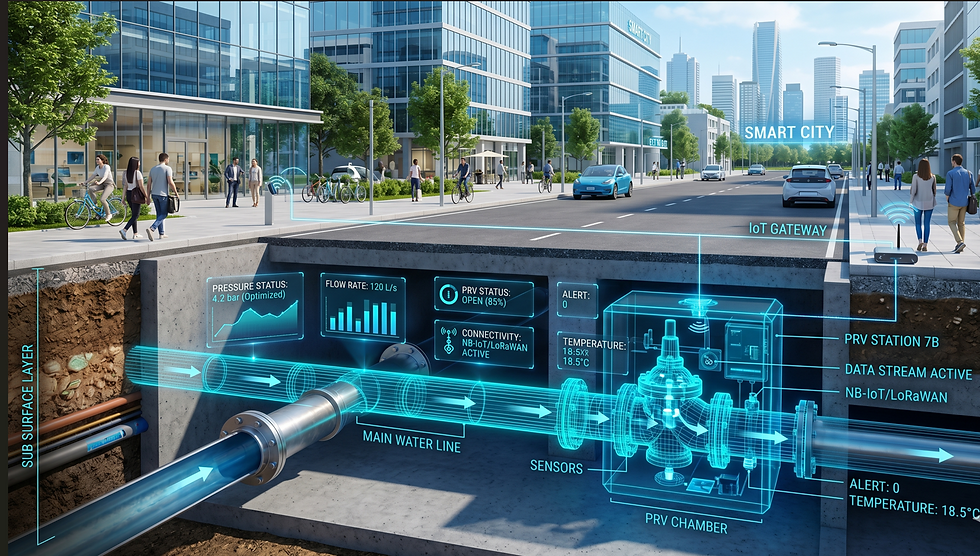
Ellenex offers pre-configured solutions designed to address these specific infrastructure challenges through the "Underground Water Pipeline Pressure Monitoring" and "Water Pipeline Pressure and Leakage Monitoring" frameworks.
This solution is engineered for buried assets where trenching for power and data cables is cost-prohibitive. By utilizing LoRaWAN or NB-IoT connectivity, Ellenex ensures high-penetration signal delivery through soil and concrete.
Mechanism: Sensors are installed in underground pits with optional external antenna extensions to overcome the signal loss from heavy lids.
Outcome: Provides visibility into buried transmission mains, allowing operators to understand "normal" operating bands and detect sudden deviations indicative of a burst.
This comprehensive solution transitions utilities from reactive "find and fix" models to proactive stewardship.
Smart Leak Detection: Uses high-frequency pressure diagnostics to identify micro-leaks before they escalate into major bursts.
Pressure Management: By optimizing pressure settings based on real-time data, utilities can reduce the baseline leak rate and extend the lifespan of aging infrastructure.
Near Real-Time Alerts: Operators can set custom thresholds via the Ellenex platform to receive instant notifications of pressure drops or over-pressure conditions.
The Ellenex Pressure Sensing Portfolio
The core of these solutions is a range of industrial-grade sensors tailored to different pipeline environments:
Product Series | Type | Features | Best Use Case |
IP68 Industrial Pressure Sensor | Designed for continuous immersion in harsh environments. | Subterranean PRV Chambers and underground pits. | |
Industrial Pressure Sensor | High accuracy (±0.25% Span) in IP65/IP67 enclosures. | Above-ground pump performance and pressurized line diagnostics. | |
Differential Pressure Sensor | Measures the difference between two points with ±0.25% accuracy. | Monitoring PRV filter/strainer performance and comparative zone pressure. | |
Pressure & Temp Sensor | Combined sensing head for liquid and gas media. | Detecting leakage signatures or thermal stress in pipelines. | |
Corrosive Resistant Pressure Sensor | Built for aggressive media such as wastewater and acids. | Pressurized sewer force mains and chemical pipelines. | |
Flush Type Pressure Sensor | Specialized for viscous or clogging-prone liquids. | Sludge detection or food processing lines. |
Operational Outcomes
Implementing Ellenex's LPWAN pressure monitoring allows utilities to achieve "Precision Under Pressure". By utilizing the IP68-rated PTS3 in PRV chambers and the PDS2 for filter monitoring, operators can detect anomalies early, reduce manual site visits, and significantly lower non-revenue water loss. The integration of high-performance sensing with reliable LPWAN connectivity transforms legacy pipelines into a modern, monitored infrastructure layer, ensuring long-term sustainability for water resources.
Frequently Asked Questions
Why is 3-point monitoring considered superior to traditional 2-point pressure monitoring?
Traditional pressure monitoring systems typically only measure upstream and downstream pressures to verify if a Pressure Reducing Valve (PRV) is performing its basic function of pressure reduction. While this provides a snapshot of the hydraulic status, it leaves operators "blind" to the internal mechanical health of the valve itself. Without visibility into the internal mechanics, critical failures such as diaphragm ruptures or pilot clogs can go undetected until they cause a major downstream incident or infrastructure damage.
By adding a third monitoring point at the valve's bonnet or control space, Ellenex solutions provide a complete picture of the valve’s performance. Utilizing a multi-channel interface like the RM4 Series allows utilities to track the relationship between all three points in real-time. This advanced configuration enables maintenance teams to distinguish between a hydraulic demand issue and an actual mechanical failure, facilitating proactive rather than reactive stewardship.
How do Ellenex sensors maintain communication from within a subterranean concrete vault?
Underground PRV chambers are notoriously difficult for wireless signals because reinforced concrete and heavy metallic lids act as Faraday cages, severely attenuating radio waves. Ellenex mitigates this challenge primarily through the use of Narrowband IoT (NB-IoT), a cellular protocol specifically engineered for "excellent signal penetration" in subsurface environments like utility vaults and deep basements. Its high spectral efficiency and deep coverage ensure that data packets can reach the carrier's base station even through dense construction materials.
In extreme cases where the signal is completely blocked by thick metal lids, Ellenex devices support external antenna extensions. These cables allow the antenna to be repositioned to a surface-level location or nearby utility pole, establishing a clear line-of-sight for transmission. While any extension cable introduces a minor signal loss (approximately -4 dBm for a 2-meter cable), the overall improvement gained from better positioning far outweighs the loss, ensuring robust and reliable data delivery from the most challenging pits.
Can digital monitoring help identify specific PRV mechanical failures like a diaphragm rupture?
Yes, digital monitoring is the most effective way to identify a diaphragm rupture before it leads to a catastrophic surge. When a PRV diaphragm fails, the pressure in the control space (the bonnet) equalizes with the upstream pressure, often forcing the valve to remain in a fully open position. In a traditional setup, this might only be noticed when customers complain of high pressure or when a burst occurs, but with Ellenex's pipeline monitoring, this fault condition is revealed immediately as the bonnet pressure signature matches the inlet pressure.
The Ellenex platform can be configured with conditional alerts that trigger as soon as the expected relationship between the control space and pipeline pressure is violated. By receiving an automated notification of a "struggling to close" condition, utility operators can prioritize a field crew to repair the valve immediately. This early detection prevents secondary failures like water hammer events and reduces the risk of excessive leakage caused by uncontrolled downstream pressure.
What is the role of differential pressure sensors in PRV chamber maintenance?
Pressure Reducing Valves are highly sensitive to debris, which is why most assemblies include internal strainers or filters. If these filters become clogged, they restrict the flow of water to the control chamber, causing the valve to hunt or fail to respond correctly to demand changes. The Ellenex PDS2 differential pressure sensor is specifically designed to measure the pressure drop across these filters with high precision (±0.25% Span). This provides a clear metric for "clogged filter performance" that indicates exactly when a strainer requires cleaning.
This data-driven approach allows utilities to move from fixed-interval maintenance schedules to condition-based maintenance. Instead of performing hazardous and expensive confined-space entries for routine inspections, teams only enter the chamber when the PDS2 detects a rising differential pressure signature. This significantly reduces operational costs and enhances personnel safety by minimizing unnecessary exposure to underground environments.
How does real-time monitoring mitigate the issue of valve "hunting" or unstable hydraulic behavior?
PRV "hunting" occurs when a valve fluctuates or oscillates rapidly because its pilot is improperly tuned or sensitive to upstream fluctuations. This unstable behavior causes premature wear on the valve diaphragm and can send destructive pressure transients through the pipeline. Ellenex sensors, such as the PTS3 and PTS2, provide near real-time feedback that identifies these high-frequency oscillations. By analyzing historical trends and rate-of-change data on the Ellenex platform, operators can see where a PRV is struggling to find a stable setpoint.
Once hunting is identified, utilities can adjust the pilot settings or seasonal setpoints to align better with actual consumption patterns. The ability to monitor these adjustments remotely ensures that the valve returns to a stable operating band immediately. Over the long term, reducing these unstable fluctuations extends the life of the infrastructure and prevents the micro-stresses that eventually lead to pipe bursts.
Are Ellenex monitoring devices durable enough for flooded PRV chambers?
Subterranean chambers are frequently subject to seasonal flooding or high-humidity conditions that would destroy standard industrial electronics. Ellenex addresses this by offering the PTS3 series, which is an IP68-rated pressure transmitter specifically designed for continuous immersion in harsh liquid environments. The ruggedized housing and UV-protected enclosure ensure that the sensing head and electronics remain fully operational even if the vault is completely submerged under meters of water.
These sensors are built with industrial-grade materials like stainless steel (SS316) to resist corrosion and mineral buildup common in water infrastructure. Because they are battery-operated and require no external wiring, there are no electrical conduits that could fail due to water ingress. This ensures that the utility maintains critical visibility of the pipeline’s status during the very flood events when infrastructure is under the most stress.
What are the primary operational benefits of switching from manual inspections to IoT-based monitoring?
The primary benefit is the transition from a reactive "fail and fix" model to a proactive stewardship strategy that significantly reduces Non-Revenue Water (NRW). Manual inspections are infrequent and often miss transient issues like overnight pressure spikes or burgeoning leaks. IoT sensors provide continuous oversight, identifying micro-leaks and pressure drops in near real-time, allowing for targeted interventions before a small leak becomes a catastrophic main burst.
Furthermore, remote monitoring drastically improves safety and reduces labor costs. Since Ellenex sensors feature an ultra-low-power design with a battery life exceeding 10 years, the need for frequent site visits to underground vaults is nearly eliminated. This reduces the administrative burden of obtaining confined-space permits and traffic control while providing more accurate data for regulatory compliance and resilience planning.


